An AI model’s performance depends on testing and validation. Wait, what? Are you not surprised? If no one is surprised here, then why, more often than not, does the robustness of AI models remain questionable at best?
A fraud detection model flags 94% of fraudulent transactions correctly. Impressive — until you notice it also flags a disproportionate number of transactions from a specific region, not because they’re fraudulent, but because of skewed training data.
The model is accurate. The model is also broken.
This is why testing AI models is both a quality gate and an accountability mechanism no one should underestimate.
When the System Can Be Right for the Wrong Reasons
Traditional software testing operates on a simple premise: given input X, the system should produce output Y. You define the expected behavior, write test cases, and verify. AI flips this. The model learns its own behavior from data. The outputs are probabilistic. The same input can return different results. And “correct” often requires judgment, not just a pass/fail check.
If your organization is building or integrating AI-powered systems, you need a testing approach that accounts for these fundamental differences.
This guide covers foundational concepts to specific testing types, frameworks, tools, and what responsible AI model testing looks like in 2026.
Key Takeaways
Model testing is the process of validating AI behavior — not just measuring accuracy. Evaluating an AI system means assessing how the model performs across functional, performance, security, and fairness dimensions.
Testing is crucial at every stage of AI development. The stages of the AI model lifecycle each carry distinct testing requirements. Treating testing as a one-time gate before launch is one of the most costly mistakes in AI development.
AI model testing is essential for long-term reliability. Testing helps ensure the model produces consistent, accurate outputs — and that AI models don’t silently degrade after deployment. Continuous testing and monitoring go together.
Investing in robust AI testing pays off beyond launch. High-quality AI products are built on rigorous testing foundations. Robust AI testing infrastructure reduces incident response time and supports regulatory compliance.
Automation makes testing effective and efficient — to a point. You can automate metrics, drift detection, and regression checks. What automation can’t replace is human judgment on whether the model is actually doing something useful and fair.
Various testing techniques apply depending on model type and context. There is no universal framework for AI. The right combination of testing methods depends on what the model does, who it affects, and what failure looks like for your application.
What Is AI Model Testing in 2026?
AI model testing is the systematic process of evaluating how an AI model performs across multiple dimensions: accuracy, reliability, fairness, security, and behavior under real-world conditions.
It’s both a discipline and a practice that ensures your AI models operate as intended before they affect real users — and continue to do so after deployment.
Why 2026 is different. With agentic AI systems and multi-model pipelines becoming standard in production, the layers that testing has to account for — training data, architecture, hyperparameters, inference environment — are more interconnected and harder to isolate than they were even two years ago. A model doesn’t fail in isolation anymore; it fails as part of a system.
The regulatory reality. The EU AI Act’s high-risk provisions are now in active enforcement. Organizations deploying AI in hiring, credit, healthcare, and public services face mandatory testing and documentation requirements. Testing is no longer just an engineering best practice — in many contexts, it’s a legal obligation.
At the highest level, AI model testing asks four questions:
Does the model produce outputs that are accurate and useful?
Does it behave consistently and degrade gracefully under stress?
Is it fair, unbiased, and explainable?
Is it secure against adversarial manipulation?
But before getting into those, it’s worth understanding what makes AI systems genuinely harder to test than conventional software — and why comprehensive AI model testing requires a fundamentally different approach.
We turn chaotic bug fixing into documented, measurable, and manageable AI testing processes
What Is Different (and Harder) When You Test AI Models
Unlike traditional software, the model wasn’t programmed — it was trained. Its behavior emerges from data, not from explicit logic. And that single shift creates a cascade of testing challenges that standard software testing processes simply weren’t designed to handle.
There is no single correct output. For a generative AI system asked to summarize a document, dozens of different outputs could all be “correct.” Testing requires defining quality criteria, not just expected values.
The model can fail silently. A misconfigured database throws an error. An AI model producing biased outputs keeps running without complaint. Without deliberate testing, those failures go undetected until they cause real harm.
Training data is a source of risk. If the data used in model training is incomplete, skewed, or outdated, the model will reflect those flaws. Testing has to probe for this.
Models drift over time. A model that performs well in January may underperform in July if the distribution of real-world inputs has shifted. This is why testing is essential to ensure ongoing reliability — not just at launch.
There’s an absence of universally accepted testing frameworks. Unlike web security testing or load testing, AI model testing standards are still being established across the industry. Teams often build their own frameworks and adapt them per project and per model type.
Words by
Igor Kovalenko, QA Lead, TestFort
“The biggest mistake we see is teams treating AI testing the same way they treat API testing — with fixed inputs and expected outputs. AI requires a different mindset. You’re evaluating behavior across a distribution, not just verifying individual responses.”
The Testing Requirements That Apply to Every AI System
Before designing a test strategy, it helps to map out the testing requirements that are non-negotiable regardless of model type or industry context. These become the baseline for any comprehensive testing effort.
Testing Requirement
What It Ensures
When It Matters Most
Functional correctness
The model does what it’s supposed to do
All systems
Model performance evaluation
Accuracy, precision, recall meet defined thresholds
Prediction-based systems
Behavioral consistency
Same input class produces stable outputs
User-facing applications
Security & adversarial robustness
The model resists manipulation and data poisoning
High-stakes, externally accessible systems
Bias & fairness validation
Model decisions don’t systematically disadvantage subgroups
Hiring, credit, healthcare, law enforcement
Explainability
Model decisions can be understood and justified
Regulated industries, clinical tools
Integration & system stability
The model functions correctly within the full stack
All production deployments
Performance under load
Inference latency and throughput meet SLAs at scale
Real-time and high-traffic systems
Drift monitoring readiness
The system can detect and flag model degradation
All production deployments
This table is a starting framework, not an exhaustive list. Complex AI models deployed in high-risk environments will have additional requirements — and the depth of testing for each dimension should be calibrated to the risk profile of the application.
Core Testing Types for AI Models
There’s no single test that tells you whether an AI model is ready for production. You need several — each designed to catch a different category of failure.
AI models require a testing vocabulary that maps to how they actually fail: not through bugs in logic, but through degraded behavior, skewed outputs, and vulnerabilities that only surface under specific conditions.
Functional Testing
Functional testing verifies that the model performs its intended task correctly. For a classification model, this means checking that predictions are accurate across the full range of input categories. For a recommendation system, it means verifying that recommendations are relevant and appropriately diverse.
Key practices in functional testing:
Test across all defined input classes, not just the most common ones;
Validate outputs against ground truth datasets with statistical significance;
Check behavior when inputs are incomplete, ambiguous, or malformed;
Verify that model behavior is stable across software versions and infrastructure updates.
For generative AI systems, functional testing also includes prompt-response evaluation: assessing whether outputs meet defined quality criteria such as relevance, coherence, completeness, and factual accuracy.
Performance Testing
Performance testing for AI models covers two distinct areas, and conflating them is a common mistake.
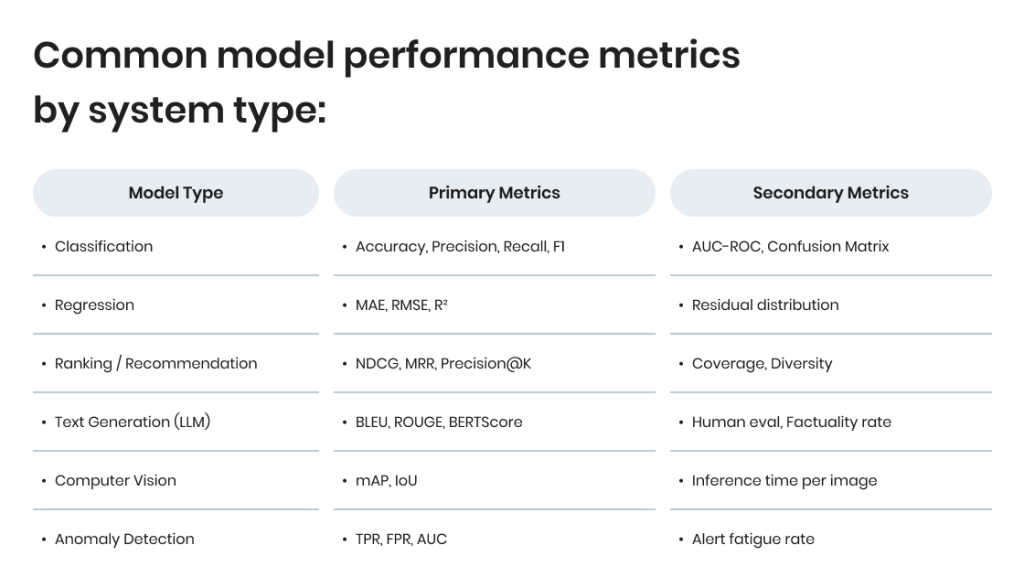
The first is model performance — how well the model makes predictions. This is measured through metrics like accuracy, precision, recall, F1 score, AUC-ROC, BLEU (for text generation), and others depending on the model type.
The second is system performance — how the model behaves under load. This includes inference latency, throughput, and resource utilization.
Common model performance metrics by system type:
A real-world example of why system performance matters independently: an AI-powered customer support chatbot performs well in testing with 10-20 concurrent users. Deployed to production, it handles 500 simultaneous conversations, latency spikes to 8 seconds, and users start abandoning conversations. The model itself wasn’t the problem — the inference infrastructure wasn’t tested at a realistic scale.
More examples?
A B2B sales copilot was inventing product details and showing racial bias. Six months later: 60% fewer hallucinations, 40% more active users
AI systems introduce attack surfaces that don’t exist in conventional software. Security testing for AI models focuses on three primary threat categories.
Adversarial inputs. Carefully crafted inputs designed to fool the model — slightly altered images that cause a vision model to misclassify, or text inputs that cause an LLM to bypass safety filters. Adversarial testing involves deliberately generating these inputs to understand the model’s vulnerabilities.
Data poisoning. If an attacker can influence the training data during model development, they can embed backdoors into the model. Testing involves auditing data pipelines and validating that training sets meet integrity requirements.
Prompt injection. Particularly relevant for LLM-based systems — malicious instructions embedded in user inputs that attempt to override the model’s system prompt or extract sensitive information. This is one of the fastest-growing attack vectors as LLMs are deployed in more consequential contexts.
Bias and Fairness Testing
Bias in AI models can emerge from skewed training data, flawed feature selection, or optimization targets that don’t account for subgroup disparities. Bias and fairness testing surfaces these issues before they affect users — and before they create legal exposure.
The testing process typically involves:
Disaggregated evaluation: measuring the performance of AI models separately across demographic subgroups (age, gender, geography, etc.) to surface differential error rates;
Counterfactual fairness testing: checking whether changing a protected attribute changes the model’s output when it shouldn’t;
Representation audits: reviewing whether training data adequately represents the full population the model will serve.
Consider a hiring AI tool trained on historical decisions from a company that historically underhired women in technical roles. The model learns to associate certain resume patterns with rejection — patterns that correlate with gender. Without rigorous fairness testing, this tool goes live and automates discrimination at scale.
Regulatory pressure here is increasing. The EU AI Act classifies high-risk AI applications and mandates bias documentation and ongoing monitoring. Ethical AI compliance is becoming a testing requirement, not just a nice-to-have.
Explainability Testing
Explainability testing verifies that model decisions can be understood and justified — both technically and to non-technical stakeholders. This is critical in regulated industries and any context where an affected party might reasonably ask “why did the system make this decision?”
Explainability testing evaluates:
Whether SHAP values or LIME explanations correctly identify the features driving predictions;
Whether explanations are consistent across similar inputs;
Whether explanations remain stable when non-relevant features change;
Whether explanations are intelligible to the end users who need to act on them.
A medical AI system that flags patients for elevated cardiovascular risk needs to explain which factors drove the assessment — not because regulators require it (though increasingly they do), but because clinicians need to validate the reasoning before acting on it.
Integration Testing
AI models don’t run in isolation. Integration testing verifies that the model functions correctly as part of the larger system — connected to data pipelines, APIs, databases, and front-end interfaces.
System testing verifies the complete end-to-end flow: from the moment a user inputs data, through preprocessing and the inference layer, to the moment a response is returned, logged, and acted upon. Any failure point in this chain — a data transformation error, a latency spike in the inference API, a logging misconfiguration — can compromise the system’s reliability even if the model itself is performing correctly.
Your team knows how to test software. AI testing is a different discipline
AI model testing is a set of activities distributed across the model development lifecycle. The testing requirements and appropriate testing strategies differ at each stage.
Stage 1: Data validation (pre-training). Before model training begins, validate training data for completeness, representativeness, labeling consistency, and absence of data poisoning. This is the highest-leverage testing investment — errors introduced here propagate through everything downstream.
Stage 2: Training monitoring. During model training, track loss curves, validation metrics, and signs of overfitting or underfitting. These aren’t tests in the traditional sense, but they establish the behavioral baseline that post-training testing is measured against.
Stage 3: Post-training evaluation. After training, run the full suite of functional, performance, bias, security, and explainability tests against the trained model. This is where most teams focus their testing effort.
Stage 4: Pre-deployment / staging. Test the model in an environment that mirrors production conditions as closely as possible — realistic load, real data distributions, integrated with actual downstream systems.
Stage 5: Production monitoring. Establish monitoring baselines and continuously track model performance, input distribution drift, and output anomalies. Set alert thresholds for when drift or degradation crosses a defined boundary.
Stage 6: Retraining validation. When the model is updated or retrained, regression test against the previous version to ensure the new model hasn’t degraded on previously solved problem classes.
Stage
Primary Testing Focus
Key Question
Data validation
Data quality, representation
Is this data safe to train on?
Training monitoring
Convergence, overfitting
Is training proceeding correctly?
Post-training evaluation
Functional, performance, bias, security
Does the model behave as intended?
Pre-deployment
Integration, system performance
Will it hold up in production conditions?
Production monitoring
Drift, anomaly detection
Is it still performing reliably?
Retraining validation
Regression, comparative evaluation
Is the new version strictly better?
Testing Generative AI Systems: A Different Category
Generative AI models — large language models (LLMs), image generators, multimodal systems — require additional testing considerations that go beyond what applies to traditional machine learning models.
Non-determinism. The same prompt can produce different outputs across runs. Testing frameworks need to evaluate outputs statistically, not just check single responses. You’re looking for acceptable output distributions, not single correct answers.
Hallucination detection. LLMs can generate plausible-sounding but factually incorrect content. Testing for hallucinations requires reference datasets, retrieval-augmented generation validation, and human evaluation loops — there’s currently no fully automated solution that replaces human review at the quality threshold most production systems require.
Instruction following. Does the model reliably follow complex, multi-part instructions? Break this down into atomic behaviors and test each one. A model might follow three-part instructions correctly 90% of the time but fail significantly more often on four-part instructions.
Tone and brand consistency. For enterprise deployments, the model needs to maintain a defined persona and communication style. Testing involves evaluating outputs against style guides and tone criteria — often using a secondary LLM as an evaluator.
Safety and content filtering. Generative AI systems need thorough testing of their content safety layers: does the model refuse to generate harmful content? Does it do so consistently across varied phrasings? Using an AI detector can help teams assess generated outputs and identify potential risks during testing. And equally important — does it over-refuse legitimate requests in ways that degrade user experience?
Before you scale an AI feature, it’s worth knowing exactly what you’re scaling
AI agents are systems that take sequences of actions toward a goal — browsing the web, writing and executing code, managing files, calling external APIs. Testing agents is substantially more complex than testing a model that responds to individual prompts, because you’re evaluating not just single outputs but entire behavioral trajectories.
Key challenges in AI agent testing:
Trajectory evaluation: the agent’s actions unfold over multiple steps. Testing has to evaluate the full sequence, not just the final output.
Goal completion rate: Does the agent reliably achieve the intended goal across varied starting conditions?
Error recovery: When the agent encounters an unexpected state, does it recover gracefully or cascade into failure?
Tool use accuracy: Does the agent invoke tools correctly and interpret their results reliably?
Scope adherence: Does the agent stay within its defined operational boundaries, or does it take actions outside its intended scope?
Words by
Mykhaylo Tomara, Head of QA, TestFort
“AI agents behave like junior developers with access to a full toolkit and no second-guessing instinct. You have to define clear behavioral boundaries and test what happens when the agent runs into the edges of those boundaries. That’s where things get interesting.”
A Practical Agent Testing Flow
Here’s how a QA team might structure testing for a document processing AI agent that reads contracts, extracts key terms, and flags anomalies:
Step 1 — Define behavioral scope. Document what actions the agent is permitted to take: read files, call the extraction API, write to the output schema. Define what it must never do: modify source files, make external network calls, process files outside the designated input folder.
Step 2 — Build scenario categories. Categorize test scenarios by complexity: standard contracts (expected to succeed), edge cases (unusual formatting, missing fields, mixed languages), adversarial cases (malformed files, oversized documents, files with embedded injection attempts).
Step 3 — Instrument the action trace. Capture every action the agent takes during test runs — every API call, every file read, every decision point. This trace is what you evaluate, not just the final output.
Step 4 — Evaluate trajectory quality. For each scenario: did the agent complete the task? Did it take unnecessary steps? Did it encounter errors and recover? Did it stay within scope at every point?
Step 5 — Regression test after updates. Any change to the agent’s tools, system prompt, or underlying model requires re-running the full scenario suite to catch behavioral regressions.
Automated Testing for AI: What Can and Can’t Be Automated
One of the most common questions in AI model testing is how much of this can be automated. The answer is: more than most teams currently automate, but less than traditional software testing allows.
What can be effectively automated:
Metric calculation (accuracy, F1, BLEU, latency) across test datasets
Regression testing against previous model versions
Data drift detection in production
Adversarial input generation
Prompt-response consistency checks using LLM-as-evaluator approaches
Load and throughput testing
What still requires human judgment:
Evaluating whether a generative AI output is genuinely good, not just technically correct
Assessing whether explanations are understandable to actual end users
Identifying novel failure modes not covered by existing test cases
Making final calls on bias findings that require contextual interpretation
The practical implication: build automated testing infrastructure for everything that can be measured quantitatively, and design structured human review processes for the qualitative dimensions. The goal is efficient testing — using automation to scale test coverage and human review to ensure the things automation can’t catch don’t slip through.
Recommended automation stack by use case:
Use Case
Recommended Tools
Automation Level
LLM response evaluation
LangSmith, Promptfoo, Ragas
High — can run at every deployment
Model metric tracking
MLflow, Weights & Biases
High — integrate into CI/CD
Data drift detection
Evidently AI, WhyLabs
High — runs continuously in production
Bias and fairness checks
IBM AIF360, Fairlearn
Medium — automated metrics, human review of findings
Adversarial robustness
ART, Garak
Medium — automated generation, human triage
Explainability review
SHAP, LIME integrations
Medium — automated computation, human interpretation
Output quality (generative)
LLM-as-judge + human review
Low-medium — automation assists, doesn’t replace
AI Model Testing Tools and Frameworks
No single tool covers the full spectrum of AI testing needs, but the ecosystem is maturing quickly. The right combination of tools and frameworks depends on your model type, deployment environment, and the testing requirements your specific application demands.
For experiment tracking and model evaluation: MLflow handles experiment tracking, model versioning, and evaluation logging. Weights & Biases provides real-time monitoring of training runs and comparative evaluation dashboards.
For LLM and generative AI testing: LangSmith traces and evaluates LLM application behavior at the chain level. Ragas provides automated evaluation specifically for RAG systems — measuring retrieval quality, answer faithfulness, and context relevance. Promptfoo is an open-source tool for systematic prompt testing, model comparison, and regression testing across prompt changes.
For bias and fairness: IBM AI Fairness 360 is one of the most comprehensive bias detection and mitigation toolkits available. Microsoft Fairlearn focuses on fairness assessment and mitigation for classification models with clear visualization of disparity metrics.
For adversarial and security testing: IBM Adversarial Robustness Toolbox supports adversarial attack generation and defense evaluation across model types. Garak is an LLM vulnerability scanner purpose-built for probing language models for failure modes including prompt injection, hallucination, and toxic content generation.
For production monitoring: Arize AI provides real-time model performance monitoring and drift detection. Evidently AI offers data and model quality monitoring with a strong emphasis on drift visualization. WhyLabs monitors continuous data and model health with minimal integration overhead.
Getting a model to production is the beginning of the testing lifecycle, not the end. Maintaining AI models in production requires a systematic approach to monitoring, drift management, and controlled retraining.
Monitor the right signals. The most important things to track are: input distribution shift (are the inputs the model receives in production still resembling what it was trained on?), prediction distribution shift (are the model’s outputs changing in ways not explained by legitimate input changes?), and ground truth performance where labels can be obtained with delay.
Set meaningful alert thresholds. Alerts based on raw metric degradation are often noisy. More reliable: use statistical process control methods to detect when metrics are shifting in a sustained, directional way rather than just fluctuating within normal variance.
Treat retraining as a tested deployment. When the model is retrained on new data, run the full pre-deployment test suite against the new version before it replaces the existing one in production. Regression against the previous version should be a hard requirement.
Document model behavior over time. Maintain a model card or equivalent documentation that tracks how model performance, fairness metrics, and behavioral characteristics change across versions. This documentation supports both internal governance and regulatory compliance.
Words by
Igor Kovalenko, QA Lead, TestFort
“Companies often come to us after something has already gone wrong in production — a model that started behaving strangely after a data pipeline change, or an LLM feature that generated outputs that made it into a user-facing product. We help them build the infrastructure to make monitoring a default, not an afterthought.”
What Responsible AI Testing Looks Like in Practice
AI systems don’t have a single stakeholder.
The model you’re shipping affects users who rely on its outputs, business teams who make decisions based on them, regulators who audit them, and in some cases — people whose livelihoods or safety depend on it. Responsible testing accounts for all of these parties, not just the engineering requirements.
A documented quality baseline and clear escalation paths
No way to answer “how do we know this is working?”
Regulators
Audit trail: documented testing, bias evaluation, monitoring history
Non-compliance with EU AI Act, sector-specific frameworks
Product & engineering
Repeatable test suites, regression coverage, drift detection
Quality regressions caught by users, not QA
End customers of your clients
AI that represents them fairly and performs reliably
Reputational and legal exposure for your client
Testing can reduce the probability and severity of failures. It can’t eliminate them. The honest goal is a system where failures are rare, detectable, and recoverable — and where everyone who needs to know what to do when something goes wrong actually knows.
Trust in AI systems is built incrementally. Every incident caught in testing rather than production, every bias finding addressed before launch — help you build the credibility to deploy it in higher-stakes contexts over time.
How TestFort Approaches AI Model Testing
TestFort’s AI testing practice is built around three principles.
Behavior-first, not metric-first. Accuracy numbers can look good while the model behaves poorly in edge cases that matter to real users. We design test suites around the behavioral requirements of the specific application, not just benchmark targets.
Risk-calibrated testing depth. The stakes of a content recommendation system are different from the stakes of a medical diagnosis tool. We calibrate testing depth, adversarial coverage, and bias scrutiny to the risk profile of the application.
Production readiness as a standard. We don’t sign off on an AI system when it passes unit tests. We sign off when it has demonstrably stable behavior under production-realistic conditions, with monitoring in place to detect the moment that changes. If your organization is building or integrating AI capabilities and needs an external QA team that understands the difference between model accuracy and real-world reliability, explore how we approach AI testing. You can also review our AI testing case studies to see how we’ve worked through these challenges across fintech, healthtech, and enterprise SaaS.
FAQ
What is AI model testing, and why does it matter?
Model testing is the procedure of systematically evaluating an AI system’s behavior across multiple dimensions — accuracy, fairness, security, performance, and explainability. It matters because AI systems can fail in ways that are invisible without deliberate evaluation: silent bias, hallucinated outputs, adversarial vulnerabilities, and gradual drift after deployment. Testing is crucial not because failure is inevitable, but because the consequences of undetected failure in production are typically far worse than the cost of finding problems early.
What are the main types of AI model testing?
The core types are functional testing, performance testing (both model performance evaluation and system-level load testing), security and adversarial testing, bias and fairness testing, explainability testing, and integration testing. For generative AI systems, hallucination testing and safety layer validation are additional requirements. The types of AI systems being tested — classification models, LLMs, AI agents, recommendation systems — determine which testing methods carry the most weight.
How do you make sure an AI model performs reliably in production?
Ensuring the AI continues to perform after deployment requires three things: a comprehensive pre-deployment test suite that covers realistic production conditions, monitoring infrastructure that tracks model performance, input distribution, and output anomalies continuously, and a defined process for retraining validation when the model is updated. Testing and monitoring aren’t separate activities — they’re two phases of the same commitment to reliability in AI systems.
Can you automate AI model testing?
You can automate the testing of quantitative metrics, regression checks, drift detection, adversarial input generation, and prompt-response consistency. Tools and frameworks like MLflow, Evidently AI, Promptfoo, and Garak make it practical to automate the testing of large test suites at scale. What remains difficult to automate is qualitative evaluation — assessing whether a generative AI output is genuinely good, whether an explanation is actually understandable, or whether a bias finding has real-world significance. Effective AI-driven testing uses automation to maximize coverage and human review to catch what automation misses.
What is the 30% rule for AI?
The 30% rule is a practical guideline used in AI model evaluation: if a model’s predictions on new, unseen data deviate from its training performance by more than 30%, it’s a signal that the model is overfitting — performing well on training data but failing to generalize.
In testing terms, this means validation and test set performance should stay within a reasonable range of training metrics. A gap larger than 30% typically warrants revisiting the training data, feature selection, or model architecture before deployment. It’s not a universal standard, but it’s a useful sanity check during model performance evaluation.
How long does it take to test AI models?
It depends heavily on the model type, application risk level, and how mature the testing infrastructure already is. A focused evaluation of a single LLM integration — covering functional correctness, hallucination rate, and basic security checks — can be structured in two to four weeks. A comprehensive testing engagement for a high-risk AI application, including bias audits, adversarial testing, integration validation, and production monitoring setup, typically runs three to six months.
The TestFort B2B sales copilot project ran six months; the recommendation engine stabilization took seven. That said, testing is never fully “done” — the production monitoring phase is ongoing by design.
What frameworks exist for AI model testing?
There’s no single framework for AI that covers everything, which is part of what makes this field challenging. The practical answer is a stack assembled from purpose-built tools: MLflow or Weights & Biases for experiment tracking and model performance evaluation, LangSmith or Ragas for LLM-specific testing, IBM AIF360 or Fairlearn for bias and fairness, Evidently AI or Arize for production monitoring, and Garak or IBM ART for adversarial robustness. The right stack depends on what you’re testing. For teams learning how to test AI models for the first time, starting with one tool per testing dimension and expanding from there is more practical than trying to implement everything at once.
How does AI model testing differ from traditional software testing processes?
Traditional software testing processes operate on deterministic logic: given a fixed input, the system should produce a fixed output. Testing machine learning systems breaks this assumption entirely. Outputs are probabilistic. The same input can return different results. The model’s behavior is shaped by training data, not explicit code. And “correct” often can’t be reduced to a boolean check. This means the goal of testing shifts from verification to characterization — understanding how the model behaves across a distribution of inputs, not just confirming it handles specific cases. It also means that considering the full lifecycle during the testing process is non-negotiable: you can’t test an AI model the way you test an API endpoint.
Share:
Jump to section
We turn unreliable AI outputs into a quality baseline you can ship with confidence
A commercial writer with 13+ years of experience. Focuses on content for IT, IoT, robotics, AI and neuroscience-related companies. Open for various tech-savvy writing challenges. Speaks four languages, joins running races, plays tennis, reads sci-fi novels.
An experienced QA engineer with deep knowledge and broad technical background in the financial and banking sector. Igor started as a software tester, but his professionalism, dedication to personal growth, and great people skills quickly led him to become one of the best QA Team Leads in the company. In his free time, Igor enjoys reading psychological books, swimming, and ballroom dancing.











 What is AI model testing, and why does it matter?
 What is AI model testing, and why does it matter?