
An ML model in production is a moving target. The data changes, user behavior shifts, upstream features get reshaped — and the model keeps returning predictions, just worse ones. There’s no exception thrown, no red alert. Revenue dips, approval rates drift, recommendations get stale, and by the time someone notices, the losses have been compounding for weeks.
That gap — between a model “running” and a model “working” — is what ML testing exists to close. And it’s what most engineering teams under-invest in, right up until the first serious incident.
This guide covers two sides of the same coin:
- Part 1 — Testing machine learning models. How to validate ML systems for accuracy, robustness, fairness, and stability, both before deployment and once models are live.
- Part 2 — Machine learning in software testing. How AI and machine learning algorithms are transforming software testing itself — from test case generation to self-healing automation.
Both fall under “ML testing” in search, but they describe different jobs. By the end, you’ll learn how to test ML models in production-grade detail and see where the two intersect.
Key Takeaways
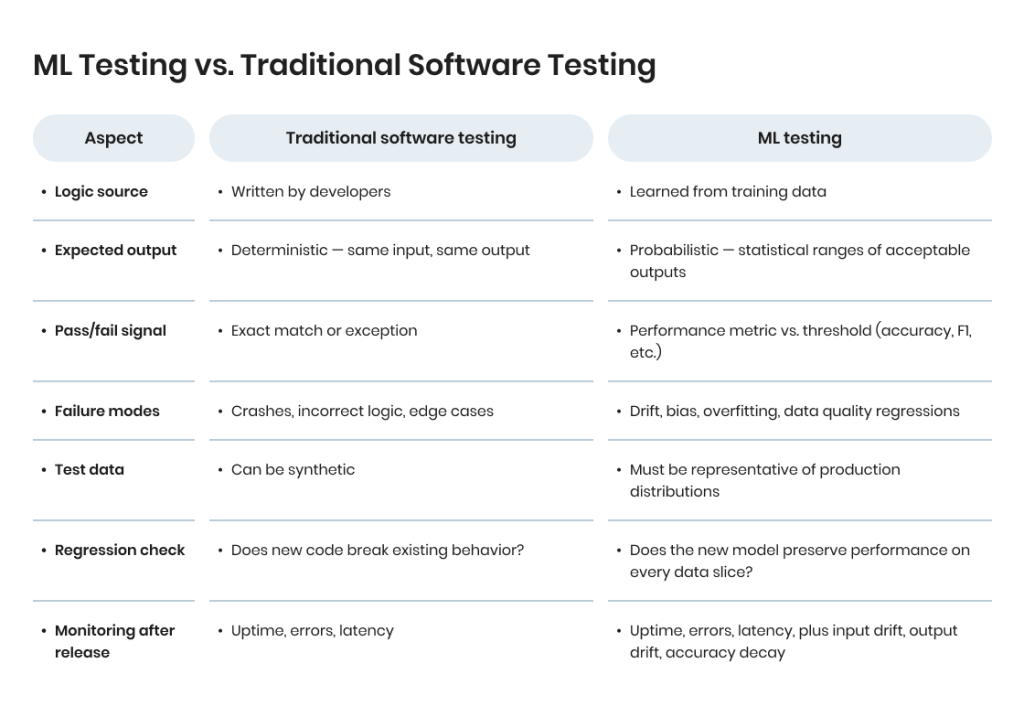
- ML testing ≠ software testing. Traditional software testing checks deterministic outputs against fixed rules. ML testing validates probabilistic outputs against statistical thresholds, distributions, and fairness constraints.
- Data testing comes first. Roughly 30–50% of ML failures originate in data — drift, leakage, imbalance, poor labeling. Validate data before you validate models.
- Test in three layers. Foundation (infrastructure and pipelines), model-centric (accuracy and robustness), and business impact (real-world outcomes).
- Pick metrics that match the problem. Accuracy, F1, AUC-ROC for classification. MAE, RMSE, R² for regression. BLEU, ROUGE, perplexity for language. FID, SSIM for vision.
- Model drift is inevitable. Real-world data shifts. Continuous monitoring and regression testing catch degradation before users do.
- ML in testing is no longer hype. Self-healing tests, predictive defect analysis, and smart test selection are production features in most modern QA platforms.
- The two sides converge. Teams shipping AI products need both: rigorous testing of their ML models and ML-powered tooling to keep up with release velocity.
Need an expert read on your ML testing maturity?
Our QA engineers can audit your current ML testing practices and pinpoint critical gaps in two weeks.

Part 1. Testing Machine Learning Models
Testing in machine learning ensures that ML models learn from data in a way that generalizes to unseen data, rather than memorizing noise or absorbing biases. Testing helps surface the gaps that cause models to fail silently after release.
What Is ML Testing?
Machine learning testing (often shortened to ML testing) is the process of evaluating and validating machine learning models to ensure they perform reliably, accurately, and fairly across realistic conditions — both before deployment and throughout their production lifecycle.
Where traditional software testing checks whether code does what the spec says, testing in ML checks whether a trained model behaves the way the business needs it to. A rule-based system either returns the right answer or it doesn’t. A machine learning system returns probabilities — the right question isn’t “did this test pass?” but “is this model good enough, on the data that actually matters, to be trusted in production?” Teams that learn how to test ML the right way treat this as an ongoing engineering discipline, not a one-off validation.
Testing individual components of an ML pipeline — data loaders, feature transforms, prediction endpoints — still matters. But because ML models are trained on data rather than explicitly programmed, the model itself requires an additional layer of testing: statistical evaluation across slices of data, behavior under shifted distributions, robustness against adversarial inputs, and consistency over time. This is why ongoing testing of machine learning models is critical for any team running ML in production.
ML Testing vs. Traditional Software Testing
Testing machine learning systems is less like “does this function return 42” and more like “does this model still make the right calls on real users, a month after we shipped it.”
How Machine Learning Models Fail
Before designing an ML test suite, it helps to know what you’re defending against. The failure modes that show up most often in production, often due to changes in data or in the environment around the model:
Data drift and concept drift. The input distribution changes over time (data drift), or the relationship between inputs and the target changes (concept drift). A fraud model trained on 2023 transactions will miss 2026 fraud patterns. Monitoring statistical properties of live inputs against training distributions catches this early.
Training-serving skew. The model sees one data distribution in training and a different one in production — often because feature pipelines differ between offline model training and live serving code.
Bias and unfairness. Models absorb historical bias from training data. A resume screener trained on past hiring decisions can reproduce past discrimination. Fairness testing across protected groups is a legal requirement in many jurisdictions.
Overfitting and underfitting. Overfit models memorize training data and fail on unseen data. Underfit models haven’t learned enough signal to be useful. Cross-validation catches both.
Data leakage. Information from the target variable or future data sneaks into training features, inflating offline metrics and collapsing in production. One of the most common — and most expensive — defects in ML systems.
Silent degradation. Unlike regular software, ML systems rarely throw errors when they break. They just start making worse decisions. The only defense is testing procedures and monitoring that don’t depend on error signals.
Types of ML Testing
Testing machine learning models is not a single activity but a collection of testing strategies for model testing at every stage — from initial model training to production monitoring. A mature ML testing framework combines most of the types below to ensure both code quality and model quality.
Unit testing for ML components. Just like regular software, ML systems are built from individual components — data loaders, feature transformers, loss functions, inference endpoints. Unit testing verifies that each piece behaves as specified. This is where you catch a normalization function that breaks on zero values, or a categorical encoder that silently maps unseen categories to the wrong bucket.
Data validation and testing. The quality of input data is the ceiling on model quality. Data validation checks for missing values, outliers, schema violations, class imbalance, and distribution shifts between training and serving data. Great Expectations, Deequ, and TensorFlow Data Validation are the common tools here.
Cross-validation. Partitions the dataset into multiple folds, trains the model on subsets, and evaluates on held-out data. Gives a more honest view of generalization than a single train/test split. K-fold and stratified K-fold are the usual defaults.
Integration testing. Verifies that components work together — that the data pipeline feeds the feature store, which feeds the model, which returns predictions to the downstream service. Usually a small end-to-end pipeline on a fixed test dataset.
Regression testing for ML models. A simple question: does the new model version perform as well as the previous one on every slice that matters? A new model might improve average accuracy by two points while quietly losing five on a critical subgroup. Regression test suites track performance across slices, release after release.
Performance testing. Inference latency, throughput, and resource usage. A model that’s 2% more accurate but 10x slower may not be deployable.
Robustness and adversarial testing. How does the model behave on noisy, corrupted, or deliberately adversarial inputs? A vision model should not misclassify a stop sign because of a few pixels of noise. ART (Adversarial Robustness Toolbox) and CleverHans generate crafted inputs to stress-test models.
A/B testing in production. Compares a new model against the existing one on live traffic. The most honest measure of business impact — offline metrics don’t always translate into user behavior.
Bias and fairness testing. Evaluates whether the model behaves equitably across protected groups: demographic parity (positive predictions distributed evenly), equal opportunity (equal true positive rates), disparate impact (ratio of favorable outcomes meets legal thresholds). Fairlearn and AI Fairness 360 provide the metric implementations.
Explainability testing. Verifies that model decisions can be interpreted and justified. SHAP and LIME surface which features drive individual predictions. For regulated industries, required documentation.
Not sure which of these your ML system actually needs?
Evaluation Metrics for ML Models
Selecting the right evaluation metric is one of the most consequential choices in ML testing. A model that looks great on the wrong metric can cause real damage in production.
Classification Model Metrics
Classification models predict discrete categories — spam detection, fraud identification, customer churn.
- Accuracy — percentage of correct predictions. Misleading for imbalanced data: a fraud model that always predicts “not fraud” scores 99% accuracy if only 1% of transactions are fraudulent.
- Precision — of all positive predictions, how many were correct? Matters when false positives are expensive (flagging legitimate emails as spam).
- Recall (sensitivity) — of all actual positives, how many did we catch? Matters when false negatives are dangerous (missing a malignant tumor).
- F1 score — harmonic mean of precision and recall. The go-to metric when classes are imbalanced.
- AUC-ROC — the model’s ability to rank positives above negatives across thresholds. Values closer to 1.0 indicate strong discrimination; 0.5 is random.
- Confusion matrix — the raw TP/FP/FN/TN table from which all the above are derived. Always look at it, not just summary metrics.
Regression Model Metrics
Regression models predict continuous values — prices, demand, time-to-event.
- MAE (Mean Absolute Error) — average absolute difference between predicted and actual. Same units as the target, easy to explain.
- MSE (Mean Squared Error) — average squared error. Penalizes large errors more heavily. Good when big misses are much worse than small ones.
- RMSE (Root Mean Squared Error) — square root of MSE. Widely used in forecasting and financial modeling.
- R² (Coefficient of Determination) — fraction of variance in the target explained by the model. Ranges from 0 to 1 on well-behaved data; higher is better.
NLP and Text Generation Metrics
- BLEU — n-gram overlap between generated and reference text. Common for machine translation. Above 0.3 is readable; above 0.5 is good.
- ROUGE — overlap-based metrics used for summarization (ROUGE-N for n-grams, ROUGE-L for longest common subsequence).
- Perplexity — how well a language model predicts a sample. Lower is better.
- BERTScore — uses contextual embeddings to measure semantic similarity. Correlates with human judgment better than exact-match metrics.
Computer Vision Metrics
- FID (Fréchet Inception Distance) — distributional similarity between generated and real images. Lower is better.
- SSIM (Structural Similarity Index) — perceptual similarity, from -1 to 1.
- PSNR (Peak Signal-to-Noise Ratio) — reconstruction quality in dB.
Fairness Metrics
- Demographic parity — positive prediction rate similar across protected groups.
- Equal opportunity — true positive rate similar across protected groups.
- Disparate impact — ratio of favorable outcomes between unprivileged and privileged groups (US 80% rule suggests ≥ 0.8).
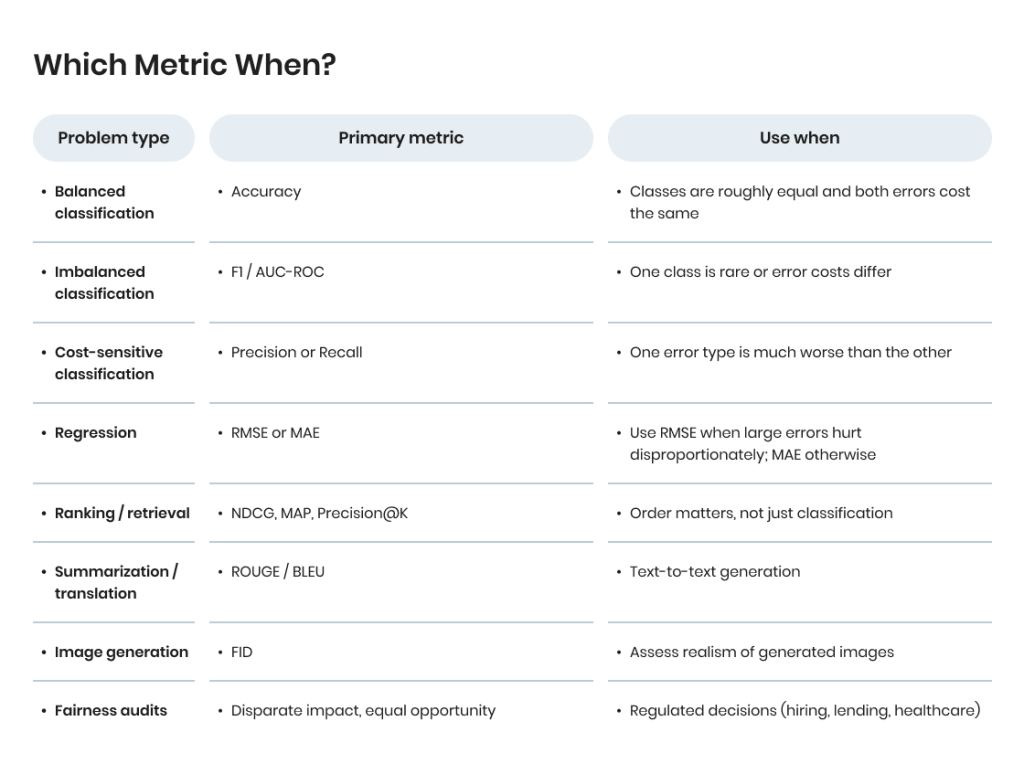
The rule of thumb: never pick a metric without asking what a failure of it costs the business.
Picking the right metrics is half the battle.
Our ML QA engineers help product and data science teams define acceptance criteria that connect model performance to business outcomes.

How to Test Machine Learning Models: A Step-by-Step Approach
Effective testing starts before the first line of model code and continues long after deployment. Here is how we structure ML testing in production engagements.
1. Understand Your Data
Before any test is written, start by testing your data. Distribution, missing values, class balance, outliers, drift over time. The shape of your test strategy is dictated by the shape of your data. If 5% of rows have corrupted labels, no amount of hyperparameter tuning will save you.
2. Split Your Data Properly
Train / validation / test splits should preserve real-world distributions. For time-series data, use a time-based split — random splits leak future information into training. For imbalanced data, use stratified sampling to keep class ratios stable.
3. Test the Foundation First (Layer 1)
The base of any ML testing pyramid is infrastructure. Data pipeline validation confirms data flows correctly from sources to training. Environment consistency checks ensure dev, test, and prod process data identically. Integration testing — API endpoints, serialization, error handling — verifies the model interfaces correctly with upstream and downstream systems. This layer is where “it worked in my notebook” meets “it doesn’t work in production.”
4. Test the Model Itself (Layer 2)
Layer 2 focuses on the ML model — accuracy, behavior, performance characteristics:
- Performance stability testing. Train the model multiple times with identical hyperparameters. Significant variation points to an unstable training process.
- Slice-based evaluation. Report performance across important subgroups — geography, customer segment, device type. Global accuracy can mask catastrophic failures on critical slices.
- Invariance testing. Verify predictions stay stable when irrelevant features change. A loan model shouldn’t change its decision because the applicant’s name formatting changed.
- Adversarial testing. Feed deliberately crafted inputs. If your model can be broken by a typo or a few noise pixels, you have a production risk.
5. Test Business Impact (Layer 3)
Layer 3 connects model performance to business outcomes. A technically accurate model that doesn’t improve business metrics is, for the company paying for it, a failed project.
- A/B testing new models against production on real traffic gives the most reliable measure of impact.
- Shadow deployment runs the new model alongside the existing system, logging predictions without affecting users.
- Canary releases gradually roll out to increasing percentages of traffic, monitoring for issues before full deployment.
6. Implement Data Quality Gates
Automated data quality checks should gate every training run and every serving batch. Minimum checks: missing value counts below threshold, no unexpected categories in categorical features, numeric distributions within tolerance of training data, class balance within expected range, and no duplicate rows across train/test splits. Any failure blocks the pipeline. This single practice prevents a large share of ML incidents.
7. Require Reproducibility
Every training run should be fully reproducible from the same inputs and random seeds. Store training data references, hyperparameters, environment configurations, seeds, and feature transformation code. Without reproducibility, debugging is guesswork.
8. Monitor Continuously After Deployment
Testing doesn’t stop at launch. Input monitoring tracks the distribution of incoming data and alerts when drift exceeds thresholds. Output monitoring watches prediction distributions for unexpected shifts. Performance monitoring tracks accuracy, latency, and resource usage over time. Effective testing and monitoring is what distinguishes ML systems that age well from ones that quietly rot.
ML Testing Tools and Frameworks
A practical ML testing framework usually combines several tools across the pipeline. The ones we use most often:
- Great Expectations — declarative data validation, pipeline-friendly.
- TensorFlow Data Validation (TFDV) — schema inference and drift detection at scale.
- Deepchecks — a Python library with ready-made checks for data integrity, model evaluation, and drift.
- Evidently AI — open-source monitoring for drift, performance, and data quality in production.
- MLflow — experiment tracking, model registry, and reproducibility.
- Scikit-learn — cross-validation, metrics, and baseline model comparisons.
- Fairlearn and AI Fairness 360 — bias detection and fairness metrics.
- ART (Adversarial Robustness Toolbox) and CleverHans — adversarial testing.
Picking an ML testing framework is less about choosing “the best tool” and more about composing the right stack for your stage: data validation at ingestion, metric tracking during training, slice-based evaluation before release, and drift monitoring in production.
TestFort Case Study: QA for an E-commerce Recommendation Engine
One of our clients, a mid-sized e-commerce platform, came to us with a classic ML problem: their recommendation engine had started suggesting irrelevant products, and click-through rates had dropped 20% over a quarter. The engineering team had focused on building the model and had not invested in the test automation needed to develop machine learning reliably at scale.
What we built: an automated regression testing pipeline that evaluated every new model version across critical product categories and user segments, a data validation strategy using statistical tests to detect drift in user behavior and catalog features before it hit the model, and continuous monitoring of input distributions and prediction quality with alerting thresholds tied to business KPIs.
Results:
- Click-through rates restored to pre-drift levels.
- 70% reduction in production defects through pre-deployment validation gates.
- 2 critical data leakage risks identified during the regression pipeline rollout — leakage that was silently inflating offline metrics.
- 95% model accuracy validation on the deployed version, confirmed across every tested slice.
The takeaway: effective testing in machine learning isn’t a one-time model validation. It’s an ongoing discipline that catches drift before users do.
Shipping an ML-powered product?
We’ve built ML testing pipelines for recommendation engines, fraud detection, forecasting, and NLP systems. Let’s talk about yours.

Part 2. Machine Learning in Software Testing
Up to here, we’ve covered how to test ML models. The second half of “ML testing” — the one search engines also return results for — is the opposite direction: how machine learning is being used in software testing itself.
How Machine Learning Is Upgrading Software Testing
Software testing generates a large amount of data — test cases, results, logs, defect reports, code changes, runtime telemetry. For years, most of it was thrown away. Then teams noticed it could be used to train machine learning algorithms to identify patterns and make predictions: which tests are likely to fail, which code changes are risky, which UI elements have moved.
That shift is what people mean when they say machine learning is revolutionizing software testing. The ability of ML to revolutionize software testing comes from one thing — data. Whether you call it machine learning in automation testing, machine learning being used across QA, or simply ML-powered testing, the mechanic is the same: ML is moving testing from rule-based scripts to adaptive systems that learn from history.
The convergence of machine learning and software testing automation is accelerating because three things happened at once across the software development lifecycle:
- CI/CD made release velocity a competitive advantage — teams can’t afford test suites that take hours.
- Application complexity outgrew human-maintainable test suites — there are too many flows, too many edge cases, too many UI variants.
- ML techniques matured enough to run in production QA tooling — what used to be research papers is now a feature in most test platforms.
This evolving software testing automation shows up in the numbers QA leads actually track: test coverage metrics, flaky test rates, and the volume of test failures that actually get surfaced to engineers instead of getting lost in noise.
Types of ML Algorithms Used in Software Testing
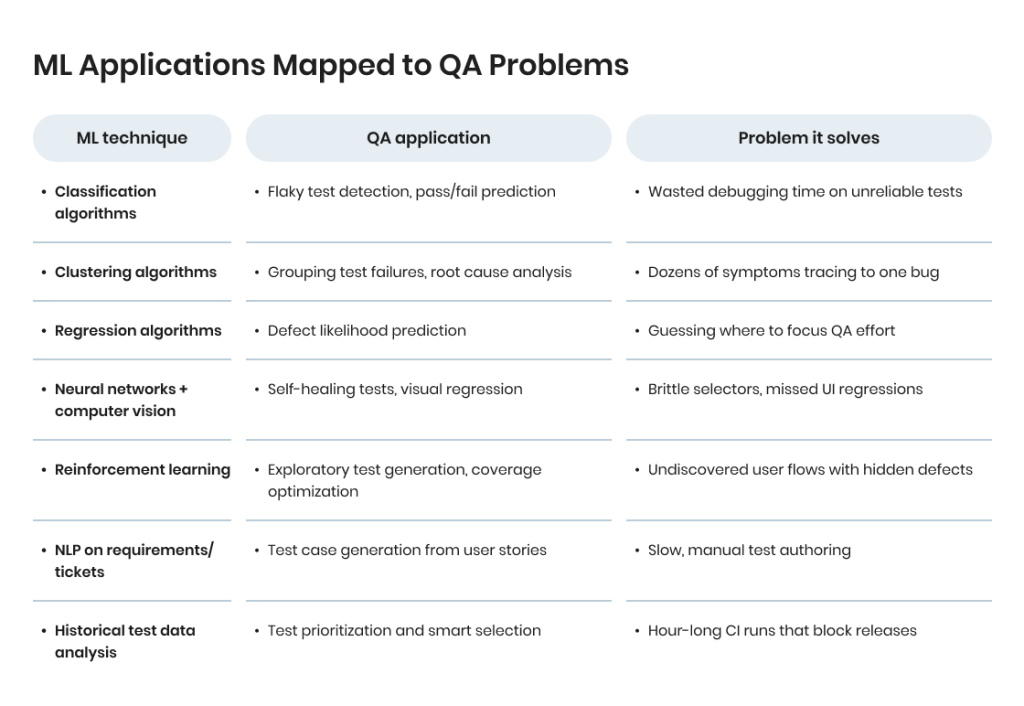
Machine learning involves training algorithms to identify patterns in data and use those patterns to make predictions. Most of the ML used in QA falls into four families, each a distinct form of machine learning with a natural fit to specific testing problems.
Supervised learning. Trained on labeled examples — tests labeled pass/fail, commits labeled defective/clean, UI elements labeled by type. Powers defect prediction, test result classification, and flaky test detection.
Unsupervised learning. Finds patterns in unlabeled data. In QA, clusters similar test failures to surface root causes, groups related bugs, and detects anomalies in server logs. It’s how teams discover that fifty seemingly unrelated failures are actually the same bug.
Reinforcement learning. Learns by trial and error, receiving rewards for good outcomes. Used to explore application states, generate test sequences that maximize coverage, and adapt execution strategies over time.
Deep learning. Neural networks with many layers — what makes visual testing and UI element recognition reliable, and the tech behind self-healing locators that find a button even after its ID, label, and position have all changed.
Underneath sit the specific algorithms: classification (decision trees, SVMs, gradient boosting) for pass/fail prediction, clustering (k-means, DBSCAN) for grouping failures, regression algorithms for failure likelihood, and neural networks for visual and semantic understanding.
Applications of Machine Learning in Software Testing
The applications of machine learning in software testing fall into a small number of high-impact categories. Every modern QA platform with “AI” in its marketing is doing some combination of these — and together they make up most machine learning applications in the QA space.
Test case generation. ML analyzes historical test data, user stories, and app behavior to generate test cases automatically, expanding test coverage into edge conditions humans miss.
Test prioritization and smart selection. ML ranks tests by probability of failure given the code that just changed — CI/CD platforms that analyze historical test data routinely report 5–10x faster feedback loops with minimal loss of coverage.
Defect prediction. Learning from past defect logs and code changes, ML highlights the modules most likely to contain bugs, so QA attention goes where it matters.
Flaky test detection. ML models score each test’s likelihood of being flaky based on execution history, automatically quarantining the unreliable ones.
Test data generation. An automated testing tool powered by ML generates realistic synthetic data for scenarios hard or impossible to capture in production — rare fraud cases, edge behaviors, compliance-sensitive records.
Self-healing tests. Self-healing frameworks use computer vision and DOM-aware ML to identify what a UI element is, not just where it was, and re-anchor tests when selectors change. Maintenance drops from hours per release to minutes.
Visual testing. Computer vision compares current UI screenshots against baselines, flagging unexpected changes conventional scripts would miss.
Automated regression testing. Regression across a large application is exactly the kind of problem ML does well: lots of historical data, clear labels, repeated execution. ML-driven regression suites identify the minimum set of tests needed to catch the most likely failures.
Your QA stack is sitting on years of test history.
We help you build ML-powered test prioritization and flaky test detection on top of your existing CI/CD.
Benefits of ML in Software Testing
The payoff of applying machine learning in automation testing falls into a few concrete wins:
- Faster test creation. Tests that used to take hours to script can now be created in minutes when the underlying framework builds an ML model of the application as the tester uses it.
- Broader test coverage. ML-driven generation surfaces edge cases and user flows humans wouldn’t think to write tests for.
- Fewer false positives. Self-healing locators and vision-based assertions are robust to cosmetic UI changes — so when a test fails, it actually means something broke.
- Lower maintenance burden. Self-healing frameworks remove most of the routine script-fixing work that crushes traditional Selenium suites after every release.
- Predictive risk analysis. ML ranks code changes and test cases by failure likelihood, so QA effort lands where the real risk is, instead of running everything every time.
- Better use of QA engineer time. Engineers move from writing and fixing scripts to exploratory testing, test strategy, and validating what the AI outputs.
- Reinforcing feedback loop. Learning and software testing automation, once separate disciplines, now reinforce each other — the more tests run, the smarter the system gets.
Challenges and Limitations
Applying ML to QA isn’t free, and the rollout has its own set of problems:
- Data quality and quantity. ML models need large, clean datasets of historical test runs and defects. Teams with thin test history or messy bug tracking won’t get useful predictions on day one.
- Integration with existing tooling. Plugging ML-driven testing into legacy CI/CD, test management, and reporting stacks is rarely plug-and-play.
- Interpretability. ML algorithms often act as black boxes. When a self-healing framework picks the wrong element, it can be hard to understand why — and even harder to prove the test is trustworthy.
- Skills gap. QA engineers need new skills to interpret ML-driven signals, tune models, and debug when the automation makes the wrong call.
- Cost of implementation. Licensing, infrastructure, and the learning curve all cost money. ROI is real, but it’s a six-to-twelve-month arc, not a quick win.
- Model bias in the tool itself. The same biases that affect ML products affect ML-powered QA tools — a test prioritization model trained on biased historical data will under-test the areas it historically under-tested.
The Future: AI and ML in QA
The next phase is already visible in leading teams: predictive analytics that score each build’s release risk, self-healing that extends from UI to API contracts, and agentic AI that evaluates an app, decides what to test, runs the tests, and issues a release/no-release verdict — with humans reviewing the reasoning, not executing the tests.
Crucially, the two sides of this guide start to merge. If your product is itself an AI application — conversational AI tools, copilots, LLM features — testing machine learning models is only part of the job.
You also need to validate hallucinations, prompt sensitivity, response variability, and safety. That’s a separate discipline: Testing AI Applications.
Why TestFort for ML Testing
Since 2001, TestFort has delivered QA for enterprise and mid-market software. In recent years, that expertise has extended into specialized AI and ML testing services — model validation, data testing, drift monitoring, bias and fairness auditing, and automation pipelines designed for ML workflows.
We bring ML-aware QA frameworks for drift, bias, and output quality scoring; dual-track capability for both custom-trained models and hosted third-party integrations; real-world testbeds combining synthetic and production-like data; and CI/CD-native automation with pre-deploy gates, post-deploy monitors, and rollback policies. ISO 27001 certified, CMMI Level 3 maturity, and flexible engagements — embedded QA pods for velocity, fixed-cost options for predictable budgets.
If you’re shipping an ML-powered product and want someone who has seen how these systems fail at scale, we’re a call away.
FAQ
 What is ML testing?
 What is ML testing?
Machine learning testing (or ML testing) is the process of evaluating ML models for accuracy, robustness, fairness, and stability — before deployment and throughout the model’s production lifecycle. Unlike regular software testing, it evaluates statistical performance across data distributions rather than exact functional correctness.
How is ML testing different from software testing?
Traditional software testing checks deterministic outputs against fixed rules. ML testing validates probabilistic outputs against statistical thresholds, slice-based performance, drift over time, and fairness across protected groups.
What are the main types of ML testing?
Unit testing of ML components, data validation, cross-validation, integration testing, regression testing across model versions, performance testing, robustness and adversarial testing, A/B testing in production, bias and fairness testing, and explainability testing.
Which tools are used for ML testing?
A typical ML testing framework combines Great Expectations or TensorFlow Data Validation for data quality, Deepchecks and Evidently AI for drift and evaluation, MLflow for experiment tracking, Scikit-learn for cross-validation and metrics, Fairlearn or AI Fairness 360 for bias, and ART or CleverHans for adversarial testing.
How does machine learning improve software testing?
ML in software testing automates test case generation, prioritizes tests by failure likelihood, predicts defect-prone modules, detects flaky tests, enables self-healing scripts, and powers visual regression testing. The net effect: faster releases, broader coverage, less manual maintenance.
What’s the difference between testing ML models and using ML in testing?
Testing ML models means validating that a machine learning system works correctly. Using ML in testing means applying ML techniques to make software testing itself faster and more accurate. Both are “ML testing” in search, but they’re different disciplines that often share tooling.
How do you test for model drift?
Drift testing monitors statistical properties of production inputs and outputs and compares them to training distributions. When divergence exceeds a threshold, alerts fire and a retraining pipeline is triggered. Evidently AI and TensorFlow Data Validation are purpose-built for this.
Jump to section
Get model-aware QA!