Financial Application Testing: Fintech QA Playbook for 2026
Where financial software testing stands in 2026: testing types, compliance requirements, manual vs automation, AI in QA, and a risk-based strategy that works.
A broken feature might cost you users. A failed transaction costs money, trust, and possibly a lawsuit.
Transaction systems, third-party integrations, real-time fraud checks, and cross-border regulations all collide in one product. Testing them is beyond validation — it’s a critical layer in your system architecture. You need to verify that:
Transactions are irreversible only when they should be.
Security holds under real-world load and threat conditions.
Regulatory requirements are met and traceable.
Edge cases don’t silently break reconciliation or reporting.
Testing in fintech is different because the stakes are different. And as systems grow more integrated and AI-backed features enter the mix, QA isn’t a late-stage checkbox anymore. It’s a strategic function — if done right.
In this guide, we’ll cover:
What exactly needs to be tested (and why)
How to handle automation, domain complexity, and compliance
When to move from QA to full-scale quality engineering
With real case examples, a practical checklist, and insights from testers who’ve handled it before.
Key takeaways:
#1. Stakes, not just bugs. In fintech, a single fault can freeze accounts or misroute funds – testing isn’t just about functionality but financial risk management.
#2. Compliance as code. Every test must be traceable with logs, screenshots, and timestamps – auditors won’t accept what you believe you tested, only what you can prove.
#3. Integration failures cost the most. Most real-world fintech problems happen between systems – when your payment processor, KYC service, and notification system stop talking to each other correctly.
#4. Risk-based prioritization pays off. Testing a profile update button with the same rigor as payment settlement logic wastes effort – focus QA resources where financial exposure lives.
#5. Localization = legal requirements. A feature that works perfectly in one market can be illegal in another – test variations in tax logic, disclosure language, and data handling by region.
#6. End-to-end testing catches what unit tests miss. Test complete journeys that span days: signup → failed KYC → retry → payment → refund → support ticket.
#7. Domain expertise matters. Generic QA misses critical issues because they don’t know the difference between authorization holds, settlements, and reconciliation processes.
#8. Evidence-driven QA protects more than code. A mature fintech testing strategy delivers stable software, audit-ready evidence, regulatory compliance, and protection against financial loss.
Financial Software Testing Challenges in 2026
Not all bugs are equal. In fintech, the wrong failure can freeze accounts, misroute funds, or trigger compliance violations that escalate into legal risks.
That’s why testing a fintech product demands more than functional coverage. You need domain awareness, systems thinking, and risk-based priorities baked into your QA process from day one.
Here are the challenges we’ve seen most often:
1) Regulatory pressure is built-In
Financial services operate under strict legal frameworks. Whether you’re launching a wallet app, payment processor, or trading platform, you’re dealing with:
DORA (EU), PCI DSS, SOX, GDPR, PSD2, MiFID II, and more
Country-specific rules — NYDFS, FCA UK, MAS Singapore, etc.
Expectations around data handling, encryption, access control, and audit trail traceability
If your QA for financial software doesn’t account for these, the system isn’t just untested — it’s non-compliant.
Words by
Igor Kovalenko, QA Lead
“In regulated environments, your documentation carries the same weight as your code quality. Auditors aren’t interested in what you believe you’ve tested — only what you can prove.”
This means every test needs to be traceable. Logs, screenshots, timestamps, tester identity — everything must be recorded. Your financial software testing isn’t complete without evidence.
High-risk transactions require risk-based testing
A standard regression test isn’t enough when:
A duplicated charge causes legal complaints
A failed refund breaks accounting
An expired auth token delays payroll
You need risk-based prioritization — making sure high-impact failures are tested first, and edge cases are covered with realistic simulations.
Check our POS compliance case:
We implemented traceability matrices and simulated failure modes across 12 devices and payment terminals — including partial refunds, offline transactions, and chargeback scenarios.
In software testing for financial services, you’re not just testing features — you’re testing financial integrity.
Application testing integrations = Business risk
Modern financial applications rarely work alone. Your testing must account for integrations with:
Banking APIs and payment gateways
AML/KYC services
Tax calculation and FX conversion engines
Accounting, CRM, and internal reporting platforms
Every one of these is a potential failure point. Multiply that by local payment regulations, exchange rates, and currencies — and you get hundreds of test cases that can’t be skipped.
In testing financial applications, what breaks is often not the code, but the logic between systems. Testing this requires strong API coverage, realistic data, and full transaction simulations.
Not sure if your fintech testing covers all risks?
Request our financial QA Audit and see all the gaps and dangers
Financial users don’t just want things to work — they need to know what’s happening.
That’s why your QA team must test:
What users see during failure (clear errors, next steps, retry options)
When and how users are notified (email, SMS, in-app)
Whether backend systems and frontend messaging stay in sync
Failed payments need to communicate: What happened? Was I charged? What now? Otherwise, confused users flood support or leave angry.
This is part of end-to-end testing in financial apps — testing not just transactions, but the surrounding ecosystem.
Types of Financial Application Testing
Functional testing
You need to ensure that every feature performs correctly across expected and edge-case conditions. In fintech, “functionality” means more than just whether the button works.
You need to verify:
Can a user initiate a payment, and does it go through?
What happens if the connection drops mid-transaction?
Can the system handle partial captures, failed refunds, and mixed payment methods?
Does your financial application behave correctly for both logged-in users and guests?
This is the foundation of any financial software testing plan — but in practice, it needs to go beyond simple happy-path flows.
In one of our payment QA engagements, we built test matrices for:
Authorization hold behaviors (release time)
Installment payment setups
Refund workflows by method and status
This helped the client reduce failed refund complaints by 37% in the first 3 months.
Integration Testing
Your goal is to validate that all external systems connected to your app work seamlessly and reliably.
Most financial services applications are not monoliths. They’re complex integrations of:
Banking APIs
KYC and identity providers
Payment gateways
FX conversion engines
Fraud and risk scoring platforms
CRM and accounting tools
A missed integration bug can delay payouts, trigger fraud alerts, or duplicate charges — and users won’t care whose API caused the issue.
In a mobile banking case, we tested a flow where payment processor downtimes weren’t correctly flagged.
The fix reduced silent payment failures by over 80% — just by adding monitoring and fallback for one external dependency.
In software testing for financial services, integration testing is one of the biggest ROI areas — because it’s where most real-world failures happen.
Key things to test:
Data consistency across systems
Retry logic and timeouts
Fallback behavior for each API
Authorization tokens and security scope changes
Performance testing
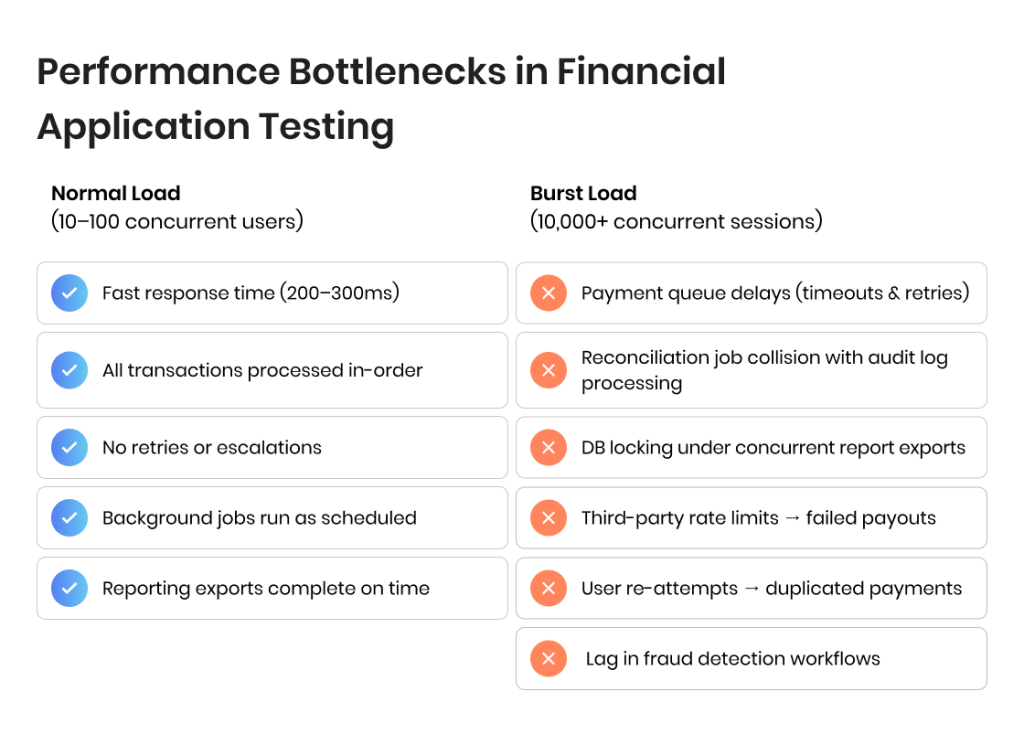
In the financial sector, performance issues rarely show up during manual checks or regular regression tests. They appear under pressure — when the system is flooded with traffic, background jobs collide, or integrations don’t respond as fast as expected.
For example:
Batch transactions that run overnight may freeze reconciliation jobs if the system architecture doesn’t account for processing delays.
10,000+ concurrent user sessions checking balances or making payouts can bottleneck your backend.
A third-party gateway may throttle your requests during peak hours, delaying or duplicating payouts — and that’s if your application integrates gracefully.
These aren’t edge cases. They’re expected stress points in software testing for financial services.
What to simulate in performance testing
Realistic performance testing in fintech means going beyond raw transaction counts. You need to simulate the business process — and test how it performs at scale.
Examples we regularly include when designing test cases:
Mixed payment volumes: cards (70%), wallets (20%), local methods (10%);
Peak-time events: salary runs, Black Friday load, tax-season refund floods;
Real-world latency: simulate poor mobile connections, timeout loops;
Background stress: audit logging, BI exports, cron jobs, settlement logic.
What we recommend
Performance testing in fintech must simulate realistic user behavior, external service latency, and background operations — or you’ll miss where the real risk lives.
✅ Include performance testing in your QA strategy from the beginning of the project, not after the first production scare ✅ Build scripts that simulate multi-system activity, not just front-end stress ✅ Define thresholds based on business requirements, not arbitrary load numbers ✅ Always test functional and non-functional aspects under stress
Performance is directly tied to risk management, user trust, and financial information system stability.
Security testing
In fintech applicationtesting, security isn’t a separate task. It should be embedded into every quality assurance phase — becausethe cost of failure and any unnoticed vulnerability is never just technical.
If user data leaks, you face regulatory fines.
If a refund flow can be gamed, you lose money.
If login sessions can be hijacked, trust is gone.
That’s why software testing in finance domain needs to go beyond “happy” paths. You must simulate real attack attempts, fraud behaviors, and access manipulation, not just test invalid input.
Security risks that quality assurance should cover
Area
Common Vulnerability
What QA Must Do
Authentication
Brute-force login, token reuse
Test MFA flows, enforce rate limiting, validate token expiry logic
Authorization & Roles
Privilege escalation, vertical/horizontal access control failures
Verify permissions by user role, simulate unauthorized actions
Payments & Transfers
Parameter tampering, replay attacks
Apply test automation to verify idempotency and signature validation
Refunds & Reversals
Business logic abuse (e.g. refund before settlement)
Test negative balances, enforce flow dependencies and timing rules
Sensitive Data Exposure
Unmasked PII in logs, unsecured APIs
Check log redaction, enforce encryption, use header scanning
Session Handling
Session fixation, hijacking
Simulate concurrent logins, check session invalidation after logout
API Security
Data scraping, insecure direct object references (IDOR)
Generate test cases for endpoint permissions, fuzz inputs, validate filtering logic
Internal Dashboards
No audit trails, unrestricted access for support staff
Include testing activities to ensure visibility of all privileged actions
Third-Party Services
Weak or expired tokens, excessive permissions
Perform software testing in financial services with token lifecycle simulation
Fraud Scenarios
Multiple withdrawals, gaming edge cases
Recreate abuse patterns with functional and non-functional testing coverage
In one of our projects, we tested a fintech app where support agents could access full payment history — even outside their assigned region. Our team built automated tests to verify access scope enforcement and helped the client avoid a potential GDPR compliance issue that would’ve surfaced during audit.
Regression testing
Regression testing for fintech solutions have to ensure new code doesn’t break existing functionality — especially where failure hurts most. Regressions are risk events and you might not notice them right away. They tend to:
Hide in edge cases no one rechecked;
Get introduced by a seemingly unrelated update;
Break critical financial flows like invoicing, payout batching, or scheduled audit exports.
Regression testing process has been here forever — way before any fancy AI updates. It both means that your testing team surely knows how to address it, and, at the same time, has many blind spots in this field.
Testing approach should adapt to reality, and when you do regression as you did even 3 years ago — you are behind. It is especially valid for testing financial software, as fintech apps are on the edge of innovation from one side, and constantly-updating compliance regulations from another/
Regression testing in fintech software development: risks vs what works
Localization and compliance testing
In fintech, launching across market is a legal minefield. A feature that works perfectly in one country can be illegal in another. A message that reassures users in English may confuse or mislead in French. A tax calculation error that goes unnoticed in staging may lead to fines and failed audits in production.
This is where localization and compliance testing becomes essential — not after development, but as part of the core QA effort based on industry standards (for financial transactions, trading accounts, payment gateways, etc.).
Compliance testing requirements by region
Regulations like DORA, PSD2, GDPR, SOX, and PCI-DSS have practical consequences on how your system operating in BFSI sector should behave — and QA must prove it. We can’t emphasize it enough — it should start with testing policy and testing strategy, not be a part of the last-minute audit.
While the table above outlines what regulations demand across regions, implementing these requirements within a testing cycle requires specialized approaches for different functional domains. The business requirements of the application must be balanced against regional compliance mandates, often creating tension between fast-paced application development and thorough validation.
Effective testing in financial information systems requires both manual testing for nuanced compliance checks and automated processes for consistent validation. When testing is performed across multiple jurisdictions, QA teams must maintain comprehensive test case preparation that addresses the unique requirements of each region while maintaining a cohesive testing approach.
Drowning in financial compliance requirements?
Our QA teams handle PCI-DSS, GDPR, PSD2, and beyond so you can focus on innovation.
Many financial institutions struggle to track compliance across their full application stack, especially when dealing with multiple lines of business. A systematic testing methodology helps bridge this gap by mapping regulatory requirements to specific areas of the software that require enhanced test coverage.
The following layered QA checklist represents industry best practices that ensure your fintech applications maintain compliance while operating across jurisdictions.
Compliance testing essentials: A layered QA checklist
By integrating these checks into your testing lifecycle, you can provide business stakeholders and business analysts with clear evidence of compliance while reducing regulatory risk when expanding into new markets.
End-to-End Testing
In the end, you need to validate full product behavior — across systems, user roles, and time.
Unit tests pass. The login works. Payments process in staging. But what happens when a user signs up, fails KYC, tries again, makes a partial payment, gets refunded, and asks for help?
That’s the journey that breaks things — and the one users actually take.
This is why end-to-end testing in financial services is a must. It’s how you find issues not in your code, but in interactions between systems. Issues that happen over time, across accounts, and in complex real-world flows.
A user may switch devices mid-payment
A payout may succeed while the status page still shows “processing”
A logged action may fail silently because the log server was down
A customer may enter the wrong IBAN twice, then get blocked.
These aren’t hypothetical. They’re scenarios we’ve seen — in production. And they happen because testing activities are scoped too narrowly.
Where it often breaks
Verification loops. Sign-up → fail KYC → retry → get stuck in a partial approval state
Cross-channel logic. User updates email on web, logs in on mobile — backend sync is delayed
Role transitions. Support elevates a user to admin → access doesn’t update in billing system
Transaction trails. Refund approved, but not reflected in export or notification logic
Time-based flows. Subscriptions expire, renew, and reactivate in ways QA never simulated
On a recent case, a fintech client couldn’t reconcile three failed payments that had technically processed. The root cause happened to be an edge-case refund flow that hadn’t been tested from start to finish, across payment gateway and reporting.
This is the final layer of mature financial application testing. Not just testing “if it works,” but testing how it works over time, under pressure, and across real usage patterns.
Manual vs Automation Software Testing Techniques
In fintech applications, where transactions directly impact customer assets and regulatory compliance, finding the right balance between manual and automated testing becomes essential. While automation drives efficiency, manual testing provides the human judgment critical for complex scenarios.
Manual testing strengths in fintech
Exploratory testing for edge cases. Manual testing excels when financial specialists explore complex user journeys that might not follow predicted patterns. A skilled QA tester with domain knowledge can identify unusual but valid transaction sequences that automated tests might miss, such as:
Partial payment reversals during multi-currency transfers;
Account reconciliation during maintenance windows;
Payment method fallback scenarios during gateway timeouts.
Compliance validation. Regulatory requirements often include subjective elements requiring human judgment:
Assessing whether disclosure language is “clear and prominent” for different user types
Evaluating the understandability of financial risk warnings
Verifying KYC/AML flows follow both the letter and spirit of regulations
User experience in financial contexts. Manual testing provides critical insights into how users interact with sensitive financial information:
Emotional responses to account balance presentations
Clarity of fee structures and pricing information
Comfort level with authentication mechanisms
Automation testing advantages for financial systems
Consistency in critical flows. Automated tests ensure core financial transactions consistently work as expected:
Account balance calculations
Payment processing sequences
Interest accrual logic
Statement generation
Regression prevention. Protecting existing functionality during rapid development cycles:
Automation Priority Matrix for Financial Applications
Feature Category
Automation Suitability
Manual Testing Need
Example
Core Calculations
High
Low
Interest calculations, fee structures
Regulatory Compliance
Medium
High
Disclosure requirements, regional variations
User Authentication
High
Medium
Login flows, MFA, step-up authentication
Reporting Functions
High
Medium
Transaction history, account statements
Risk Assessment
Medium
High
Fraud detection, unusual activity alerts
Where AI Fits In Testing Banking and Financial Apps
The integration of artificial intelligence into financial software testing represents a significant evolution in how banks and financial institutions ensure system integrity. Rather than replacing human testers, AI augments their capabilities, enabling more comprehensive coverage while allowing QA professionals to focus on nuanced financial scenarios that require domain expertise.
Anomaly detection in transaction testing
Traditional testing approaches often struggle to identify unusual patterns across millions of financial transactions. AI excels at this scale:
Machine learning models can analyze transaction patterns to flag statistically improbable sequences that might indicate potential bugs
Anomaly detection algorithms can identify edge cases in payment processing that would be impossible to manually script
AI systems can monitor test data for subtle inconsistencies in financial information management that might otherwise go undetected
When testing systems that handle thousands of concurrent user sessions, AI can identify performance degradation patterns that emerge only under specific load conditions, helping prevent costly outages during peak financial activity periods.
Intelligent test case generation
One of the most promising applications of AI in fintech testing is the ability to generate comprehensive test scenarios:
AI can analyze historical production data to identify realistic test cases that reflect actual user behavior
Machine learning algorithms can suggest test variations that human testers might not consider
Natural language processing can convert written financial regulations into testable scenarios
For example, when testing a mortgage application system, AI might generate hundreds of applicant profiles with varying credit histories, income verification documents, and property characteristics — each designed to test different branches of underwriting logic and compliance rules.
Predictive risk assessment
AI enables a proactive testing approach by predicting which system components have the highest risk of failure:
Analyzing code changes to identify high-risk modifications to financial processing logic
Predicting which features are most likely to experience issues based on historical patterns
Identifying potential integration failures when financial applications may be interacting with multiple external systems
This capability allows testing teams to focus resources where they matter most, especially when working with complex systems that integrate with mainframe or any other legacy infrastructure common in banking environments.
Is your payment system ready for Black Friday, salary day spikes, or tax season?
We use automation and AI QA to test for real-world financial pressure points
As AI becomes more integrated into testing processes, financial institutions must navigate an evolving regulatory landscape specifically targeting algorithmic systems:
Quality Assurance Strategy That Matches Fintech Reality
Testing every feature equally might look good in a report — but it doesn’t protect financial systems where it matters most. In fintech, you can’t afford to treat a login button and a payout trigger with the same testing weight.
Risk-based prioritization is the only efficient testing strategy that holds up under real business conditions and regulatory scrutiny.
Start with financial risk, not feature lists
When building a testing strategy for a fintech product, the first step isn’t writing test cases. It’s understanding where real financial or legal risks live within your application. Each function carries different levels of potential harm to users, business continuity, and compliance status.
Consider these contrasting failure impacts:
Good QA strategies map risk to user journeys, not just UI screens. This requires close collaboration between testing teams, business stakeholders and business analysts who understand both technical implementations and business requirements of the application.
In one of our projects, a payment gateway API change caused invisible failures at settlement time — days after transactions appeared “successful” to users. Because payment flows were prioritized in testing based on financial risk assessment rather than feature complexity, we caught the issue before customers experienced financial losses or regulatory reporting errors.
Payment flows over feature coverage
It’s easy to fall into the feature checklist QA trap:
Can users update a profile? ✅
Can users send money? ✅
Can users change currency? ✅
But this approach fundamentally misunderstands that feature coverage isn’t financial safety. In financial applications, the depth of testing on core money movement functions matters far more than breadth across peripheral features.
Testing payment flows end-to-end — including retries, delays, partial captures, and gateway timeouts — provides stronger protection than comprehensive testing of settings screens and profile management. When designing test cases for payment systems, consider aspects that impact financial integrity:
Critical payment testing scenarios
Financial institutions that excel in testing understand that selective re-testing of these critical pathways after system changes provides more security than broad but shallow testing of the entire application.
Authorization holds and releases Testing the full lifecycle from initial hold to final capture or timeout release
Split payments and partial refunds Verifying correct handling of partial actions across ledgers and payment providers
Voided transactions before settlement Ensuring proper reversal of pending authorizations without residual financial impact
Delayed payment capture flows Validating that transactions can be completed after initial authorization windows
Handling expired payment methods gracefully Testing renewal paths, fallback options, and clear user communication
This method is known as selective re-testing in quality assurance circles and forms the foundation of efficient payment testing in fintech environments.
Strengthen your payment processing with our specialized transaction testing team
In scaling fintech products, QA cannot live only inside the QA team. The complexity of financial systems to ensure compliance requires a distributed approach to quality.
Developer integration in the testing lifecycle
Developers must understand:
Where their changes intersect with regulated flows
How new features might introduce audit gaps
Which code paths impact financial transaction integrity
How to build testability into sensitive functions
Product management alignment
Product managers must understand:
Which releases increase compliance risk
Why not all “bugs” have equal business impact
How feature prioritization affects testing resources
The importance of testing documentation for audits
Many leading fintech organizations run “payment disaster simulations” with cross-functional teams: What happens if the payment provider drops 5% of webhooks for two hours? Who notices? What data gets corrected? How fast can the system recover? These exercises build institutional knowledge about failure modes that purely technical testing might miss.
QA ownership across multiple lines of business is the only way to scale fast without scaling risk. This distributed approach to testing financial software transforms quality assurance from a bottleneck into an enabler of safe innovation.
Practical implementation: Building risk maps
When planning test case preparation for financial applications, start with a systematic approach to risk assessment:
This strategic approach transforms QA from a cost center into an integral part of business risk management — and that’s exactly what effective testing of financial software requires in today’s complex regulatory landscape.
For financial institutions expanding into new markets or working across different domain applications, this risk-based testing is essential to maintain both rapid development velocity and the robust security posture demanded by regulators and customers alike.
Domain Knowledge: Why Generic QA Doesn’t Work
Technical correctness isn’t enough when you need to test the application in the fintech domain. A system can pass every standard QA check yet fail catastrophically in production when faced with real financial edge cases. This disconnect occurs when testing teams lack the domain expertise to identify where technical functionality intersects with complex economic concepts.
Fintech applications operate in a specialized environment where generic testing approaches can miss critical issues:
Financial domain expertise: What testers need to know
To effectively test fintech applications, QA specialists need working knowledge in several core domains:
Payment processing fundamentals
Understanding the difference between card-present vs. card-not-present transactions, authorization flows, settlement timing, and the implications of different payment methods is essential. When a tester knows that card networks handle chargebacks differently than ACH returns, they test these paths with appropriately different scenarios.
Accounting principles
Effective fintech QA requires familiarity with double-entry bookkeeping, reconciliation processes, and financial reporting standards. Without this knowledge, a tester might miss that a seemingly successful transaction created an accounting imbalance that will cause month-end closing failures.
Regulatory framework basics
Testing teams need awareness of major financial regulations like KYC/AML requirements, PSD2, SOX controls, and regional variations. This knowledge helps QA identify when a technically functional feature might still expose the company to regulatory risk.
Financial data security standards
Understanding PCI-DSS requirements, tokenization approaches, and secure handling of financial information ensures testing catches potential compliance issues before they reach production.
By investing in financial domain knowledge within your QA team, you transform testing from a technical validation function into a critical business protection mechanism. In fintech, where errors can have immediate financial consequences, this transformation isn’t optional — it’s essential.
Strengthen your payment processing with our specialized transaction testing team
Wrapping Up: Testing Financial Applications in 2026
Most fintech testing advice sounds good in theory. Until something breaks in production — and the team’s left explaining how a “fully tested” system let a refund go missing or a payout slip through without authorization.
That’s the difference in this domain.
You’re not just testing functions. You’re testing money, compliance and trust.
We’ve seen test suites that hit 95% coverage — but missed the one edge case that froze payroll for over 500 users. We’ve seen platforms pass UAT with flying colors — only to fail during audit, because evidence wasn’t logged.
By now, it should be clear: fintech testing requires more than automation scripts and bug trackers. It demands:
Domain fluency — so testers understand what’s at stake with every transaction.
Compliance awareness — because unproven test coverage means audit failure.
Real-world simulation — because production failures aren’t hypothetical.
System-level thinking — to trace what happens across APIs, roles, devices, and time.
And above all: risk-based prioritization.
Not every feature is equal. Refund logic, payment timing, access control — these are where the real danger lives. And that’s where QA has to live, too.
If you want to build or test financial software that actually holds up under pressure, these are the questions to ask:
Are you testing the flows that matter most?
Do you simulate how real users — and real fraudsters — behave?
Can you prove, not just assume, compliance?
If the answer to any of these is “not yet” — we can help.
We’ve tested trading apps, payment systems, banking platforms, and fintech APIs across jurisdictions, audit requirements, and usage spikes. We know where it breaks. And we know how to prevent it.
A commercial writer with 13+ years of experience. Focuses on content for IT, IoT, robotics, AI and neuroscience-related companies. Open for various tech-savvy writing challenges. Speaks four languages, joins running races, plays tennis, reads sci-fi novels.