Risk-Based Testing Approach: Process, Examples, Mistakes, and More
Where does risk-based testing approach make the most sense and how to incorporate it in your testing routine? Learn all about risk-based testing and how to make it work.
Most teams don’t have a testing problem in the sense of doing too little of it. They have a targeting problem. The hours go in, the test cases pile up, the coverage numbers look respectable, and yet something still slips through, usually in a spot nobody thought to look hard at because it seemed like low stakes at the time. The effort was real — it just wasn’t aimed at the right things.
Risk-based testing is how you fix that. The whole idea is to point your attention at what’s genuinely likely to break and what it would actually cost you if it did, rather than spreading your team thin across everything as though it all carried the same risk. This article gets into what that looks like in practice, how to target testing work by risk, and how we approach it at TestFort on real projects.
Key Insights on Risk-Based Testing:
Risk-based testing is most effective when it influences real testing decisions, not just how risks are documented.
The quality of risk assessment depends more on cross-functional input than on the scoring model used.
Prioritizing testing efforts based on risk often means testing fewer areas more deeply, not more areas superficially.
Disagreements in risk evaluation are useful — they usually indicate gaps in understanding or hidden dependencies.
Low-risk areas still require testing; the difference is in depth, not inclusion.
Risk should be reassessed continuously, especially in agile environments where priorities and systems evolve quickly.
A strong testing strategy focuses on reducing meaningful risk instead of maximizing coverage.
Risk-based testing works best when it becomes part of everyday decision-making instead of a one-time activity.
What Is Risk-Based Testing in Software Testing?
Risk-based testing starts with a simple admission: you can’t test everything with the same amount of attention, so you may as well be deliberate about where the attention goes. Risk is what makes that choice possible. You look at each part of the system through two questions — how likely is this to fail, and how much would it hurt if it did, and then you let the answers pull your effort toward the places that score high on both.
That plays out in a few ways:
You rank the work by business impact instead of treating every feature the same way
You draw a real line between what needs deep testing and what a quick pass can cover
You spend your testing resources where they’ll actually change the outcome
The contrast with the traditional approach is the point. Spreading effort evenly feels thorough, but it makes the risky areas feed the safe ones. Risk-based testing turns that around and puts the biggest amount of effort where failure would cost the most.
Risk-Based Testing vs. Traditional Testing Approach
The real difference between risk-based testing and traditional testing comes down to where the effort goes and how much of the product it tries to cover. Traditional testing tries to cast a wide net, spreading effort fairly evenly and treating most features as equal. Risk-based testing does the opposite: it puts the biggest effort where failure is most likely and most costly, and treats everything else with ease. Here is how that difference plays out.
Aspect
Traditional testing
Risk-based testing
Testing scope
Broad or exhaustive testing
Based on risk and business impact
Testing effort
Evenly distributed
Prioritizing testing efforts
Test process
Static, predefined
Dynamic and continuously adjusted
Test cases
Coverage-driven
Test cases based on risk scenarios
Adaptability
Low
High (also fits agile environments)
Goal
Maximum coverage
Risk mitigation and impact reduction
In a traditional testing approach, teams aim for broad or exhaustive testing, distributing effort evenly across features. This can work for stable systems, but it often leads to over-testing low-impact areas and under-testing critical ones.
Risk-based testing takes a different approach. Testing efforts are prioritized based on risk, meaning high-impact and high-likelihood failure scenarios receive deeper coverage, while low-risk areas are tested more lightly.
This shift changes the test process:
From the volume of test cases to the relevance of test cases
From equal coverage to prioritizing testing efforts
“Of course, risk analysis is part of traditional testing too. We plan and estimate QA effort based on risk assumptions, such as issues with the test environment or team members being occasionally unavailable. The difference is that the risk-based approach deals with significant limitations of time and/or resources, so risk analysis becomes the main way to build a proper QA process in such circumstances.”
Unlike traditional testing, risk-based testing focuses on risk mitigation rather than maximum coverage. It helps testing teams allocate effort where it has the greatest impact on software quality.
Core Concepts to Know: Risk, Risk Assessment, and Prioritizing Testing Efforts
Understanding risk-based testing starts with a few core concepts that shape the whole approach. Once you fully grasp these, the rest of it — how you prioritize, where you go deep, what you’re comfortable skipping — follows naturally. These are the key concept you need to know for risk-based testing.
The definition of risk in testing
In software testing, risk is the possibility that a failure will impact business, users, or system stability. It is typically defined as:
Likelihood of failure
Impact of failure
Together, they form a risk rating (low, medium, high) that reflects the level of risk associated with a feature or component.
This rating helps testing teams prioritize testing efforts and decide where deeper test cases are required.
In practice, risk discussions matter more than the numbers — disagreements often reveal hidden risk factors or assumptions.
What is risk assessment in the testing process?
Risk assessment involves identifying and evaluating potential risks across the system to guide the testing strategy.
A structured approach to risk assessment typically includes:
Risk identification (what can go wrong)
Risk analysis (how likely it is)
Risk evaluation (how severe the impact is)
There are two common approaches:
Formal risk assessment (documented, repeatable)
Lightweight risk-based testing (based on experience and historical data)
Lightweight approaches are faster, but formal risk assessment is easier to defend in front of stakeholders.
Who is responsible for identifying risks?
Risk-based testing works best as a cross-functional effort. Risk identification and assessment should involve:
QA (testing perspective)
Developers (technical risk)
Product owners (business impact)
Security specialists (compliance and threat risk)
This shared responsibility improves the accuracy of risk evaluation and helps align testing efforts with real-world priorities.
How often should risk be reassessed?
Risk is not static, especially in agile environments. It should be reviewed continuously as part of the test process.
Key triggers for reassessment include:
New features or changes in scope
Production incidents or defects
New integrations or dependencies
Regulatory or compliance updates
Relying on a one-time risk assessment leads to outdated priorities. Continuous risk evaluation ensures that testing efforts remain aligned with current risk levels.
Experts often agree that the value of risk assessment rarely comes from the final score. What matters is the discussion behind it, especially when people disagree. That’s usually where missing context shows up.
We’ll turn risk into your point of growth, not a point of failure
Different types of risk influence how testing efforts are prioritized. Identifying them early helps shape a more effective testing strategy and ensures the scope of testing reflects real impact.
Business risks
Business risks affect revenue, operations, or reputation.
Examples:
Payment failures leading to lost transactions
Pricing errors affecting revenue
Downtime during peak traffic
Testing focus:
Critical user flows
Revenue-impacting features
End-to-end scenarios
Technical risks
Technical risks relate to system stability and architecture.
Examples:
API failures between services
Database inconsistencies
Performance bottlenecks under load
Testing focus:
Integration testing
Performance and load testing
Error handling and recovery
Compliance risks
Compliance risks arise from failing to meet regulatory or security requirements.
These risks affect usability, experience, and overall product perception.
Examples:
Broken user journeys (for example, checkout flow)
Confusing UI leading to drop-offs
Inconsistent behavior across devices
Testing focus:
Usability testing
Cross-platform testing
Validation of critical user scenarios
Type of risk
Example scenario
Impact
Testing focus
Business
Payment failure during checkout
Revenue loss
End-to-end and critical flows
Technical
API failure between services
System instability
Integration and error handling
Compliance
Unauthorized access to user data
Legal penalties
Security and access control
User/product
Broken checkout flow
User drop-off
Usability and core journeys
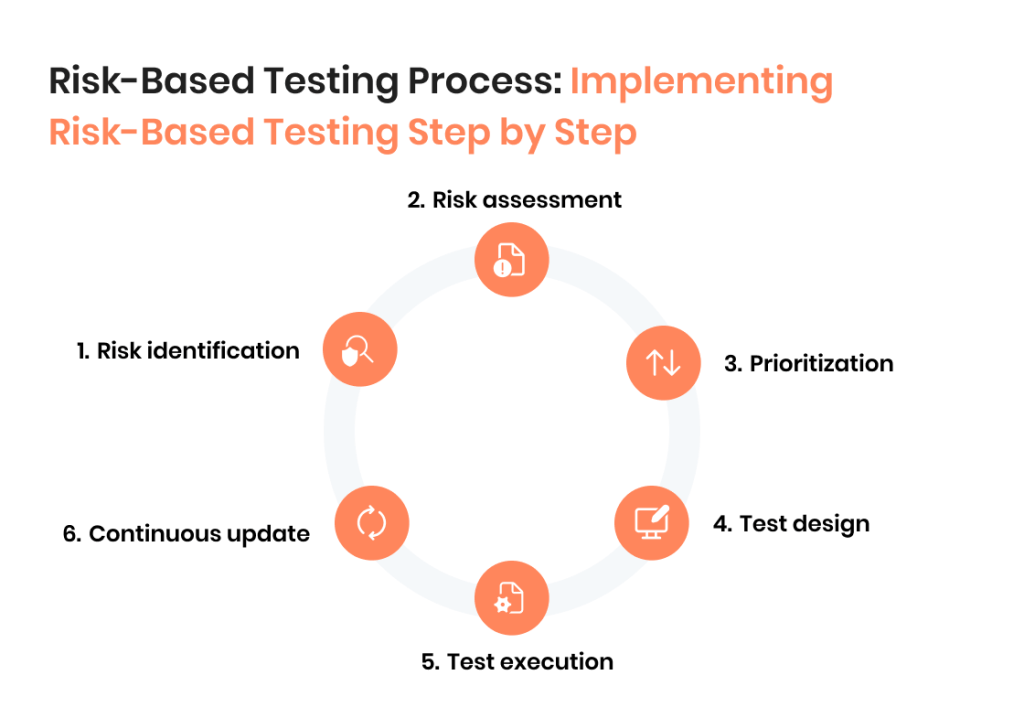
Risk-Based Testing Process: Implementing Risk-Based Testing Step by Step
A risk-based testing process gives teams a way to turn vague worries into concrete testing decisions. You’re not trying to test everything to the same depth. You’re letting the level of risk decide what gets attention and how much. Here’s how risk-based software testing usually works in practice.
Step 1: Identify risks
Start with risk identification: what can fail, where, and with what consequences.
Useful inputs include:
Past defects and incidents
Complex workflows and integrations
Revenue-critical or compliance-sensitive features
Stakeholder concerns
Recent software changes
This step should capture both business and technical risk.
Step 2: Perform risk assessment
Risk assessment involves identifying the likelihood and impact for each potential risk.
A simple model is usually enough:
Low likelihood × high impact
High likelihood × low impact
High likelihood × high impact
This creates a risk rating and helps teams compare risk exposure across features without overcomplicating the test process.
Step 3: Prioritize testing efforts based on risk
Once risk levels are defined, teams can prioritize testing efforts based on business value and risk exposure.
High-risk areas get deeper testing first. Lower-risk areas still stay in scope, but with lighter coverage. This is the core of risk-based prioritization.
Step 4: Design test cases
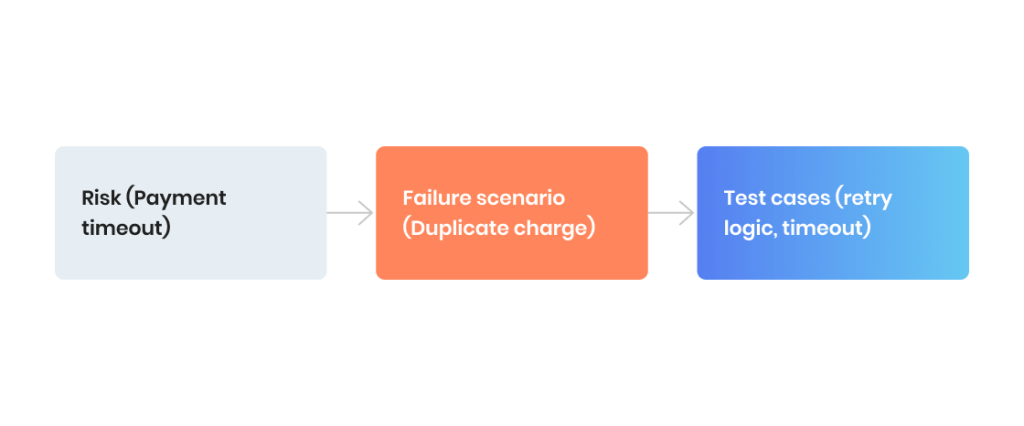
The next step is to turn risks into concrete test cases based on named failure scenarios.
For example:
Payment gateway timeout causes duplicate charges
Weak session handling exposes user data
Inventory sync failure allows overselling
This is where risk-based testing techniques become practical.
According to industry leaders, teams are usually good at listing risks. The gap appears later, when those risks need to be turned into concrete test cases. If that step is weak, the entire approach stays theoretical.
Step 5: Allocate test effort
Testing efforts based on risk should differ by feature, flow, and component.
That may mean:
Comprehensive test coverage for high-risk workflows
Targeted checks for medium-risk features
Smoke testing for low-risk areas
Low risk does not mean no testing. It means testing effort is scaled based on the risk.
Risk level
Testing depth
Testing methods
Example
High
Deep, comprehensive testing
End-to-end, performance, security
Payment processing
Medium
Targeted testing
Integration, functional testing
User profile update
Low
Light testing
Smoke, basic validation
UI customization
Step 6: Pair with your automation testing strategy
High-risk and repetitive test cases are strong candidates for test automation.
Examples include:
Regression checks for critical payment flows
API validation for sensitive endpoints
Performance testing for high-load scenarios
When used well, automation testing supports faster test execution without reducing focus on significant risk.
Step 7: Continuously update risks
Risk is not fixed. In agile and DevOps environments, new releases, integrations, regulations, and incidents can quickly change the level of risk associated with a feature.
That is why implementing risk-based testing requires continuous risk review throughout the testing cycle. Without it, testing efforts based on risk become outdated.
How to build risk-based testing into your QA process?
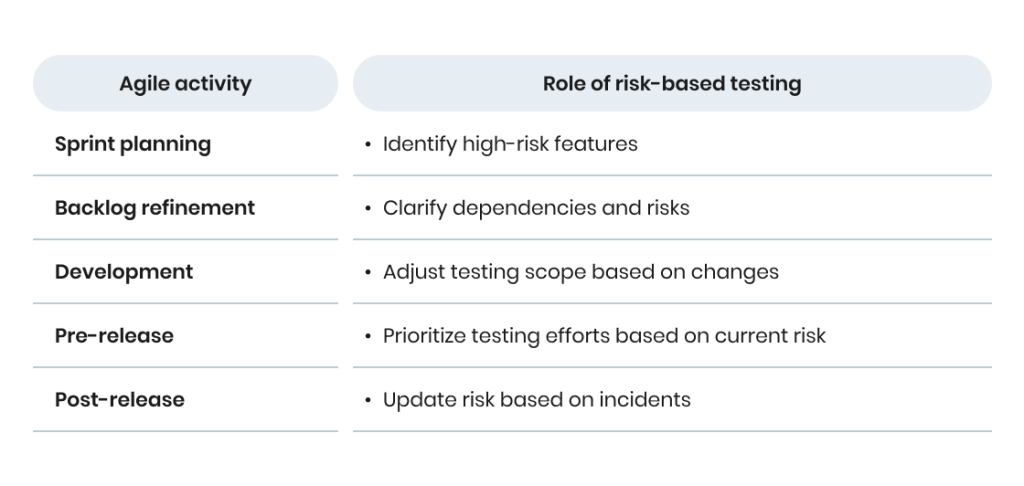
In agile environments, risk-based testing looks different from what it does on a traditional project. There’s no big test plan locked in at the start. Development and testing move forward together, and the real work is making quick decisions as you go — teams reassess risk sprint by sprint and adjust their effort to match.
In agile and DevOps setups, that ends up tightly incorporated into the everyday rhythm. Sprint planning is where you flag the high-risk features. Backlog refinement is where you dig into risk factors and dependencies. And right before a release, you adjust your testing effort against whatever the risk map looks like at that moment. That flexibility is exactly why risk-based testing fits agile so well: priorities and scope keep moving, and the approach moves with them.
The idea shared by many QA leaders is that risk-based testing doesn’t actually reduce the amount of work. It changes when that work happens. More effort goes into deciding priorities, which makes execution faster and far more focused.
How risk-based testing works in a real team
In practice, risk assessment is rarely done by QA alone. The most effective approach is cross-functional:
QA highlights testing risks and gaps
Developers identify technical constraints and failure points
Product owners define business impact and priorities
These discussions often happen quickly, but they are critical. Differences in how team members assess risk usually indicate hidden complexity or incomplete understanding.
The point that often comes up in discussions is that teams often assume risk-based testing speeds up the testing cycle. In reality, it shifts effort earlier — more time is spent on prioritizing testing efforts, but test execution becomes faster and more focused.
Working in agile means risk must be reassessed continuously. As new features are added or changed, the level of risk associated with different components evolves, and testing efforts should adapt accordingly.
Risk-Based Testing Examples by Industry
Risk-based testing makes the most sense once you see it applied to a real situation. What counts as high-risk can change a lot depending on what you’re building — a bug that’s nothing more than a minor annoyance in one industry can be a serious problem in another. The examples below show how teams point their testing effort at different risks depending on the field they work in.
Experience shows that many failures don’t come from the gateway itself, but from retry logic and state handling between services — a key risk factor that is often underestimated.
Fintech and banking systems
Risk identified:
Weak authentication enables unauthorized fund transfers
Testing approach:
MFA and session/token validation
API security testing for exposed endpoints
Rate limiting and DDoS simulation
Transaction integrity checks
Outcome:
Reduced fraud risk
Improved compliance readiness
Lesson learned
Security risks are usually known, but controls like rate limiting are often deprioritized until incidents expose the risk.
Healthcare SaaS & HIPAA-compliant systems
Risk identified:
Misconfigured access allows unauthorized EHR access
In healthcare software, compliance is not a separate concern — it is a primary driver of risk-based prioritization.
HR management systems
Risk identified:
Incorrect payroll calculation due to edge-case input handling
Testing approach:
Boundary testing for salary, tax, and benefits logic
Validation of different employment types and contracts
Regression testing for payroll cycles
Integration testing with accounting systems
Outcome:
Accurate payroll processing
Reduced financial and legal risk
Lesson learned
Payroll issues often stem from edge cases, not standard flows — making them a high-impact but sometimes overlooked risk.
AI-powered applications
Risk identified:
AI model generates incorrect or misleading outputs
Testing approach:
Prompt-based testing across edge cases
Validation against trusted datasets
Monitoring hallucination rates and bias
Fallback and guardrail testing
Outcome:
Improved output reliability
Reduced reputational and legal risk
Lesson learned
Unlike traditional software, risk in AI systems is probabilistic, which makes continuous testing and monitoring essential.
Risk-Based Testing Techniques and Tools
Risk-based testing does not work on instinct alone. Once you’re deciding where risk actually lives and how much of it you can live with, you need a reliable way to locate the risks, weigh them against each other, and then aim your testing where it counts. That’s where the right techniques and tools come in. The ones below help teams find risk, assess it, and act on it without creating more tests for the sake of it.
Risk-based testing techniques
Several techniques help structure testing efforts based on risk:
Risk matrix. Visualizes risk levels based on likelihood and impact to guide prioritizing testing efforts.
All-pairs testing. Reduces the number of test cases while still covering critical combinations in high-risk areas.
Boundary-value testing. Targets edge conditions where failures are most likely to occur.
State-transition testing. Validates how systems behave across different states, especially in complex workflows.
Threat modeling. Identifies security-related risk early, especially in fintech or compliance-heavy software.
These risk-based testing techniques help testing teams focus on scenarios with the highest potential risk rather than relying on exhaustive testing.
Tools that support risk-based testing
Risk-based testing does not require specialized software, but the right tools make the test process more effective:
Test management tools(Jira, TestRail). Help organize test cases based on risk and track testing efforts
Test automation tools(Playwright). Useful for automating high-risk, repetitive test cases
Performance testing tools(JMeter). Simulate load and identify performance-related risk
Monitoring and analytics tools. Provide insights from production to inform continuous risk evaluation
Speaking from our experience at TestFort, tools do not define the testing strategy — they support it. The effectiveness of risk-based testing depends more on how well risks are identified and prioritized than on the tools themselves.
Common Mistakes in Risk-Based Testing
Even when teams adopt a risk-based testing approach, common mistakes can reduce its effectiveness and weaken the overall testing strategy. These are the mistakes a software testing team needs to be aware of:
Overcomplicating risk assessment. Using overly detailed scoring models slows down the test process without improving decisions. A simple risk rating is usually enough to guide testing efforts.
Treating risk-based testing as documentation. Risk assessment becomes a formality instead of a decision-making tool. If it does not influence test cases or testing efforts, it adds little value.
Ignoring business input. Technical teams often define risk in isolation, missing business-critical scenarios. This leads to gaps in software quality where impact is highest.
Not updating risk over time. Risk is dynamic. Failing to reassess risk during the testing cycle leads to outdated priorities and misaligned testing efforts.
Assuming low risk means no testing. Low risk does not eliminate the need for testing. It means applying lighter testing methods, such as smoke or basic validation.
No connection between risk and test cases. Identifying risk is not enough. If risks are not translated into concrete test cases, the testing approach remains theoretical.
Over-reliance on intuition. Decisions based only on experience, without documented risk assessment, are harder to justify and maintain across teams.
An idea that some may find controversial is that risk assessment often looks solid on paper, but if it doesn’t change what gets tested or how deeply, it’s not influencing the testing strategy in any meaningful way.
Words by
Michael Tomara, QA Lead, TestFort
“Risk assessment, per se, is a method, not the goal. The goal is to build a proper QA process and help the product team reach an acceptable level of quality of the product. The QA team uses risk assessment to achieve this goal in certain situations.”
How Risk-Based Testing Is Implemented at TestFort
At TestFort, we don’t treat risk-based testing as a separate box to tick. It runs through the whole test process as a core principle, shaping how we work from early discovery all the way to test execution and the decisions we make at release. Here is how we approach risk-based testing on real projects.
Shared responsibility from the start
We treat risk identification as a cross-functional activity, not a QA-only task.
QAs bring a testing perspective and failure scenarios
Developers highlight architectural and integration risks
Product owners define business impact
Business analysts add context around requirements and change
This approach helps surface risks earlier and makes prioritizing testing efforts more grounded in reality. Our team has also found that the most valuable insights often come from conflicting perspectives, not agreement.
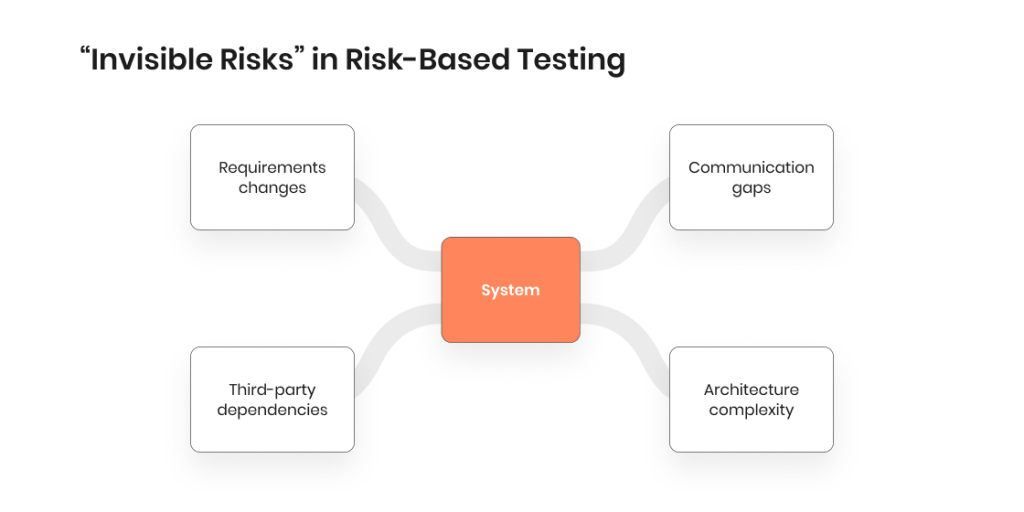
Looking beyond obvious risks
We deliberately expand the scope of risk identification beyond technical issues.
Alongside system-level risks, we also consider:
Changing or unclear requirements
Third-party dependencies
Communication gaps between teams
These seemingly invisible risks often have a direct impact on delivery and software quality, even if they are not tied to a specific component.
Separating risk identification from mitigation
One of the key principles we follow is keeping risk identification and risk mitigation separate.
First: list everything that could go wrong (without filtering)
This prevents early bias and ensures that risk evaluation remains objective before decisions are made.
Translating risk into test cases and testing efforts
Risk-based testing only works if risks directly influence test cases and testing efforts.
When applied to the actual testing process, this means:
Defining test cases based on specific failure scenarios
Prioritizing testing efforts based on business impact
Focusing on high-risk areas with deeper coverage
Applying lighter testing methods where risk is lower
What our team learned from this is that coverage alone does not improve software quality — what matters is how well testing efforts match actual risk.
Many teams aim for maximum coverage because it feels safer. In practice, that approach spreads testing efforts too thin. What works better is being selective — focusing on scenarios where failure has a clear business impact and accepting lighter coverage elsewhere.
Continuous risk review throughout the testing cycle
Risk management is not a one-time step. We treat it as a continuous activity across the testing cycle.
We update our risk assessment:
During each iteration
After incidents or defects
When new integrations or changes are introduced
This allows the testing team to adjust priorities and keep testing efforts based on current risk levels. In real projects, time and budget are always limited. Risk-based testing helps make trade-offs visible and intentional.
Instead of trying to cover everything, we:
Prioritize testing efforts based on risk exposure
Focus on business-critical scenarios first
Accept lighter coverage where the level of risk is lower
The goal here is not to eliminate all risk — it is to make sure the remaining risk is understood, controlled, and acceptable.
Let’s give your product a quality boost that propels it to success
Final Thoughts: When Is Risk-Based Testing the Right Choice?
Risk-based testing is often described as a way to prioritize testing. Unfortunately, that undersells it. What it really does is push teams to make their decisions about risk out in the open instead of letting those decisions happen by default and hoping for the best.
Every product already carries risk. The only question is whether you understand that risk and manage it, or leave it to chance. Testing everything shouldn’t be prioritized over testing what matters, and that’s exactly why risk-based testing is the approach to choose right now.
FAQ
What types of risk matter most in software testing?
Business, technical, compliance, and user risks all matter. The priority depends on context, but anything with high impact on revenue, security, or user experience should guide the testing strategy.
How do you prioritize testing efforts based on risk?
Start with risk assessment: evaluate likelihood and impact, assign risk levels, then map them to testing depth. High-risk areas get deeper test cases and earlier test execution, while low-risk areas are covered with lighter checks.
Can risk-based testing replace regression testing?
No. Risk-based testing complements regression testing by helping prioritize what to retest first. It ensures critical areas are always covered, even when time or testing resources are limited.
Who should be involved in risk assessment?
Risk identification and assessment should be cross-functional. QA, developers, and product owners all contribute different perspectives, which leads to more accurate risk evaluation and better prioritizing testing efforts.
How often should risk be reassessed?
Risk should be reviewed continuously, not just once. Update it during each testing cycle, after incidents, or when introducing new features, integrations, or compliance requirements.
When does risk-based testing not work well?
It is less effective for very small or simple systems where risk is low and evenly distributed. In those cases, a simpler testing approach may be enough without formal prioritization.
Share:
Jump to section
Hand over your project to the pros.
Let’s talk about how we can give your project the push it needs to succeed!
Inna is a content writer with close to 10 years of experience in creating content for various local and international companies. She is passionate about all things information technology and enjoys making complex concepts easy to understand regardless of the readers tech background. In her free time, Inna loves baking, knitting, and taking long walks.
Michael has more than 10 years of experience in software testing and a strong technical background in e-commerce, telecom, and customer support projects. He excels in creating, reviewing and maintaining project documentation from requirements and functionality descriptions to test plans and checklists.









 What types of risk matter most in software testing?
 What types of risk matter most in software testing?
 Who should be involved in risk assessment?