Software testing has always been a vital component of building innovative, reliable products. However, in the past few years, it has emerged as the central part of how modern digital products evolve. As organizations release new software more frequently and user expectations continue to rise, QA teams are adapting their testing practices to ensure performance, resilience, and trust across increasingly complex systems.
Testing now refers not only to finding defects but also to validating customer experience and business outcomes throughout the software development lifecycle. As QA becomes more proactive and data-driven, new trends in software testing are emerging to help companies deliver high-quality software faster and maintain confidence in every release.
In this guide, we’ll explore the latest trends in software testing shaping 2026 and beyond.
Key Takeaways
Software testing is becoming more predictive, autonomous, and intelligence-driven thanks to rapid advances in AI and ML.
Test automation now extends far beyond UI scripts, supporting API testing, regression testing, and continuous security verification.
Testing is shifting earlier in the software development lifecycle to reduce risk and improve time to market.
AI-powered testing helps improve test coverage, identify hidden risks, and generate test cases at scale.
Security testing is embedded into DevSecOps pipelines to continuously protect systems from evolving cyber threats.
New testing methods are required for IoT devices, edge computing workloads, and cyber-physical systems operating in real-world environments.
Accessibility testing and usability validation are essential to ensure inclusive and consistent digital experiences.
Quality engineering practices connect testing efforts with business outcomes, customer trust, and operational resilience.
What the Data Says
To better understand the latest testing trends and form your own approach to software QA, it helps to look at where the industry is investing. Multiple research reports confirm a strong pattern toward automation, continuous security, and AI in testing. Let’s explore the latest software testing developments and what they look like in numbers:
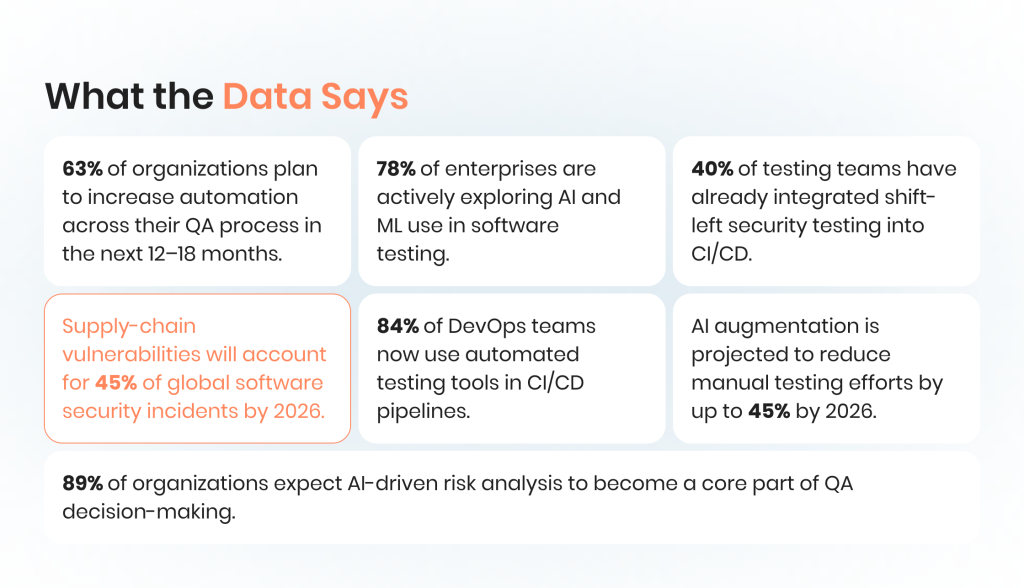
63% of organizations plan to increase automation across their QA process in the next 12–18 months.
78% of enterprises are actively exploring AI and ML use in software testing.
40% of testing teams have already integrated shift-left security testing into CI/CD.
Supply-chain vulnerabilities will account for 45% of global software security incidents by 2026.
84% of DevOps teams now use automated testing tools in CI/CD pipelines.
AI augmentation is projected to reduce manual testing efforts by up to 45% by 2026.
89% of organizations expect AI-driven risk analysis to become a core part of QA decision-making.
Together, these insights confirm a rapid shift toward AI-powered testing, continuous validation, and quality engineering that connects software testing trends to business resilience and reduced time to market.
AI in Software Testing: From Automation to Autonomy
Words by
Maxim Khimiy, AQA Lead, TestFort
“AI is now not just for automation — utilizing AI tools has become a necessary, highly valued skill for both manual and automated QA engineers.”
AI in software testing is no longer limited to simple automation scripts. Testing is evolving as AI enhances intelligence and autonomy across:
Test generation and execution
Test migration between technologies
Maintenance and self-healing behavior
Analysis of risks and user flows
Decision-making about where to test and when
This shift reflects a major testing trend: automation becomes more predictive, adaptive, and aligned with business outcomes.
AI agents become the new QA team members
AI agents are now able to generate test cases from requirements, analyze code changes, and prioritize which test scenarios to run first. They detect patterns in test data and user behavior to improve testing efficiency without manual intervention. This movement turns automated test execution into true autonomy, reducing repetitive tasks for QA teams.
Generative AI improves testing efficiency at every stage
Generative AI tools like ChatGPT help testers generate test cases, design test strategies, and review requirements faster. AI algorithms also support regression testing by identifying the riskiest areas after each build, speeding up verification before software releases. These AI tools help development and testing operate earlier in the software development lifecycle, enabling shift-left testing and accelerating time to market.
Words by
Igor Kovalenko, QA Lead, TestFort
“Generative AI helps reduce routine work for QA Engineers and allows them more time to work on edge cases and QA improvements.”
Self-healing test automation as the new baseline
One of the most impactful emerging trends is automation testing that automatically adapts to UI or API changes. Instead of breaking when elements move or labels change, AI-powered testing solutions adjust locators and maintain stability. This reduces the cost of test maintenance and keeps the testing process aligned with new software updates.
Predictive test strategies powered by analytics
AI in software testing helps teams optimize test execution by predicting failure-prone areas, recommending better testing methodologies, and preventing bottlenecks before they occur. Continuous testing becomes smarter when AI prioritizes tests based on risk and business impact, helping organizations make better decisions about quality engineering and software development.
Testing AI models for safety and reliability
Words by
Maxim Khimiy, AQA Lead, TestFort
“Using AI blindly does not add value, while using AI in a proper context and with some degree of oversight and validation helps teams get more value out of it.”
As more software applications incorporate AI models, QA must validate how AI behaves in the real world. AI testing focuses not only on accuracy but also on reliability, transparency, risk, and fairness. This is crucial because generative AI and autonomous systems can behave unpredictably when exposed to new data or environments.
Key risks QA teams must evaluate include:
Hallucinations and incorrect responses that could mislead users
Bias in decision-making, especially in finance, hiring, and healthcare
Model drift due to changing data over time
Low explainability that makes root cause analysis harder
Security vulnerabilities, such as prompt injection attacks
Words by
Igor Kovalenko, QA Lead, TestFort
“In my opinion, a good approach to getting more out of AI is to work collaboratively with it. Give clear prompts to AI, validate the output, and focus on more creative things to improve processes.”
To support effective testing, organizations are adopting new testing methods specifically for AI systems. An AI quality validation checklist for 2026 can look like this:
Validate outputs using reference datasets and domain heuristics
Test generalization across new inputs and adversarial scenarios
Assess transparency, logging, and decision traceability
Continuously monitor degradation and retrain when needed
Ensure compliance with ethical and regulatory frameworks
Words by
Maxim Khimiy, AQA Lead, TestFort
“As AI becomes more integrated into software, QA’s role goes beyond just detecting errors. Continuous testing and monitoring are crucial to prevent harm or bias, making QA essential both during development and post-deployment to keep AI safe and effective.”
Moreover, testing efforts must continue after deployment. AI behavior evolves, and testing ensures models remain safe and aligned with policy requirements throughout the software development life cycle. This evolution pushes QA into governance and risk mitigation roles, making AI in testing one of the most impactful emerging trends.
Cutting testing time by 80% using AI: QA for creative console systems
Security Testing Moves Left and Becomes Continuous
Security testing is becoming fully embedded into development workflows as applications face constantly evolving cyber threats. Testing to ensure protection is no longer a final stage activity, but a continuous quality requirement throughout the software development life cycle. This shift-left testing approach reduces vulnerabilities earlier in development and improves overall software quality before deployment.
Zero-trust validation and secure-by-design architectures
Modern systems operate across distributed cloud environments, where identity, access control, and encryption must be validated automatically. QA teams increasingly adopt zero trust principles, verifying every connection regardless of source or network perimeter. Automated test enforcement of these rules keeps security aligned with frequent releases and complex infrastructure changes.
This involves automated validation of:
Identity and access policies
Encryption enforcement and key rotation
Network segmentation and traffic inspection
Real-time anomaly detection
SBOM monitoring & supply-chain risk scanning
The continued expansion of the software supply chain means organizations must track components, open-source libraries, and third-party packages in every build. Continuous monitoring with a Software Bill of Materials (SBOM) helps detect tampering, outdated dependencies, or known vulnerabilities. Automated compliance testing tools integrate scanning into pipelines to reduce risk without slowing software development.
AI and ML enhance vulnerability detection speed
AI-powered testing tools use pattern recognition and anomaly detection to identify threats that manual testing might miss. These AI tools evaluate code changes, assess attack surfaces, and assist in faster prioritization during remediation. AI in software testing accelerates analysis while reducing false positives in security testing results, generating opportunities to improve testing efficiency.
Privacy and compliance automation
Industries such as healthcare, finance, and insurance rely on strict data governance. Automation tools now verify compliance requirements continuously, supporting real-time enforcement of GDPR, HIPAA, PCI DSS, and region-specific policies. Automated test frameworks help reduce audit complexity and ensure testing without exposing sensitive data during performance testing or functional testing.
Security testing also becomes part of quality engineering
Security is no longer a separate discipline managed only by security engineers. QA teams build security checkpoints directly into the testing process, using standardized test strategies to prevent vulnerabilities, not just detect them. This integration helps teams protect customer trust and maintain confidence in new software as development and testing accelerate.
Words by
Michael Tomara, QA Lead, TestFort
“There is a new aspect of data security that is becoming increasingly important with the growth of AI usage. As mentioned above, AI adoption is one of the main trends in today’s QA. In order to analyze requirements, generate test scenarios and find edge cases, AI needs access to product documentation, its code and other sensitive information. QAs need to be aware of this and take the risks of data leakage into account – for instance, when working with cloud-based AI tools.”
Testing Real-World Systems: Edge, IoT, and Cyber-Physical
More software is now embedded inside physical products, from wearables and smart appliances to industrial robots, drones, and connected vehicles. Testing is becoming more complex as software interacts with sensors, hardware, and unpredictable real-world environments. These emerging trends require new testing methods that validate performance, reliability, and safety outside of controlled lab conditions.
Testing on the edge: 5G and low-latency load testing
Applications running at the edge must operate with minimal latency, intermittent connectivity, and limited resources. Testing efforts expand beyond cloud testing to verify behavior under high demand and distributed loads. This introduces:
Load testing for 5G networks and low-latency streaming
API testing across heterogeneous devices
Monitoring real-time performance at the network edge
Testing becomes a continuous process that adapts to dynamic infrastructure changes.
Words by
Maxim Khimiy, AQA Lead, TestFort
“Testing these real-world systems also requires QA teams to think like systems engineers, anticipating how software, hardware, and environmental forces interact under stress.”
Cyber-physical systems introduce risk-based test scenarios
As software controls movement, navigation, and safety-critical functions, test scenarios must account for environmental variables and physical constraints. Functional testing and regression testing extend into unpredictable conditions such as:
Sensor malfunctions
Weather variability
Localization inaccuracies
Hardware component degradation
Effective testing helps prevent failures in autonomous vehicles, drones, and robotics, where reliability is essential.
Interoperability and industrial integration testing
IoT ecosystems combine devices from different manufacturers using varied protocols, data formats, and connectivity standards. IoT testing methodologies must ensure that software applications and hardware can communicate reliably, recover gracefully after network disruptions, and maintain data integrity at scale. Interoperability testing also verifies compatibility throughout the software development life cycle, helping reduce fragmentation and ensuring that devices continue to function correctly as environments evolve.
Words by
Michael Tomara, QA Lead, TestFort
“API testing is a central element of the IoT industry. While it is often difficult for a QA team to test an IoT solution that can be connected to many different smart devices, it’s vital to at least validate the endpoints used to connect those devices. “
UX & Accessibility Evolve with New Interfaces
As software interfaces move beyond keyboards and touchscreens, QA must validate experiences that rely on voice, gestures, biometrics, and augmented reality. Testing becomes more holistic: it must cover usability, sensory accessibility, and consistent functionality across devices and environments. This evolution reinforces that testing practices directly influence user satisfaction and brand perception.
Voice assistants, smart displays, and AR applications require functional testing that accounts for recognition accuracy, environmental noise, and visual alignment. Test scenarios expand to include context-awareness and differing physical conditions. Ensuring the same interaction quality on phones, wearables, and headsets pushes testing methodologies toward unified experience validation.
Accessibility testing is essential for every release
Testing to ensure equal access is no longer optional and extends beyond compliance checklists. Modern accessibility testing focuses on adaptive design, assistive technology compatibility, and removing friction points that affect users with diverse needs. Automated tests help identify issues quickly, while manual testing remains critical for validating real user experiences.
Let’s Turn Complexity Into Progress
Deliver reliable software faster with our testing expertise.
Measuring experience becomes part of the QA process
Performance testing now includes factors like responsiveness, visual stability, and perceived speed. Testing without understanding how users feel during interactions can result in software applications that technically work but still fail to meet expectations. Quality engineering integrates user-centric measurements such as:
Task completion and navigation clarity
Error recovery paths and guidance
Responsiveness under dynamic conditions
This approach strengthens software quality across the entire software development life cycle.
Regulations and industry standards shape testing strategies
Compliance frameworks like WCAG guide development and testing with clear criteria for accessible layouts, color contrast, keyboard navigation, and screen reader support. QA teams adopt automation tools to scan for violations continuously, while validating that remediation steps improve real-world usability.
Quality Meets Responsibility and Sustainability
As digital systems become more embedded in everyday life, software testing trends increasingly focus on trust, environmental impact, and responsible AI adoption. Testing becomes not only a technical discipline, but also a way to ensure that software applications behave safely, ethically, and sustainably throughout the software development life cycle.
Environmental impact influences performance and architecture decisions
Modern cloud architectures can drive up energy consumption when services scale. Testing is becoming more aware of resource usage, with QA evaluating:
Energy efficiency under varying loads
Resource overhead related to automation tools and AI testing
Carbon impact in distributed environments
This shift helps optimize test automation and performance testing to support greener software development.
AI-enabled products rely on AI models that evolve as new data arrives. QA and development teams must validate fairness, transparency, and consistency to prevent bias or harmful behavior. Testing refers to more than output accuracy — it must confirm that decisions remain explainable, repeatable, and aligned with user expectations. These testing efforts protect confidence in automation across industries adopting AI in software.
Compliance drives transparency and accountability
Organizations must guarantee that data use stays compliant, especially when automated systems process sensitive information. New testing methodologies and automation testing techniques are designed to verify governance requirements continuously:
Responsible use of test data
Protection of personal information during testing activities
Traceability from requirements to validation results
Testing becomes a central contributor to risk management — not a final checkpoint.
Let’s make your testing process faster, smarter, and more predictable with our QA consulting services.
As testing evolves towards autonomy, continuous security validation, and real-world reliability, QA leaders must adapt organizational capabilities, not just tools. Improving testing efficiency requires planning for collaboration, skill evolution, and the right automation investments throughout the software development life cycle.
Words by
Igor Kovalenko, QA Lead, TestFort
“Preparing for software testing means constantly updating your knowledge. Trends change frequently, and we must always keep up with them. If we don’t constantly learn something new, we will soon find that we are lagging behind.”
Invest in AI-powered testing and automation at scale
Automation testing is moving into a new stage where AI tools generate test cases, assist with execution, and reduce maintenance. Leaders should:
Evaluate where AI can remove bottlenecks in existing testing processes
Introduce automation tools that support self-healing and analytics-driven prioritization
Expand test automation beyond UI into API testing, compliance, and performance testing
This shift frees QA teams to focus on strategic risk and continuous quality improvement.
Words by
Maxim Khimiy, AQA Lead, TestFort
“One of the crucial tasks for testing in 2026 is to invest into getting development and QA teams up to speed on AI tools and their usage for daily work activities.”
Strengthen security by design with continuous validation
Security testing must run earlier in the software development process and across every release pipeline. To support this:
Integrate SBOM tracking and automated vulnerability scanning
Adopt testing methodologies aligned with zero-trust requirements
Use AI-powered testing to surface critical weaknesses faster
Build domain expertise into development and testing workflows
As industries adopt advanced digital products, QA teams must understand domain-specific risks such as healthcare compliance, financial reporting, or IoT interoperability. Upskilling ensures testing to ensure business outcomes, not just functional correctness.
Evolve team structures for smarter collaboration
Testing is becoming more collaborative across development and testing roles. Leaders should:
Encourage joint ownership of quality between dev, QA, and security
Support visibility into test coverage, risk, and software releases
Embrace shift-left practices that reduce handoffs and inefficiencies
With clarity and shared metrics, organizations deliver new software more confidently.inseparable from quality engineering an
Measure success beyond defect counts
Testing practices increasingly evaluate value, not just error prevention. Leadership metrics now include:
Time to market improvements
Reduction in critical incidents in production
User experience satisfaction scores
Evidence of continuous testing maturity
These indicators help decision makers track trends in software testing that align directly with business goals.
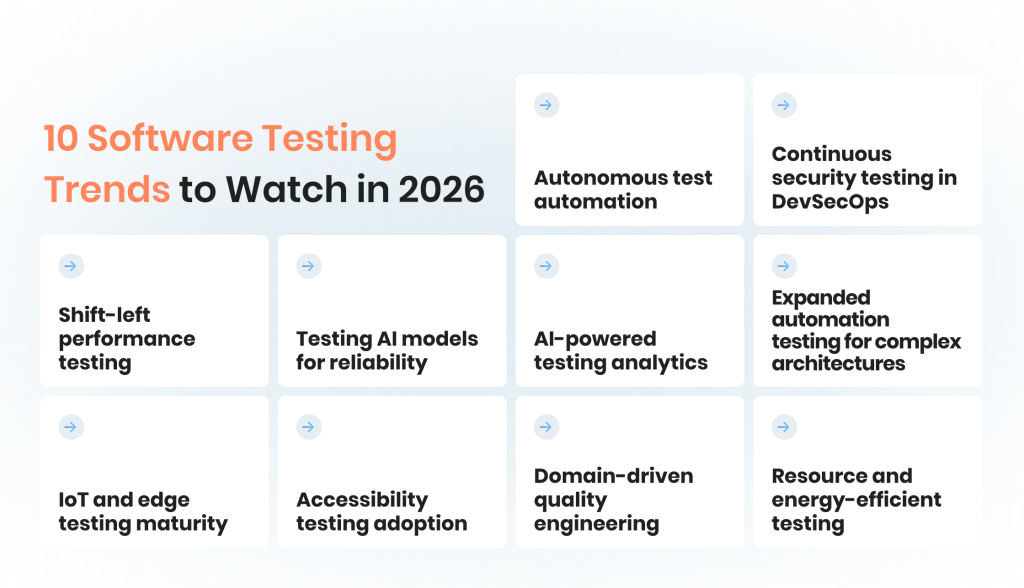
Summing Up: 10 Software Testing Trends to Watch in 2026
So, what can we expect in the near future of software testing, and which software QA trends will have the biggest impact on the industry a year from now? These top software testing trends highlight how testing is becoming smarter, faster, and more adaptive.
1. Autonomous test automation
AI agents generate test cases, monitor systems, and optimize execution without manual intervention.
2. Continuous security testing in DevSecOps
Zero-trust validation, SBOM monitoring, and AI threat detection are being built directly into pipelines.
3. Shift-left performance testing
Performance and load testing move earlier in the software development life cycle to prevent late bottlenecks.
4. Testing AI models for reliability
Validating behavior, transparency, and safety as AI in software continues to expand.
5. AI-powered testing analytics
Risk-based prioritization and predictive insights for faster decision-making and improved test coverage.
6. Expanded automation testing for complex architectures
Cloud-native applications, APIs, microservices, and distributed systems require smarter automation tools.
7. IoT and edge testing maturity
More real-world reliability testing for connected devices and cyber-physical products.
8. Accessibility testing adoption
WCAG compliance and inclusive design become mandatory in testing methodologies.
9. Domain-driven quality engineering
Healthcare, fintech, and regulated sectors demand testing to ensure safety and compliance from day one.
10. Resource and energy-efficient testing
Optimizing infrastructure usage and carbon impact as testing scales across global environments.
These emerging trends support continuous testing and faster software releases while reducing risk and operational overhead.
From automation to AI-driven QA, we make software testing work for your business.
Software testing is becoming a strategic capability rather than a back-end function. As AI, automation, and continuous security reshape expectations throughout the software development life cycle, QA leaders must evolve both their testing efforts and the way quality engineering supports business outcomes. The emerging software testing trends outlined in this article show that testing is becoming faster, more intelligent, and more integrated with development and operations teams.
Yet one thing remains constant: testing ensures that users can trust digital products to perform safely and reliably. Organizations that embrace modern testing methods, invest in AI-powered testing practices, and build strong collaboration across development and testing will be best positioned to adapt to whatever comes next. The future of software testing is not just about tools — it’s about delivering human-centered, resilient, and responsible technology that moves businesses forward.
FAQ
What are the latest software testing trends in 2026?
The latest software testing trends include AI-powered testing, autonomous test execution, continuous security validation, and interoperability testing for cloud and edge systems. These innovation areas help improve testing efficiency and ensure high-quality software delivery.
How will AI improve the future of software testing?
AI and ML optimize testing cycles by helping teams generate test cases automatically, prioritize risks, and maintain stability through self-healing test automation. This reduces manual testing work and supports continuous testing throughout the software development lifecycle.
What skills will QA teams need going forward?
QA professionals will benefit from knowledge of AI testing tools, automation frameworks, API testing, cloud testing, and data-driven decision-making. Quality engineering skills that align testing efforts with business outcomes are increasingly valuable.
How does automation improve the testing process?
Test automation reduces repetitive work, speeds up regression testing, and expands test coverage for complex systems. Automation testing also supports faster software releases, earlier risk detection, and more effective testing activities in agile pipelines.
What testing methodologies are most effective for modern systems?
Shift-left testing, continuous testing, and risk-based testing methodologies are essential for modern architectures. These testing methods help organizations detect issues earlier in development and testing workflows while maintaining stability in production.
Share:
Jump to section
Hand over your project to the pros.
Let’s talk about how we can give your project the push it needs to succeed!
Inna is a content writer with close to 10 years of experience in creating content for various local and international companies. She is passionate about all things information technology and enjoys making complex concepts easy to understand regardless of the readers tech background. In her free time, Inna loves baking, knitting, and taking long walks.








 What are the latest software testing trends in 2026?
 What are the latest software testing trends in 2026?