The EU AI Act introduces comprehensive regulations for artificial intelligence systems, with particularly strict requirements for those classified as high-risk. As organizations rush to achieve compliance before enforcement deadlines, AI testing has emerged as the cornerstone of AI governance and regulatory readiness. Understanding the classification rules for high-risk AI and the obligations providers of high-risk AI systems face is essential for successful implementation of the AI Act.
What Is an AI System Under the EU AI Act?
The EU AI Act defines an AI system as “a machine-based system designed to operate with varying levels of autonomy and that may exhibit adaptiveness after deployment and that, for explicit or implicit objectives, infers, from the input it receives, how to generate outputs such as predictions, content, recommendations, or decisions that can influence physical or virtual environments.”
This broad definition captures everything from simple recommendation engines to complex general-purpose AI models. The key characteristics that qualify a system as AI include:
Machine-based operation with varying autonomy levels
Adaptiveness after deployment
Input-based inference generating predictions, content, recommendations, or decisions
Capability to influence physical or virtual environments
When determining whether an AI system falls under the regulation, the EU Artificial Intelligence Act considers that an AI system used in the EU must comply with specific requirements based on its risk classification. The classification of AI systems depends on their intended purpose and potential impact on fundamental rights, safety, and the environment.
Key Takeaways, TL;DR
The EU AI Act classifies AI systems into four risk levels: unacceptable (prohibited), high-risk (heavily regulated), limited (transparency required), and minimal (voluntary best practices).
High-risk AI systems are defined three ways. When the AI is itself a regulated product, when it’s a safety component of a regulated product, or when it falls into eight specific categories listed in Annex III.
Profiling triggers automatic high-risk classification. Any AI system that performs profiling of individuals is automatically considered high-risk, regardless of other factors.
Seven core requirements apply to high-risk systems: risk management, data governance, technical documentation, transparency, human oversight, accuracy/robustness, and cybersecurity.
Compliance follows a structured lifecycle. Pre-deployment testing, conformity assessment, EU database registration, post-market monitoring, and incident reporting are all required.
General-purpose AI models have distinct rules. Foundation model providers face transparency requirements, with stricter obligations for models presenting systemic risk.
Quality assurance is now a legal requirement. For high-risk AI systems, testing and documentation determine whether your product can legally operate in the EU.
Ensure Your AI Meets EU Standards Before Deployment
Talk to our testing experts to build a compliance roadmap tailored to your AI use case.
No mandatory obligations, voluntary best practices encouraged
Unacceptable risk
AI applications incompatible with EU values and fundamental rights are completely prohibited.
This includes systems for subliminal manipulation, exploitation of vulnerabilities, general-purpose social scoring, real-time remote biometric identification in public spaces (with limited law enforcement exceptions), workplace emotion recognition, predictive policing, and untargeted facial image scraping.
High-risk AI systems
These face the most extensive regulatory requirements and include safety components of already regulated products and stand-alone AI systems in eight specific areas.
High-risk systems can potentially cause significant harm if they fail or are misused, affecting health, safety, fundamental rights, or the environment.
Systems will be subject to conformity assessment and registration requirements before they can be placed on the market or put into service in the EU.
Limited risk
AI systems with manipulation or deceit potential must meet transparency requirements.
Users must be informed about AI interaction (unless obvious), and deepfakes must be clearly labeled. Chatbots and most generative AI systems fall into this category.
Minimal risk
All other AI systems, such as spam filters, have no mandatory restrictions but should follow general principles of human oversight, non-discrimination, and fairness.
Words by
Igor Kovalenko, QA Lead at TestFort
“The EU AI Act changes everything about AI testing. Quality assurance is no longer optional — it’s the foundation of regulatory compliance. Organizations need to prove their AI systems are safe, fair, and reliable before they can enter the EU market.”
General-Purpose AI Models and Systemic Risk
The EU AI Act provides specific rules for general-purpose AI models, recognizing that these systems present unique challenges. Providers of general-purpose AI models must meet transparency requirements, with stricter obligations for general-purpose AI models with systemic risk. AI models with systemic risk are those requiring significant computing power to train and that could pose systemic risks due to their reach and capabilities. These providers must conduct model evaluations, assess systemic risks, track serious incidents, and ensure adequate cybersecurity protection.
AI Testing That Delivers
See how TestFort helped a CI/CD platform reduce hallucinations by 60% and improve AI accuracy from 65% to 82%.
The EU AI Act provides clear rules for high-risk AI systems, establishing three pathways through which AI systems are classified as high-risk:
When the AI system is itself a certain type of product already subject to EU harmonization legislation requiring third-party conformity assessment (medical devices, toys, aircraft, vehicles)
When the AI system is a safety component of such products (AI used in rail infrastructure, lifts, industrial machinery)
When the AI system meets the description of systems listed in Annex III, covering eight critical application areas
AI systems listed in Annex III are always considered high-risk unless they meet specific exception criteria. However, certain AI systems that fall under these categories may not be considered high-risk if they don’t pose significant risk of harm to health, safety, or fundamental rights. The exception does not apply when an AI system performs profiling of individuals—such systems automatically become high-risk regardless of other factors.
The Eight High-Risk AI Categories
The list of AI systems classified as high-risk includes the following categories, with systems referred to in Annex III facing the strictest regulatory oversight:
Biometric identification and categorization Remote biometric identification systems (unless purely for identity verification), biometric categorization systems, and emotion recognition systems pose risks of biased results and discriminatory effects. AI systems intended to be used for biometric purposes must undergo rigorous testing to ensure they don’t violate fundamental rights or perpetuate discrimination.
Does your system process biometric data for identification purposes?
Is the system used for anything beyond simple identity verification?
Does it categorize individuals based on biometric characteristics?
Does it attempt to recognize or infer emotional states?
Is your AI system is intended for use in public spaces or sensitive environments?
Critical infrastructure management AI systems intended to be used as safety components in the management and operation of critical infrastructure, including digital infrastructure, road traffic, and utilities (water, gas, heating, electricity), are high-risk because their failure could endanger lives and disrupt social and economic activities. Using AI in these contexts requires extensive safety validation.
Is your AI system a safety component in infrastructure operations?
Could system failure disrupt essential services or endanger public safety?
Does it control or manage traffic, utilities, or digital infrastructure?
What safeguards exist for system malfunctions?
Education and vocational training Systems intended to be used for determining access to educational institutions, evaluating learning outcomes, assessing appropriate education levels, or monitoring for cheating can profoundly impact educational and professional trajectories. These AI systems may perpetuate discrimination if not properly designed and tested.
Does your system determine admission or access to educational institutions?
Does it evaluate student performance or learning outcomes?
Is it used to assess appropriate education levels for individuals?
Does it monitor student behavior or detect academic misconduct?
Could it affect students’ fundamental rights to education and non-discrimination?
Employment and worker management AI systems intended for recruitment, candidate evaluation, promotion decisions, task allocation, or performance monitoring affect livelihoods and workers’ rights, potentially perpetuating historical discrimination patterns. The use of AI in employment contexts requires careful consideration of fairness and transparency.
Is your system used in recruitment, candidate screening, or hiring decisions?
Does it evaluate employee performance or make promotion recommendations?
Does it allocate tasks or monitor worker behavior?
Could it influence employment terms, contracts, or termination decisions?
Does it collect or analyze data that could lead to discriminatory outcomes?
Access to essential services Systems intended to be used for evaluating eligibility for public benefits, healthcare, housing, creditworthiness, credit scoring, life and health insurance risk assessment, or emergency service prioritization significantly impact fundamental rights. These AI systems are classified as high-risk because they directly affect people’s access to essential services.
Does your system determine eligibility for public services or benefits?
Is it used for credit scoring or creditworthiness assessment?
Does it evaluate risk or pricing for life or health insurance?
Does it prioritize emergency service dispatch or response?
Could it deny individuals access to essential services?
Law enforcement AI systems intended to be used for assessing crime victim or offender risk, polygraph-like tools, evidence reliability evaluation, and criminal profiling are classified as high-risk due to their profound impact on justice and individual rights. Law enforcement agencies using AI must ensure systems don’t violate fundamental rights or produce biased outcomes.
Is your system used by law enforcement agencies?
Does it assess individuals’ risk of offending or victimization?
Does it evaluate evidence reliability in criminal proceedings?
Is it used for profiling individuals in criminal investigations?
Does it influence decisions about arrests, prosecutions, or sentencing?
Migration, asylum, and border control management Systems intended to be used for assessing security risks, examining asylum, visa, or residence permit applications, or detecting and identifying individuals at borders fall under high-risk classification. AI systems in asylum and border control management must be carefully tested to avoid discrimination and protect applicants’ rights.
Does your system assess security or health risks of individuals entering the EU?
Is it used to examine asylum, visa, or residence permit applications?
Does it detect, recognize, or identify individuals for border control purposes?
Could it affect individuals’ rights to seek asylum or family reunification?
Administration of justice and democratic processes AI systems intended to assist courts in researching facts and law, applying law to specific situations, or influencing election outcomes and voting behavior require stringent oversight. These systems directly impact democratic processes and judicial fairness.
Is your system used by courts or judicial authorities?
Does it assist in legal research, fact-finding, or law application?
Could it influence election outcomes or voting behavior?
Is it used to shape democratic processes beyond administrative logistics?
Does it impact individuals’ access to fair judicial proceedings?
Words by
Nora Laievska, Director of Partnerships & Growth at TestFort
“We’re seeing organizations treat EU AI Act compliance as a competitive advantage. Companies that demonstrate rigorous testing and validation of their AI systems gain significant trust with European clients, especially in regulated industries like fintech and healthtech.”
Important Exception: The Profiling Rule
Even if an AI system appears to meet criteria for exclusion from high-risk classification, it automatically becomes high-risk if an AI system performs profiling of individuals. This represents a critical threshold that organizations must carefully evaluate. AI systems that fall into the profiling category are considered to be high-risk regardless of other contextual factors, as profiling inherently affects fundamental rights.
Rules for High-Risk AI Systems: Compliance Requirements
High-risk AI systems must comply with extensive technical and organizational requirements before entering the EU market. Providers of high-risk AI systems bear primary responsibility for ensuring compliance, though deployers, importers, and distributors also face specific obligations. The EU AI Act takes effect with a phased implementation schedule, and all AI providers must understand their responsibilities.
Requirement Category
Key Elements
Testing Focus
Risk Management
Continuous identification, analysis, and mitigation of risks throughout lifecycle
Protection against unauthorized access and manipulation
Penetration testing, data poisoning resistance, access control validation
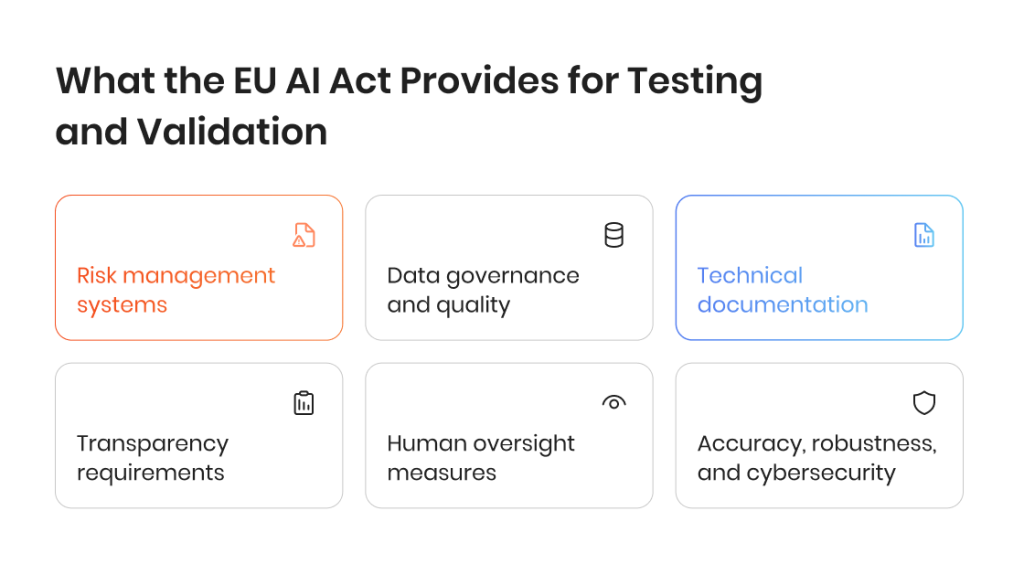
What the EU AI Act Provides for Testing and Validation
Upon the registration of high-risk AI systems in the EU database, providers must demonstrate that their systems have undergone comprehensive testing under real-world conditions outside AI regulatory sandboxes. Testing in real world conditions outside AI regulatory sandboxes provides crucial evidence of system performance and safety in actual deployment scenarios.
Risk management systems Continuous identification, analysis, estimation, and mitigation of risks throughout the AI system lifecycle. This includes testing for potential risks and implementing measures to reduce them to acceptable levels. High-risk AI systems referred to in Annex III must establish and maintain comprehensive risk management processes.
Data governance and quality Training, validation, and testing datasets must be relevant, representative, free of errors, and complete. Data quality directly impacts system accuracy and the potential for bias or discrimination. The classification rules for high-risk AI emphasize data quality as fundamental to compliance.
Technical documentation Comprehensive documentation proving compliance with EU AI Act requirements, including detailed information about the system’s development, capabilities, limitations, and performance characteristics. This documentation supports the registration of high-risk AI systems and enables regulatory oversight.
Transparency requirements High-risk AI systems must be designed to enable deployers to interpret outputs and use them appropriately. Users must be informed when interacting with AI systems, and the purpose of the use cases must be clearly communicated.
Human oversight measures Systems must be designed to allow effective human supervision, including the ability to intervene, override decisions, or stop the system when necessary. This ensures that fundamental rights are classified as high-risk considerations in system design.
Accuracy, robustness, and cybersecurity AI systems must achieve appropriate levels of accuracy and be resilient to errors, faults, inconsistencies, and attempts to manipulate the system or data. Testing must validate that systems perform reliably across diverse conditions.
Words by
Mykhailo Tomara, QA Lead
“Bias testing is now one of the most important parts of EU AI Act compliance. AI systems that work well in testing can show discriminatory patterns with real users. The regulation requires us to check not just if the system works, but if it works fairly for everyone.”
How to Test High-Risk AI Systems Under the EU AI Act
Effective testing strategies for EU AI Act compliance require comprehensive approaches addressing multiple dimensions. Understanding which AI systems are considered high-risk and what testing procedures apply is essential for successful implementation of the AI Act.
Functional Testing
Verify that the AI system performs its intended functions correctly across diverse scenarios and edge cases. This includes testing outputs against expected results and validating that the system behaves predictably under various conditions. For systems intended to be used in critical applications, functional testing must cover all specified use cases.
Bias and Fairness Testing
Evaluate the AI system for discriminatory outcomes across different demographic groups. Testing must identify potential bias in training data, model outputs, and real-world applications to ensure compliance with non-discrimination requirements. This is particularly critical for AI systems not falling under minimal risk categories, as they directly affect fundamental rights.
Data Quality Validation
Assess training, validation, and testing datasets for relevance, representativeness, accuracy, and completeness. Data quality testing identifies gaps, errors, or biases that could compromise system performance or fairness. AI systems classified as high-risk require especially rigorous data validation.
Robustness and Stress Testing
Challenge the AI system with adversarial inputs, edge cases, and unusual scenarios to evaluate resilience. Robustness testing reveals vulnerabilities that could lead to system failures or manipulation. Systems may exhibit unexpected behaviors under stress that don’t appear during normal operation.
Security Testing
Assess the AI system’s resilience to cybersecurity threats, including attempts to manipulate inputs, poison training data, or extract sensitive information. Security testing is particularly critical for systems handling personal or sensitive data, especially in contexts like asylum and border control management.
Transparency and Explainability Testing
Evaluate whether the system provides interpretable outputs and sufficient information for human oversight. Testing must verify that users can understand how the system reached its conclusions. This addresses the transparency requirements that certain AI systems must meet.
Performance Monitoring
Establish baseline performance metrics and continuously monitor system behavior after deployment. Performance testing identifies degradation over time or unexpected behavior in production environments, ensuring ongoing compliance as the EU AI Act enters full enforcement.
Compliance Documentation Testing
Verify that technical documentation accurately reflects the system’s capabilities, limitations, and testing results. Documentation testing ensures that compliance evidence is complete and verifiable for regulatory review.
Ready to Test Your High-Risk AI System?
Contact us for a consultation on AI testing strategies and compliance validation.
Organizations developing or deploying high-risk AI systems should implement structured testing procedures aligned with when the EU AI Act takes effect:
Testing Phase
Activities
Timeline
Deliverables
Pre-deployment
Comprehensive evaluation across all testing dimensions
Before market entry
Test reports, compliance evidence, risk assessments
Conformity Assessment
Third-party or internal assessment with notified body
Incident reports, root cause analysis, corrective measures
Pre-deployment testing Comprehensive evaluation before the system enters production, including all testing dimensions mentioned above. Pre-deployment testing provides the foundation for conformity assessment and demonstrates that AI systems listed in Annex III meet regulatory requirements.
Conformity assessment High-risk AI systems must undergo third-party conformity assessment or internal assessment with notified body involvement, depending on the system type. Testing evidence supports this assessment. AI systems as high-risk products cannot be placed on the market without successful conformity assessment.
70% Fewer Defects, 20% CTR Recovery
Discover how comprehensive AI model testing restored performance for an eCommerce recommendation engine.
Registration requirements Providers must register high-risk AI systems in the EU database, including information about testing procedures and results (except for law enforcement systems, which have non-public registration). The registration of high-risk AI systems creates transparency and enables regulatory oversight.
Post-market monitoring Continuous monitoring and periodic testing after deployment to identify issues arising from real-world use. Post-market surveillance catches problems that weren’t apparent during pre-deployment testing. AI systems that fall under high-risk classification require ongoing monitoring throughout their lifecycle.
Incident reporting Serious incidents or malfunctions must be reported to market surveillance authorities. Robust testing procedures help organizations quickly identify and address incidents, maintaining compliance and protecting users.
Record-keeping Automatic logging of system operations enables traceability and accountability. Testing procedures must verify that logging mechanisms function correctly and capture necessary information for regulatory audits.
Why AI Testing Services Matter for EU AI Act Compliance
As the EU AI Act enters force with phased implementation beginning in 2025, AI testing has become fundamental to AI governance for several compelling reasons. Understanding the overview of the EU AI Act and its testing implications is essential for all AI providers and deployers.
Complexity of compliance The EU AI Act’s requirements are extensive and technically demanding. Organizations need specialized expertise to design and execute comprehensive testing strategies that address all compliance dimensions. The classification of AI systems into different risk levels requires expert analysis.
Risk mitigation Thorough testing identifies issues before they cause harm, protecting both end users and organizations from the consequences of system failures. Early detection through systematic testing prevents costly post-deployment problems and helps organizations avoid penalties when the EU AI Act provides enforcement mechanisms.
Quality assurance as AI governance Testing provides objective evidence that AI systems meet regulatory requirements. Quality assurance processes create the documentation trail necessary for conformity assessment and regulatory audits. This is especially critical for the use of AI in high-stakes contexts like healthcare, finance, and law enforcement.
Competitive advantage Organizations that achieve compliance early can enter the EU market confidently while competitors struggle with regulatory uncertainty. Robust testing demonstrates commitment to responsible AI development and builds trust with customers concerned about AI regulatory compliance.
Foundation for continuous improvement Testing establishes baseline performance metrics and identifies areas for enhancement. Ongoing testing supports iterative development that maintains compliance as systems evolve and as regulatory expectations develop.
Stakeholder confidence Comprehensive testing builds trust with regulators, customers, and end users by demonstrating that systems have been rigorously evaluated for safety, fairness, and reliability. For AI systems listed in high-risk categories, this confidence is essential for market acceptance.
Reduced regulatory risk Organizations with strong testing practices are better positioned to respond to regulatory inquiries, address incidents quickly, and avoid penalties for non-compliance. As AI systems may face scrutiny from multiple stakeholders, documented testing provides crucial evidence of due diligence.
Support for AI regulatory sandboxes Organizations can explore the EU AI Act’s provisions through participation in AI regulatory sandboxes, where testing under real-world conditions outside AI regulatory sandboxes normal constraints helps refine compliance approaches before full market deployment.
Words by
Oleg Sivograkov, VP of IT Operations at TestFort
“The EU AI Act requires continuous monitoring after deployment, not just one-time testing. High-risk AI systems need automated logging and incident response built in from the start. Adding compliance features after launch creates major technical challenges and regulatory risks.”
Comprehensive risk assessment identifying whether an AI system qualifies as high-risk and which specific requirements apply.
End-to-end testing strategies covering functionality, bias, robustness, security, and transparency for all AI systems classified under the regulation.
Support for providers of high-risk AI systems in meeting conformity assessment and registration requirements.
Documentation support for conformity assessment and regulatory submissions, including evidence that systems are considered to be high-risk and have undergone appropriate validation.
Ongoing monitoring and testing for post-market surveillance, ensuring continued compliance as systems operate and evolve.
Expert guidance on AI governance frameworks integrating quality assurance as a core compliance element.
Testing validation for general-purpose AI models and assessment of whether they present systemic risk.
The EU AI Act represents a paradigm shift in AI regulation, with quality assurance emerging as the cornerstone of AI governance. As organizations race to achieve compliance before the EU AI Act takes effect, specialized testing expertise has become essential for developing and deploying high-risk AI systems in the European market.
Understanding the rules for high-risk AI systems and implementing robust testing procedures is no longer optional — it’s a fundamental requirement for operating in the EU.
Need help testing your AI system for EU AI Act compliance? Contact TestFort for a free QA audit and discover how comprehensive testing strategies can accelerate your path to regulatory readiness.
Share:
Jump to section
Hand over your project to the pros.
Let’s talk about how we can give your project the push it needs to succeed!
A commercial writer with 13+ years of experience. Focuses on content for IT, IoT, robotics, AI and neuroscience-related companies. Open for various tech-savvy writing challenges. Speaks four languages, joins running races, plays tennis, reads sci-fi novels.