Before a customer ever complains, leaves a review, or contacts support, something can go wrong much earlier. A sign-up email arrives too late, a checkout step behaves differently on mobile, or a user gets stuck between two systems that technically “work” but do not work together. None of these issues is dramatic on its own, yet they quietly break the experience and push customers away.
Customer journey testing exists to catch these problems where traditional testing often falls short. By looking at how a customer moves through a product from first interaction to long-term use, it helps teams see the experience as customers actually live it — across steps, touchpoints, and time. This perspective is becoming essential as products grow more complex and customer experience becomes an important factor in trust, retention, and growth. Find out how to perform customer journey tests and why this stage of the delivery process should never be skipped.
Key Takeaways
- Customer journey testing reveals UX issues that only appear when interactions are connected over time, especially at points that traditional feature testing often overlooks.
- Using real customer behavior as input makes testing more accurate, since analytics, interviews, and support data show how people actually move through a product in everyday conditions.
- A user journey map provides structure for testing by turning abstract experience discussions into concrete scenarios that reflect real stages, actions, and customer touchpoints.
- Testing entire user journeys helps teams identify where small inconsistencies add up, such as unclear messaging or delayed responses.
- This activity is especially effective for identifying early signals of customer churn, which often emerge across multiple interactions rather than from a single failure.
- Continuous testing helps teams keep journeys relevant as products evolve, preventing outdated assumptions from shaping design or testing decisions.
- Cross-functional team involvement is essential, since testing, design, analytics, and customer support each see different parts of the journey and contribute unique insights.
- Prioritizing journeys by impact helps testing teams focus effort on flows that influence long-term customer loyalty rather than spreading effort evenly across features.
What Is Customer Journey Testing?
Customer journey testing evaluates how a product or service performs across a sequence of real customer interactions, rather than checking isolated features. Instead of focusing on whether a single function works, it examines whether the journey works as a whole — from first contact through later use, support, and repeat engagement.
This type of testing reflects how real customer behavior unfolds over time. It considers transitions between steps, changes in context, and variations across devices or channels. Because of this, customer journey testing looks at the entire customer journey, not just ideal paths, and helps teams see where expectations are met or broken along their journey.
How customer journey testing fits into customer experience and user experience
Journey testing connects user experience and customer experience by examining how individual interactions combine into a broader outcome. User experience focuses on task-level usability, while customer experience reflects the overall relationship with the product or brand. Journey testing brings these perspectives together by validating how tasks, messages, and interactions flow from one stage to the next.
By testing sequences instead of screens, teams gain insights into user behavior and friction that only appears across multiple steps. This includes gaps between stages, unclear transitions, or inconsistencies across touchpoints. Inputs such as analytics, customer interviews, and customer feedback help define which journeys matter most and where testing should focus.
Why customer journey testing matters beyond traditional QA
Traditional QA verifies that features meet requirements, but many issues that affect customer satisfaction appear outside individual components. Confusing handoffs, inconsistent information, or mismatched expectations often emerge only when viewing the journey end to end. Customer journey testing helps surface these issues before they impact the customer base.
This approach also adds context to end-to-end testing by tying technical checks to real customer interactions and specific customer needs. It allows testing teams to move beyond verification and gain insights into customer experience quality, supporting informed decisions about how to improve customer experiences across the entire journey.
We’ll combine QA, design, and product expertise to make your UX shine

Customer Journey Map and Its Place in Testing
A customer journey map plays a central role in turning abstract experience discussions into something testing teams can work with. It provides structure, shared language, and a clear way to move from assumptions to testable scenarios.
What is a customer journey map?
A customer journey map, or user journey map, is a visual representation of how a customer moves through a product or service over time. It describes actions, thoughts, and emotions across each stage of the customer lifecycle, from first contact to long-term use and support. The purpose is to show how the entire customer interacts with a system, not just how a single feature behaves.
In testing, the map serves as a reference point for understanding real customer interaction. It reflects real customer behavior gathered from analytics, customer interviews, and customer support data to understand how people actually move through the journey, rather than how teams expect them to.
Key components of a customer journey map
A useful map includes elements that testing teams can directly translate into scenarios and checks:
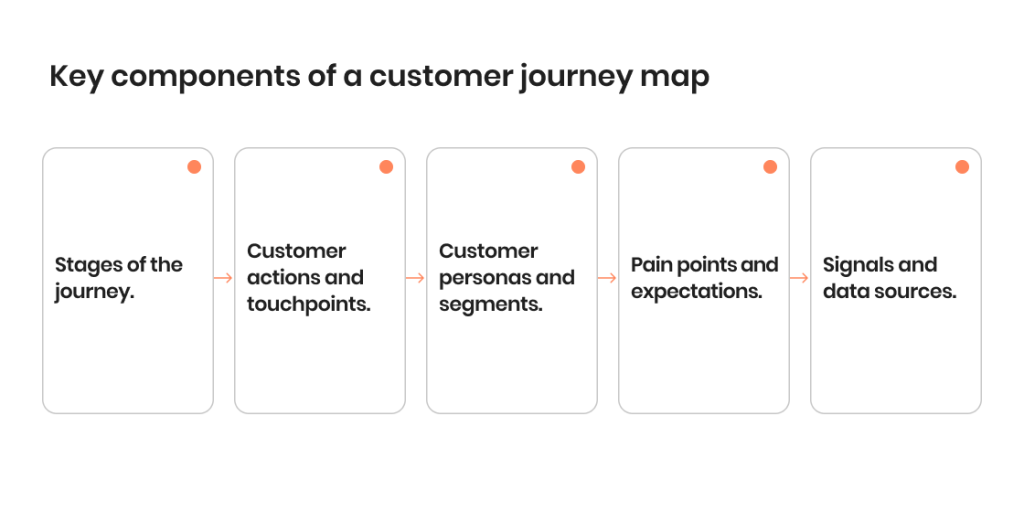
- Stages of the journey. Clear stages of the customer journey, such as discovery, onboarding, active use, and support.
- Customer actions and touchpoints. Key moments where customer interaction occurs, including digital flows, emails, and customer touchpoints across channels.
- Customer personas and segments. Definitions of a specific customer or customer segment to reflect different goals, constraints, and expectations.
- Pain points and expectations. Areas where customer needs may not be met or where frustration commonly appears.
- Signals and data sources. Inputs such as analytics, feedback from customer interactions, and customer feedback analysis.
Together, these components support mapping the customer journey in a way that is practical for testing, not just descriptive.
How journey maps impact testing
Journey maps influence how testing is planned, prioritized, and executed. Instead of selecting test cases based only on features, teams use the map to focus on flows that matter most to a real customer and to the overall customer experience.
In practice, journey maps help testing teams:
- Identify which paths to test first based on risk and frequency
- Design journey test scenarios that reflect user behavior, not scripted flows
- Support end-to-end testing with business context
- Connect testing results to customer journey insights and outcomes
By using customer journey maps as a foundation, teams can conduct customer journey testing with a clearer view of how the product supports an effective customer journey and where it may fail across the entire journey.
How to Create a Customer Journey Map
Creating a customer journey map is a highly structured activity that combines research, analysis, and validation. For testing purposes, the goal is not to produce a perfect visual artifact, but to capture how a real customer moves through the product and where experience risks may appear.
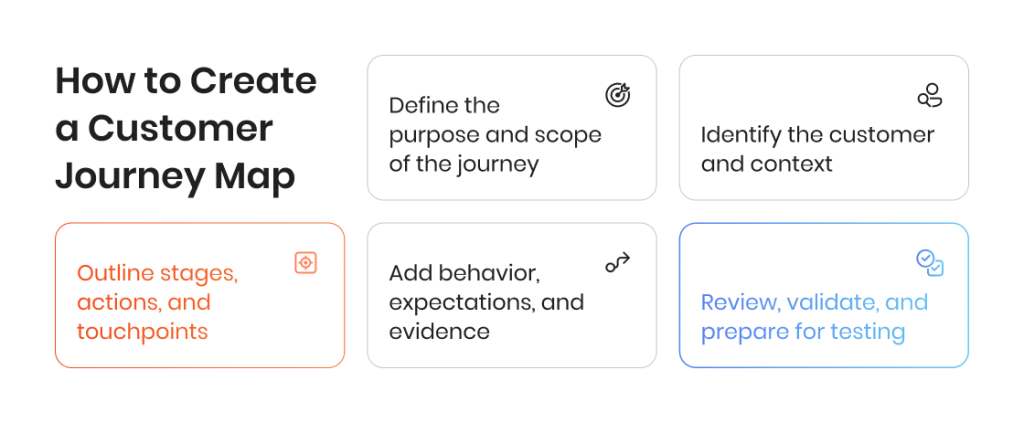
1. Define the purpose and scope of the journey
Start by clarifying why you want to create a customer journey map and what part of the journey you want to study. Some teams focus on onboarding or conversion, while others look at retention, support, or renewal. Defining scope early prevents the map from becoming too abstract or disconnected from testing needs.
At this stage, it is important to decide whether the map represents the entire customer journey or a specific stage of the customer journey. Narrower scopes are often more effective for early journey testing efforts.
2. Identify the customer and context
Next, define who the journey represents. This may be a specific customer persona, a customer segment, or a different customer group with distinct goals. The map should reflect a real customer, not an average or hypothetical one.
Inputs such as customer interviews, customer feedback, and customer support data help teams understand the customer and capture real motivations, constraints, and expectations. This step ensures the journey reflects user needs and avoids assumptions based only on internal opinions.
3. Outline stages, actions, and touchpoints
Once the customer is defined, outline the sequence of stages and actions along their customer journey. Each stage should describe what the customer is trying to achieve and how they interact with the product or service.
This step typically includes:
- Stages and steps across the journey
- Customer touchpoints where interaction happens
- Systems, channels, or teams involved at each point
Documenting these elements makes it easier to see gaps between steps and supports mapping the customer journey in a way that testing allows to be validated later.
4. Add behavior, expectations, and evidence
A useful journey map goes beyond actions. It captures customer behavior, expectations, and emotional signals at each stage. This helps teams see not only what happens, but how it feels from the customer’s perspective.
Analytics data, an analytics tool, and insights into user behavior can be used here to confirm or challenge assumptions. Drop-offs, delays, and repeated actions often signal experience issues that should later be included in journey test scenarios.
5. Review, validate, and prepare for testing
Before using the map for testing, review it with stakeholders across product, design, and testing teams. Validation helps ensure the map reflects how the customer journey works in practice and not just how it was designed.
At this point, teams can create customer journey maps that are ready for testing, or refine an existing map to use customer journey insights more effectively. A comprehensive map becomes the foundation for testing your customer journey, measuring customer journey outcomes, and refining your journey over time.
We’ll help you gain 100% confidence in your product’s UX

How Does Customer Journey Testing Work?
Customer journey testing works by translating mapped journeys into testable scenarios that reflect how customers actually move through a product or service. Instead of validating isolated functions, testing focuses on sequences of actions, decisions, and responses across the entire journey.
The basics
At its core, customer journey testing starts with a defined journey and turns it into a structured testing process. Teams use the journey map to understand how customers progress from one stage to another and where experience risks may appear.
The basic flow typically includes:
- Selecting a journey to test, based on business impact or risk
- Defining expected outcomes at each stage
- Observing how the system behaves when the journey is executed end to end
This approach helps testing teams test the customer journey as a whole and gain insights into customer interaction patterns that are easy to miss in feature-based testing.
Types of testing involved
Customer journey testing does not replace existing testing methods. Instead, it brings several testing types together within a single flow. Depending on the journey and goals, this may include:
- Functional testing. Verifying that each step in the journey works as intended.
- Usability testing. Evaluating whether users can complete actions without confusion or unnecessary effort.
- Non-functional testing. Checking performance, reliability, and behavior under real-world conditions.
- End-to-end testing. Confirming that integrated systems support the journey from start to finish.
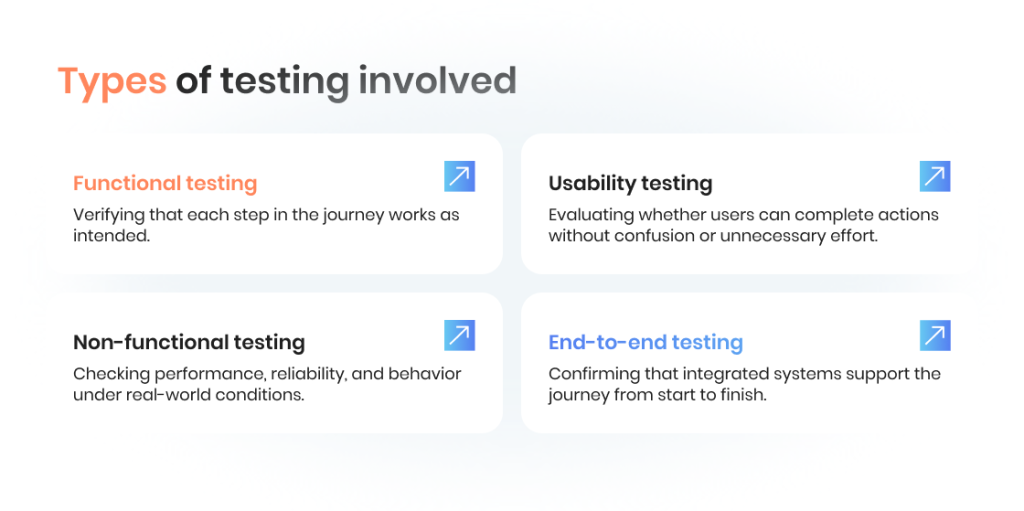
This type of testing combines multiple testing methods into one coherent view, making it easier to see how technical behavior affects the overall customer experience.
Crucial scenarios to test
Not every journey requires the same depth of testing. Teams should focus on scenarios that have the greatest effect on the overall customer and the business. These often include:
- First-time journeys that shape initial impressions
- High-value paths that help increase conversions
- Journeys involving multiple systems or handoffs
- Support-related flows that affect customer satisfaction
Testing these scenarios allows teams to prioritize customer needs, identify risks early, and improve the customer journey where it matters most. By focusing on real usage patterns, journey testing offers a practical way to validate how products perform across the entire journey.
Benefits of Customer Journey Testing
Customer journey testing helps teams move from isolated checks to a broader understanding of how customers actually experience a product or service. By examining journeys end to end, it reveals experience issues that affect satisfaction, loyalty, and long-term use, while also providing practical guidance on where testing effort delivers the most value.
Clearer view of the entire customer experience
Customer journey testing offers a structured way to see the entire customer experience as a connected sequence of interactions. It highlights gaps between stages, inconsistencies across channels, and breakdowns that affect the overall customer, even when individual features appear to work correctly.
Better understanding of real customer behavior
By testing complete journeys, teams gain a more accurate view of customer behavior in real conditions. This helps reveal how different customer types move through the product, where they struggle, and which steps create hesitation or abandonment.
Stronger connection between testing and outcomes
One of the benefits of customer journey testing is its ability to connect testing results to business impact. Focusing on key paths helps teams identify issues that affect conversion, retention, and customer loyalty, rather than treating all defects as equal.
More focused and effective testing effort
Journey-based testing allows teams to prioritize customer flows that matter most. Instead of testing everything at the same depth, testing teams concentrate on journeys that support customer needs and have the greatest influence on the overall experience.
Better shared understanding across teams
Customer journey testing creates a shared reference point across product, design, analytics, and testing roles. This makes discussions about improving the customer journey more concrete and helps teams agree on what an effective customer journey should deliver over time.
Data and Analytics in Customer Journey Testing
Data and analytics give customer journey testing a factual foundation. While journey maps describe how an experience should work, analytics show how the journey actually unfolds. Combining both allows teams to measure customer journey performance, validate assumptions, and make decisions based on evidence rather than intuition.
Key analytics metrics you should track
Not all metrics are equally useful for journey testing. The most valuable ones reflect movement, friction, and outcomes across stages rather than isolated events.
Key metrics to monitor include:
- Journey completion rates: How many customers successfully move through the entire journey
- Drop-off points: Stages where customers leave or abandon actions
- Time between stages: Delays that signal confusion or friction
- Repeat actions: Indicators of failed steps or unclear guidance
- Customer support interactions: Moments where customers need help to continue
Together, these metrics help teams measure customer journey quality and understand where experience issues affect the overall customer experience.
Tools and techniques for data-driven testing
Data-driven journey testing relies on a combination of qualitative and quantitative inputs. An analytics tool can show paths, funnels, and behavior trends, while testing validates why those patterns occur and whether changes improve outcomes.
Common techniques include:
- Funnel and path analysis to observe how journeys progress
- Session recordings and heatmaps to understand user behavior
- Customer feedback and customer feedback analysis to capture intent and expectations
- Correlation of test results with analytics to confirm improvements
When analytics are used alongside journey testing, teams gain deeper insights into customer interaction, build a clearer view of customer behavior, and improve customer experiences based on measurable results rather than assumptions.
Ensuring quality and usability for a gaming app with 900k+ user interactions: Our recent project at TestFort
How to Test the Customer Journey
Testing the customer journey turns abstract experience goals into concrete, verifiable outcomes. It focuses on how a customer moves through connected steps, how systems respond along the way, and whether expectations are met across the entire journey, not just within individual features.
Prepare journeys for testing
The first step is to select which journeys to test and define what success looks like. Teams typically start with high-impact flows that affect conversion, retention, or customer support load. These journeys are taken from existing maps or created specifically to support testing.
Preparation usually includes:
- Choosing a specific customer or customer segment
- Defining expected outcomes at each stage
- Identifying critical customer touchpoints and dependencies
This ensures testing reflects real usage rather than theoretical paths.
Design realistic test scenarios
Once a journey is selected, it is broken down into test scenarios that reflect how a real customer behaves. This includes variations in timing, device, data state, and prior interactions. The goal is to test the journey as customers actually experience it, not as a perfect linear flow.
At this stage, testing teams often combine multiple testing methods within a single scenario, such as functional checks, usability testing, and non-functional testing, to reflect real conditions across the journey.
Execute and observe end-to-end behavior
Journey testing is executed across systems and channels, following the journey from start to finish. This is where end-to-end testing becomes meaningful, because results are evaluated in the context of customer interaction rather than system integration alone.
During execution, teams observe:
- Where the journey slows down or breaks
- How errors are handled across stages
- Whether messaging and behavior remain consistent
These observations help reveal issues that only appear when the entire journey is exercised.
Analyze results and refine the journey
After execution, results are reviewed together with analytics and qualitative inputs. This helps teams understand why issues occurred and whether they reflect deeper problems in designing customer flows or meeting customer expectations.
Testing to validate changes is an ongoing activity. Teams test the customer journey repeatedly as products evolve, using insights into customer behavior to refine the journey, reduce friction, and improve their customer journey over time.
Improving Your Customer Journey Outcomes
Improving customer journey outcomes requires more than fixing isolated issues. It depends on how well teams use testing results to guide decisions, adapt to changing customer behavior, and maintain consistency across the entire journey.
How testing impacts design and product decisions
Customer journey testing gives design and product teams concrete evidence of how decisions affect real customer interaction. Instead of relying only on assumptions or isolated usability findings, teams can see how design choices influence progression across stages and whether they meet customer expectations.
These insights help teams improve the customer journey by adjusting flows, content, and interactions that create friction. Over time, testing supports designing customer experiences that better reflect customer needs and reduce confusion across different customer segments.
The use of continuous testing and iteration
Customer journeys are not static. New features, content updates, and changes in customer behavior constantly reshape how journeys unfold. Continuous testing allows teams to monitor these changes and understand how they affect the entire journey.
By repeatedly testing journeys as they evolve, teams can measure customer journey performance, validate improvements, and respond quickly when issues appear. This iterative approach supports improving your customer journey without waiting for major releases or visible problems.
Cross-functional collaboration for a better user journey
Improving journey outcomes depends on collaboration between testing teams, product managers, designers, and analysts. Customer journey testing provides a shared reference that helps these groups discuss the same journey from different perspectives.
When teams work from the same journey view, decisions about prioritization, fixes, and enhancements become clearer. This shared understanding supports a better user journey, improves the overall customer experience, and helps teams improve the CX across the entire user base.
Common Challenges of Customer Journey Testing and How to Overcome Them
Customer journey testing brings clear benefits, but it also introduces practical challenges. These issues often stem from complexity, incomplete data, or gaps between teams and tools. Understanding them early helps teams set realistic expectations and avoid ineffective testing efforts.
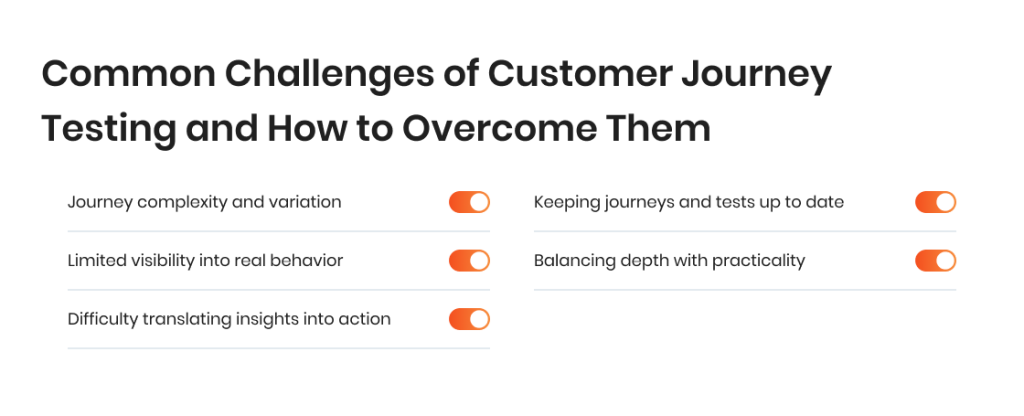
Journey complexity and variation
Customer journeys are rarely linear. Different entry points, devices, channels, and timing can create many variations of the same journey. This makes it difficult to decide which paths to test and how much coverage is enough.
Without clear priorities, teams may either oversimplify journeys or attempt to test too many paths at once. Both approaches reduce effectiveness and make it harder to draw meaningful conclusions from testing.
Limited visibility into real behavior
Journey testing depends on understanding how customers actually behave, not how teams expect them to behave. When analytics data is incomplete, outdated, or fragmented across tools, journey assumptions can be misleading.
This challenge is especially common when data from marketing, product, and support systems is disconnected. As a result, testing scenarios may miss critical steps or focus on journeys that do not reflect real usage.
Difficulty translating insights into action
Even when journey issues are identified, turning findings into concrete improvements can be difficult. Problems often span multiple systems or ownership areas, making responsibility unclear.
If testing results are not clearly connected to decisions and follow-up actions, journey testing risks becoming an observational exercise rather than a driver of change.
Keeping journeys and tests up to date
Customer journeys evolve continuously as products change and customer expectations shift. Journey maps and test scenarios can quickly become outdated if they are not reviewed regularly.
Maintaining relevance requires ongoing effort, including updating assumptions, refining scenarios, and retiring tests that no longer reflect how customers use the product.
Balancing depth with practicality
Testing every possible journey variation is rarely feasible. Teams must balance thoroughness with time and resource constraints, deciding where deeper testing is justified and where lighter checks are sufficient.
This balance improves over time, but in order to get there, the process requires experience, discipline, and a clear understanding of which journey issues have the greatest impact on the experience.
Let each point of your customer journey strengthen your business

The Future of User Journey Testing: Where Do We Go Next?
User journey tests are changing as products become more adaptive, data-rich, and interconnected. Discussions across industry articles, LinkedIn posts, and forums point to several clear directions that are shaping how teams test journeys going forward.
Adaptive and AI-driven journeys
More products now change behavior in real time based on customer actions, context, or history. This means journeys are no longer fixed paths but dynamic sequences that adjust as the customer moves forward. Journey testing will continue being a big part of AI product testing and will increasingly focus on validating these adaptive paths, checking whether changes still meet customer expectations and support a consistent experience across the entire journey.
Predictive analytics shaping test priorities
Predictive analytics is starting to influence which journeys teams test first. Instead of reacting only to past failures, teams use forecasts to anticipate where customers may struggle or drop off. This shifts journey testing toward earlier intervention, helping teams test potential risk areas before they affect customer satisfaction or increase customer churn.
Broader use of behavioral data beyond clicks
Future journey testing relies on richer signals than basic usage metrics. Data from customer support, surveys, and qualitative feedback provide insights into customer intent and frustration that raw event data cannot show. Using this information helps testing teams build a deeper view of customer behavior and validate journeys that matter most to the overall customer experience.
Scaled scenario coverage through automation
As journey complexity grows, teams are exploring automated ways to expand scenario coverage. This includes generating journey variations based on patterns observed in real customer data. While human review remains essential, automation testing helps teams cover more journey paths without manually designing every case.
Stronger connection between journey testing and product strategy
Journey testing is becoming a long-term practice rather than a one-time activity. Teams increasingly use journey insights to guide ongoing product decisions, refine flows over time, and respond to changing customer needs. This positions journey testing as a continuous input into improving customer experiences, not just a validation step before release.
Final Thoughts
Customer journey testing changes how teams think about quality. Instead of asking whether a feature works, it asks whether the experience works for a real customer moving through the product over time. This shift matters because most frustration, confusion, and lost trust do not come from single failures, but from how small issues add up across the journey.
As products grow more complex and customer expectations continue to rise, testing that ignores the journey becomes increasingly incomplete. Customer journey testing gives teams a way to understand the customer in context, spot experience risks early, and make decisions that improve the entire customer experience, not just individual releases. When used consistently, it becomes a practical foundation for building products that customers want to return to, recommend, and rely on.
FAQ
 What is customer journey testing in simple terms?
 What is customer journey testing in simple terms?
Customer journey testing checks how a product or service works across a sequence of real interactions, not just individual features. It focuses on whether customers can move smoothly from one stage to another and whether the experience meets customer expectations across the entire customer journey.
How is customer journey testing different from end-to-end testing?
End-to-end testing confirms that systems work together technically, while customer journey testing evaluates how those systems support real customer interaction. Journey testing adds context, intent, and experience goals, making it easier to see how technical behavior affects the overall customer experience.
Who should be involved in customer journey testing?
Customer journey testing works best when testing teams collaborate with product, design, and analytics roles. Input from customer support and customer interviews also helps ensure journeys reflect real customer needs and customer behavior rather than internal assumptions.
What types of testing are used in customer journey testing?
Journey testing combines more than one type of testing, including functional testing, usability testing, non-functional testing, and end-to-end testing. The focus is not on the method itself, but on how well each method supports validating the entire journey.
How often should teams test the customer journey?
Customer journeys should be tested continuously, not just before release. Changes in features, customer behavior, or customer expectations can affect journeys at any time. Regular testing helps teams refine the customer journey and maintain an effective customer journey.
Jump to section
Hand over your project to the pros.
Let’s talk about how we can give your project the push it needs to succeed!