In the past two decades, SaaS, or Software as a Service, has gone from a novelty concept to one of the most common ways to develop and distribute software. Thousands of businesses worldwide in every niche, from eCommerce and fintech to healthcare and manufacturing, are relying on SaaS solutions for reliability, speed, and a flawless user experience.
However, those expectations can only be met when the product is fully and thoroughly tested. SaaS product testing goes beyond standard QA techniques — it must also account for the unique characteristics of SaaS solutions, such as frequent updates, global user bases, and numerous third-party integrations. Find out how testing SaaS applications works, how to use automation and quality engineering in your approach, and which testing challenges to watch out for from our detailed guide to SaaS testing.
Key Takeaways
SaaS testing must support continuous delivery, making automation and CI/CD integration essential.
Multi-tenancy requires strict testing of data isolation, roles, and tenant-specific configurations.
SaaS QA goes beyond UI, covering backend resilience and distributed system behavior.
SaaS products are always live, so reliability and monitoring must be built into testing.
Subscription and billing logic must be tested carefully as it directly affects revenue.
Early defect detection reduces costs and prevents widespread production issues.
Automation enables fast feedback and stable releases in frequent deployment cycles.
Manual testing remains important for usability, exploratory, and complex scenarios.
Metrics like defect leakage and uptime guide continuous quality improvement.
SaaS testing must adapt to constant configuration and environment changes.
Global SaaS products require testing for localization, time zones, and compliance.
What Makes SaaS Testing Unique
SaaS solutions may look like regular software on the surface, but upon closer inspection, they turn out to have a lot of standout features that make them different from traditional software. These differences also require a one-of-a-kind approach to testing a SaaS application. Here is how the SaaS application testing approach is different from regular software and how to incorporate it in the testing process to ensure that the SaaS solution is tested with maximum efficiency.
Fast and continuous delivery
Frequent releases are the norm in SaaS — it’s one of the most common ways for SaaS providers to win over and retain their user base. Updates may go live daily, leaving no time for slow, manual testing. Automation becomes critical to maintain quality at speed. Tests must run as part of CI/CD pipelines, enabling rapid feedback, and QA teams must shift left and collaborate closely with developers to catch issues early and support continuous delivery.
Multi-tenancy complexity
SaaS platforms often serve multiple customers from a shared infrastructure. Testing must ensure strict data isolation between tenants and validate tenant-specific configurations. Each customer might have unique roles, features, or branding, so testers need to cover variations in workflows and usage patterns. A one-size-fits-all test approach won’t catch the issues that affect individual tenant setups.
Cloud-native architecture
SaaS apps are typically cloud-native, using microservices, containers, and autoscaling infrastructure. Testing must verify service resilience, failover handling, and performance in dynamic environments. Since components communicate across distributed systems, failures in one area can impact others. QA needs to go beyond UI testing to cover backend behaviors, orchestration, and real-time recovery.
Integration-dependent ecosystem
SaaS platforms often integrate with CRMs, payment systems, and other tools. Each dependency adds risk. Testing must validate API behavior, version compatibility, and graceful error handling. If an external service fails or changes unexpectedly, the app must continue functioning or alert the user clearly. Integration testing becomes a key priority for ensuring stability.
Words by
Igor Kovalenko, QA Lead, TestFort
“It is crucial to verify all external services to ensure that all key functions work properly within the user flow.”
Constant availability expectations
SaaS apps are always live, so even small issues can instantly impact thousands of users. There’s no private release phase — production is the testing ground. Testing must include reliability, failover, and recovery checks. Monitoring and alerting are also part of quality assurance, helping detect and fix issues before customers are affected.
Subscription and licensing models
Most SaaS apps have tiered pricing and access levels. Testing must verify correct entitlements, usage limits, and upgrade/downgrade behavior. Features available to premium users should be locked for others, and limits like API quotas must trigger the right alerts. These business rules add extra layers of logic that require precise and repeated validation.
Performance and scaling requirements
Users expect fast, responsive SaaS apps at all times. As demand grows, the system must scale without performance drops. QA teams need to simulate high traffic, identify bottlenecks, and ensure that the elastic infrastructure responds correctly. Load and stress testing aren’t optional — they’re necessary to deliver a consistent user experience across devices, geographies, and time zones.
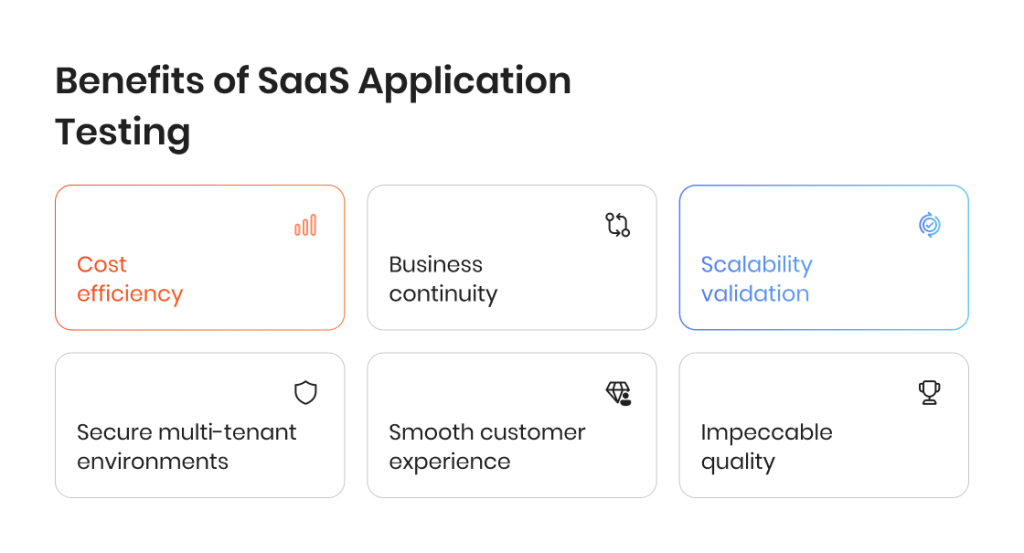
Testing SaaS applications brings many of the benefits that regular software testing does, including higher-quality products that are reliable and compatible with different platforms. At the same time, the unique nature and architecture of Software as a Service products also mean that the benefits that come with timely testing are unique and relevant to the SaaS industry. Here is what you get when you take the time to test your SaaS application.
Cost efficiency through early defect detection
With continuous testing integrated into the pipeline, defects are caught early, before they escalate into customer-facing issues or costly rollbacks. This is particularly beneficial in SaaS, where issues in production can affect all users simultaneously. Early detection reduces support overhead and limits the risk of customer churn.
Business continuity across rapid updates
SaaS companies release new features and fixes frequently. Without robust automated and regression testing, these frequent deployments risk breaking existing functionality. A strong SaaS testing practice ensures that rapid delivery doesn’t compromise the product’s core stability, allowing development teams to innovate without fear of regressions.
Scalability validation under real-world conditions
SaaS platforms must perform well for both small teams and large enterprises. Testing helps validate the app’s behavior across different usage patterns and subscription tiers. It also verifies that auto-scaling works under peak load and that the application can maintain performance without manual intervention.
Confidence in multi-tenant environments
In a shared infrastructure setup, one bug can affect every customer or worse, expose data across tenants. SaaS testing ensures tenant isolation, verifies configuration differences, and protects customer-specific experiences. This builds trust with clients, especially enterprise buyers who expect strict data boundaries and predictable performance.
Faster onboarding and smoother customer experiences
SaaS testing covers not just individual features, but also flows like user registration, billing setup, and initial configuration. These onboarding processes are critical for retention. By validating these scenarios regularly, companies ensure a smooth start for every new customer, reducing friction and increasing adoption.
Quality becomes a competitive advantage
High-performing, bug-free SaaS products are easier to scale, sell, and support. Consistently strong testing translates into faster release cycles, better user feedback, and fewer customer complaints. This enables product teams to focus on innovation while building a reputation for reliability that directly supports growth and retention.
Core Testing Areas and Types of SaaS Testing
SaaS products operate in dynamic, distributed environments with diverse user bases, which means QA must go beyond functionality alone, and that dictates the choice of testing types to be used on the project. Core testing areas cover everything from security and scalability to subscription management and integration stability, which together create the flawless user experience that every SaaS product owner is pursuing. Here are the types of testing and focus areas that successful SaaS testing includes.
Functional testing
This verifies that every feature works as intended across different user roles, plans, and configurations. In SaaS, functional testing also covers scenarios like tenant-specific customizations, permission-based access, and workflow differences between subscription tiers. It ensures the product behaves predictably for all users, regardless of how they interact with it.
Integration and API testing
SaaS platforms often act as hubs, connecting to external services like CRMs, payment processors, or analytics tools. Integration testing validates the stability of these connections and confirms that data is exchanged accurately. API testing ensures endpoints are secure, well-documented, and stable across versions, which is critical for partner ecosystems.
Performance and load testing
SaaS users expect fast, consistent performance, whether they’re a small team or a global enterprise. Performance testing for SaaS applications focuses on how the system handles traffic spikes, concurrent users, and resource scaling. It also identifies performance bottlenecks in specific modules like reporting or search, helping ensure reliability under real-world load conditions.
Security and data privacy testing
Because SaaS platforms are cloud-hosted and internet-facing, security testing is essential. This includes checking for vulnerabilities like injection attacks, broken authentication, and insecure APIs. Data privacy testing focuses on ensuring tenant isolation, access controls, and compliance with regulations like GDPR, especially when handling sensitive customer data.
Usability and accessibility testing
User experience is a key differentiator in the crowded SaaS market. Testing focuses on clean UI behavior, mobile responsiveness, and intuitive flows, especially for onboarding, billing, and support features. Accessibility testing ensures the product can be used by people with disabilities, which can be essential for enterprise clients or regulated industries.
Words by
Igor Kovalenko, QA Lead, TestFort
“The most important types of non-functional testing are accessibility, UI, and UX testing. The outcomes of these testing activities show how comfortable customers feel using your product and how likely they are to continue using it.”
Disaster recovery and failover testing
High availability is expected in SaaS. Testing confirms that backups, failover systems, and recovery procedures actually work when infrastructure issues occur. This includes validating auto-restart mechanisms, backup restoration, and data integrity after recovery, especially in multi-region deployments or during planned maintenance.
Subscription, billing, and access testing
SaaS monetization relies on subscription logic. Testing ensures that users are billed correctly, access is restricted according to their plan, and upgrades or cancellations work seamlessly. It also verifies trial periods, discounts, usage limits, and metered billing rules. Errors here can directly affect revenue and customer trust.
User acceptance testing
UAT focuses on validating that the product meets real-world business needs from the end user’s perspective. In SaaS, this involves tenant-specific validation, where enterprise clients may require tailored workflows or configurations. UAT helps confirm that the application is fit for release and aligns with client expectations and use cases.
Cross-platform and cross-browser testing
SaaS users access applications from various browsers and devices. Therefore, compatibility testing must ensure consistent behavior and layout across Chrome, Firefox, Safari, Edge, and others, on both desktop and mobile. Cross-platform testing also verifies responsive design and compatibility with different operating systems, minimizing support tickets caused by inconsistent UI behavior.
From sign-up to scaling — We will ensure your app’s durable success.
SaaS Testing Methodology: Which Testing Approach to Go For?
Choosing the right testing methodology is an essential part of creating a winning SaaS testing strategy. Teams can choose from a range of SaaS testing methods and approaches, from traditional ones to those that are better suited for the key principles of SaaS development, including speed, flexibility, and collaboration. These are the methods and approaches most widely used for SaaS testing.
Agile and iterative testing
Agile is often the go-to methodology for SaaS teams, thanks to its ability to support continuous delivery and rapid iteration. Agile testing is incorporated into every sprint, enabling QA teams to test new features incrementally and align closely with evolving business requirements. This approach ensures early feedback and a fast response to change.
Shift-left testing
Shift-left testing is especially effective for SaaS, where fast release cycles leave little room for last-minute QA. By involving testers early in the development lifecycle, starting from requirements and design, teams can catch defects sooner and reduce costly rework. It also promotes better collaboration between developers, testers, and product managers.
Words by
Igor Kovalenko, QA Lead, TestFort
“Considering the complexity of SaaS products, the shift-left approach should be a non-negotiable stage in the SDLC.”
Continuous testing
For SaaS products deployed through CI/CD, continuous testing is essential. Automated tests are integrated directly into build pipelines, validating each code change in real time. This approach supports the “release anytime” model and ensures that performance, security, and functionality checks are always up to date without manual delays.
Risk-based testing
Not all features carry the same level of risk. Risk-based testing helps prioritize QA efforts based on business impact, usage frequency, and likelihood of failure. In SaaS, this might mean focusing more on billing logic, authentication, or integrations, while deprioritizing low-risk admin screens or cosmetic changes.
Exploratory testing
In addition to scripted automation, exploratory testing plays a key role in SaaS QA. It helps uncover issues that automated scripts might miss, such as unexpected UI behavior, inconsistent workflows, or usability hiccups. This is especially useful in multi-tenant environments with varied customer configurations.
Automation Testing for SaaS Products & How to Pair It With Manual Testing
Testing SaaS software is largely based on the expertise of manual testers. However, unlocking the full potential of the product and ensuring its spotless quality typically also involves testing with automation tools and techniques. Here is what you can achieve with automation, how automation works with the unique aspects of SaaS applications, which tools to use, and how to pair manual and automated testing for the best results.
Why automate SaaS testing?
SaaS products evolve fast, often releasing updates several times per week. Automated testing ensures quick, reliable validation of core functionality, integrations, and user flows. This speeds up delivery, minimizes manual effort, and improves overall release stability.
It also supports continuous testing in CI/CD pipelines, giving teams rapid feedback on code quality and helping prevent regressions before they reach production. With automation, SaaS companies can scale testing alongside their product and user base.
Words by
Taras Oleksyn, AQA Lead
“In the fast-moving world of SaaS, manual testing alone can’t keep up. Automation isn’t just a boost — it’s the backbone of reliable, scalable delivery.”
What’s special about automated SaaS testing?
As is always the case, automation testing can only be successful when it takes into account not just the goals and objectives the team is trying to achieve, but also the peculiarities of the product itself. These are the key standout features of SaaS software that need to be taken into account with automation:
Multi-tenancy. Tests must work across different customer environments, with unique data sets and configurations.
Role-based access. Scripts need to simulate multiple user types, each with different permissions and workflows.
Frequent UI updates. Automation should be resilient to frontend changes using strategies like page object models or stable locators.
Plan-based features. Tests should verify what’s available to users on different subscription levels or feature toggles.
Dynamic test data. SaaS tests often rely on configurable data and need mechanisms for test data setup and cleanup.
Words by
Taras Oleksyn, AQA Lead
“Effective test automation isn’t just about covering functionality, it’s about deeply understanding the product’s architecture. Multi-tenancy, access control, dynamic data, and rapid UI changes all demand a smarter, more flexible testing strategy.”
Best tools for automating SaaS testing
Automated testing verifies that the SaaS application performs exactly as expected and in any conditions or environments. With the advanced state of automation in 2025, there are plenty of tools and solutions designed to speed up the process, remove the risk of human error, and maximize its efficiency:
Test frameworks: JUnit, TestNG, Pytest
UI testing: Selenium, Playwright, Cypress
API testing: Postman, Rest Assured, SoapUI
CI/CD integration: Jenkins, GitHub Actions, GitLab CI
Cross-browser testing: BrowserStack, Sauce Labs
Test management & reporting: TestRail, Allure TestOps, qTest
Balancing automation and manual testing
While automation accelerates delivery, manual testing remains essential. Manual testing is best suited for usability checks, exploratory sessions, and complex user scenarios. Moreover, manual QA helps uncover issues that automation might miss, such as design inconsistencies or real-world edge cases.
By all accounts, a hybrid model, which combines manual and automated testing activities, works best. Automating repetitive tests like regression, smoke, and integration checks while using manual testing for new features, UI validation, and user acceptance testing ensures thorough coverage and business relevance in a fast-moving SaaS industry.
Don’t Choose Between Speed and Quality of Testing
We’ll pair manual and automated QA expertise for the best results.
The Role of Quality Engineering in SaaS App Testing
For years, development and testing teams used traditional QA techniques to verify the spotless state of their products. However, effective and successful SaaS testing calls for a more innovative, in-depth approach. The emerging approach proving its particular efficiency for SaaS products is quality engineering, often referred to as the future of testing.
Words by
Taras Oleksyn, AQA Lead
“In SaaS, speed demands more than traditional QA. Quality engineering builds quality into the product from the start, turning testing from a final checkpoint into a continuous, collaborative force.”
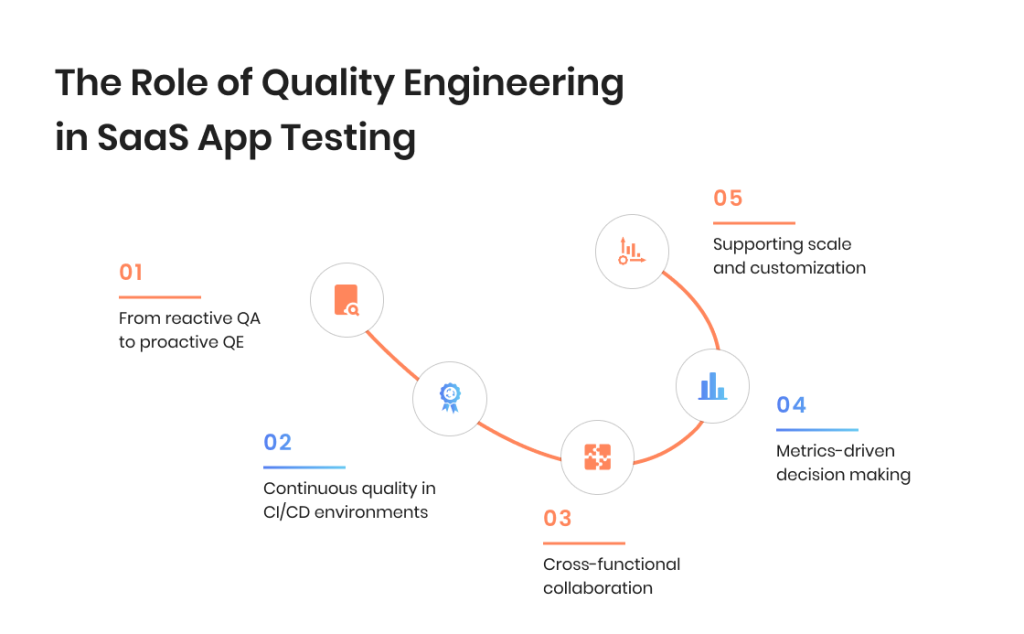
Quality engineering goes beyond traditional QA by embedding quality into every stage of SaaS product development. Rather than just testing for defects after features are built, QE emphasizes prevention, automation, collaboration, and continuous improvement, making it a natural fit for the fast, iterative nature of SaaS delivery. Let’s take a closer look at the core principles of implementing quality engineering for SaaS testing.
1. From reactive QA to proactive QE
In a traditional QA model, testing happens after development, often leading to bottlenecks, late defect discovery, and expensive rework. In contrast, QE introduces quality practices from the outset, starting with planning, architecture, and design. This shift-left approach helps SaaS teams identify risks early, align testing with business goals, and create a more stable product from the ground up.
2. Continuous quality in CI/CD environments
QE supports continuous quality across all stages of the DevOps pipeline. It involves writing testable code, integrating automated tests in CI/CD workflows, monitoring live performance, and using feedback loops to drive product improvements. For SaaS teams shipping updates daily or weekly, this ensures each release meets performance, security, and usability standards without slowing down delivery.
3. Cross-functional collaboration
Quality engineering fosters collaboration between developers, testers, DevOps engineers, and product owners. Everyone shares responsibility for quality, which leads to fewer silos and faster problem resolution. For SaaS products that serve diverse users and evolve rapidly, this collective ownership is crucial for maintaining long-term stability and innovation.
4. Metrics-driven decision-making
QE relies heavily on metrics to track and improve quality. This includes test coverage, defect leakage, deployment frequency, customer-reported issues, and uptime. For SaaS businesses, these metrics not only guide internal improvements but also support SLAs and build trust with enterprise clients who expect transparency and reliability.
Words by
Igor Kovalenko, QA Lead, TestFort
“Gathering and analysing metrics is one of the most effective ways to improve your product in the long run.”
5. Supporting scale and customization
As SaaS products grow and onboard larger customers, QE helps ensure that new features, integrations, and configurations don’t compromise quality. It supports scalable test strategies, tenant-aware automation, and performance monitoring under load — all critical for multi-tenant SaaS platforms that need to support different users, roles, and regional compliance requirements.
So, how do you implement these quality engineering practices into your SaaS testing workflow to unlock a new level of product finesse and process efficiency? Here are a few tips that will help you make the move:
Start with a shift-left mindset. Integrate testing and quality planning early in the development lifecycle — during requirements, architecture, and design phases.
Automate critical test workflows. Focus on automating regression, API, and integration tests to keep up with rapid SaaS release cycles.
Embed testing in CI/CD pipelines. Ensure automated tests run with every build and deployment to catch issues early and maintain release confidence.
Use monitoring to close the feedback loop. Collect real-time performance, availability, and user behavior data to improve future releases and detect production issues.
Encourage cross-functional ownership of quality. Involve developers, testers, product managers, and DevOps in quality discussions and decisions.
Define and track key quality metrics. Monitor KPIs like defect leakage, deployment frequency, test coverage, and customer-reported issues to drive improvements.
Design test strategies for scalability and customization. Account for multi-tenant architecture, user role variations, and environment configurations in your QE strategy.
Invest in continuous learning and tools. Train teams on modern QE practices and adopt scalable tools for automation, performance testing, and observability.
SaaS Testing Challenges and How to Overcome Them
SaaS solutions are built with flexibility, agility, and scalability in mind. But while those are the biggest strengths of the SaaS model, they can also turn into challenges for the testing team, as testers need to focus on many aspects of the software beyond core functionality. Below are key challenges that can materialize when SaaS applications are accessed for quality.
Continuous configuration changes
Unlike on-premise software, SaaS platforms are constantly evolving with new customer configurations, custom fields, workflows, and permission schemes. This makes it harder to create stable test environments and reusable test cases.
How to overcome: Implement configuration-aware test automation that adjusts dynamically based on environment or tenant settings. Maintain a well-documented configuration matrix to support coverage and traceability.
Frequent third-party service dependencies
SaaS applications often integrate with external APIs, payment processors, authentication providers, and analytics tools. Ensuring these services are available, stable, and backward-compatible across environments adds complexity to testing.
How to overcome: Use service virtualization and mock APIs during test runs to simulate third-party behavior. Monitor live integrations in production with alerting to catch changes or downtimes early.
High customer diversity and expectations
A single SaaS product may serve startups and large enterprises alike, each with different usage patterns, security needs, and compliance expectations. Testing must validate that the platform performs well and securely for all user profiles and usage scales.
How to overcome: Use persona-based testing and real-world usage scenarios. Segment test cases by user type, usage volume, and compliance needs to ensure broader relevance.
Global availability and time zone-related issues
SaaS platforms with international users must be tested for localization, time zone handling, date formatting, and even regulatory differences. Missed bugs in this area often surface only after deployment.
How to overcome: Test with varied locale and time zone settings in both frontend and backend. Use automation to simulate global user activity and validate date/time logic under different conditions.
Test data privacy and tenant isolation
One of the major challenges of testing SaaS applications is ensuring that test environments mimic production while respecting data privacy laws like GDPR and maintaining tenant isolation. Synthetic data generation and environment sanitization become essential.
How to overcome: Use synthetic or anonymized data in non-prod environments. Build tests that validate data access boundaries and enforce strict environment separation per tenant.
Release fast and avoid common bottlenecks and roadblocks with our SaaS testing expertise
We’ll pair manual and automated QA expertise for the best results.
Comprehensive SaaS testing is crucial for the success of the product, but a standard testing strategy may not be enough to fully check the application for defects. Additional tips and best practices will help you achieve maximum efficiency within the process and reach even the most ambitious project goals.
1. Design for multi-tenancy from the start
Ensure your test cases account for tenant-specific data, permissions, and configurations. Build tests that can run across different tenant environments to validate isolation, consistency, and customization support.
2. Make automation a core strategy
Automate high-value tests, especially for regression, APIs, and integrations, to support rapid release cycles. Prioritize stable, reusable test scripts and maintain them continuously to reduce test debt.
3. Integrate testing into CI/CD pipelines
Shift testing left by embedding it into your development pipeline. Run automated tests on every commit or deployment to catch issues early and ensure delivery confidence.
4. Use production monitoring as a testing extension
Augment traditional QA with real-time monitoring tools to track performance, user behavior, and error trends post-release. This helps quickly detect issues that weren’t caught in staging.
5. Continuously test third-party dependencies
Set up automated health checks for critical external services and track their versioning. Include fallback or alerting mechanisms in case of failure or API changes.
6. Prioritize scalability and performance early
Introduce performance testing as part of your pre-release QA. Validate system behavior under expected and extreme loads to ensure your platform is ready to scale.
7. Treat quality as a shared responsibility
Foster collaboration between development, QA, DevOps, and product teams. Create shared goals and metrics for quality to align efforts across the delivery lifecycle.
Final Thoughts
The world of SaaS development is becoming increasingly dynamic and demanding, with users expecting nothing short of perfection in their SaaS solutions. This means that SaaS testing is more important than ever, serving to not just verify the basic functionality of the application but also ensure its stability, security, and reliability. Cutting down on testing or skipping the QA phase altogether is not an option if you want to appeal to a large user base, retain customers, and grow your market share. Whether you are developing a brand new product or scaling an existing solution, a comprehensive testing approach that is aligned with your business goals is essential for durable success.
Share:
Jump to section
Hand over your project to the pros.
Let’s talk about how we can give your project the push it needs to succeed!
Inna is a content writer with close to 10 years of experience in creating content for various local and international companies. She is passionate about all things information technology and enjoys making complex concepts easy to understand regardless of the readers tech background. In her free time, Inna loves baking, knitting, and taking long walks.