LMS Testing Guide: All About Learning Management System Testing
Create a spotless learning experience for your users with comprehensive LMS testing. Learn all about the test process, test cases, challenges, and more.
Learning platforms rarely attract attention when they work as expected. Courses load, learners progress, reports are generated, and training moves on. But when an LMS fails, the impact is immediate and visible — missed deadlines, incomplete records, frustrated learners, and uncertainty around whether learning outcomes can be trusted. As organizations rely more heavily on digital learning, even small LMS issues can quickly turn into operational or compliance problems.
What makes this challenging is that many LMS problems are not obvious at launch. They appear later, when learning happens over time, usage peaks, integrations are stressed, or data is needed for decisions. This guide looks at why LMS platforms are uniquely difficult to test, who is most affected by LMS quality issues, and how a focused approach to LMS testing helps reduce risk while supporting learning at scale.
Key Takeaways
An LMS is not just a content repository, but a system that supports learning delivery, tracking, reporting, and often compliance-critical processes.
Many LMS quality issues surface weeks or months after launch, when learning activity, reporting needs, or deadlines increase pressure on the system.
Testing short sessions or isolated features is not enough; LMS quality depends on how learning flows behave over time and across interruptions.
Learning paths, prerequisites, and reassigned courses are common failure points because they introduce complex, rule-driven behavior.
Integration failures often remain invisible because the LMS interface continues to function while data flow breaks in the background.
Different user roles interacting with the same courses create hidden dependencies that simple checks do not reveal.
Treating LMS testing as a one-time activity increases long-term risk as content, users, and system connections change.
What Are Learning Management Systems and Why Are They Difficult to Test?
A learning management system is more than a place to host courses. In most organizations, it becomes a central system for delivering learning programs, tracking progress, managing assessments, and proving that training requirements have been met. Over time, the LMS evolves into a core operational platform that supports onboarding, compliance, professional development, and, in some cases, customer or partner education.
This breadth of responsibility is exactly what makes LMS platforms difficult to test effectively. These are the challenges organizations frequently encounter throughout the process of testing a learning platform.
Learning happens over time, not in single sessions
Unlike many business applications, an LMS is not built around short, transactional actions. Learners may start a course, pause for days or weeks, and return from a different device or browser. Progress must be preserved accurately across sessions, interruptions, and resumptions.
From a testing perspective, this means validating long-running learning journeys rather than isolated interactions. Issues often appear only after repeated access or delayed completion, making them easy to miss during short test cycles.
LMS platforms operate as interconnected systems
An LMS rarely functions in isolation. It typically integrates with identity providers, HR systems, reporting tools, and external content libraries. Changes in any of these connections can affect enrollments, permissions, progress tracking, or analytics.
These problems are particularly difficult to detect because the LMS interface may continue to work as expected while data flows or access rules break quietly in the background.
Different user roles create complex logic paths
LMS platforms support multiple user roles, including learners, instructors, administrators, and managers. Each role has distinct permissions, workflows, and visibility into data.
Testing needs to account for how these roles interact with the same learning content and processes in different ways. A scenario that works for a learner may fail for an administrator, or vice versa, especially when approvals, reporting, or role-based access rules are involved.
Content quality affects data accuracy, not just experience
Courses are frequently created internally or sourced from third-party providers, often using different standards and formats. Content can appear to play correctly while producing incomplete progress records, incorrect assessment results, or inconsistent reporting.
Because these issues are not always visible during the learning experience, they often go unnoticed until reports are reviewed or compliance evidence is required.
Many LMS issues surface only after rollout
Some of the most damaging LMS problems do not appear during initial implementation. They emerge when usage scales, when certification deadlines approach, or when reporting accuracy becomes critical.
By the time these issues are discovered, the LMS is already embedded in business processes, making correction more complex and disruptive.
Why this changes how LMS testing should be approached
When considered together, these challenges mean that LMS testing cannot focus only on whether features work in isolation. It must account for real learning behavior, long-term data integrity, system integrations, and how the platform performs under real-world conditions. Without this broader perspective, even a well-designed LMS can fail to deliver reliable learning outcomes.
Secure your top industry spot with flawless software
LMS testing is often associated with learning platform development, but in practice, it is relevant to a much wider range of organizations. Any business that relies on an LMS to deliver, track, or prove learning outcomes faces quality risks that cannot be fully covered by vendor testing alone. The need for independent validation depends on how the LMS is built, used, and changed over time. These are the three groups that should invest particular effort into testing an LMS solution.
LMS vendors and product owners
For LMS vendors and internal product teams, testing is closely connected to platform reliability and customer trust. As features change and customer requirements grow more diverse, even small defects can affect multiple clients at once.
Beyond core functionality, vendors need confidence that learning workflows, role-based access, reporting logic, and integrations continue to work correctly across different configurations. Ongoing testing helps reduce support load, prevent recurring issues, and protect the platform’s reputation as it scales.
Companies using third-party LMS solutions
Organizations that rely on commercial or SaaS LMS platforms often assume that quality is fully handled by the vendor. In reality, most risks appear in areas shaped by local configuration and usage.
Custom learning paths, integrations with internal systems, user roles, and reporting expectations differ from one organization to another. Testing helps ensure that the LMS supports real operational needs and produces reliable data, even when the platform itself is not owned or developed internally.
Words by
Michael Tomara, QA Lead, TestFort
“Like any complex system, LMSs need regular testing. Even without any significant changes in the system itself, there might be hidden issues that accumulate over time, so it can be considered a health check. Besides, if you would contact your LMS vendor about the issues, it would be useful to do it with some structured results on your hands, including the test scenarios that were used to locate these issues.”
Organizations going through LMS migration or modernization
LMS migration and modernization introduce a concentrated period of risk. Data is moved, content formats change, integrations are rebuilt, and users are expected to adapt with minimal disruption.
Testing plays a critical role in checking that historical learning data remains accurate, progress is preserved, and new workflows behave as expected. Without this step, issues often surface only after go-live, when fixing them becomes far more expensive and disruptive.
Common LMS Quality Failures from Real Projects
Most LMS issues that cause real business impact are not edge cases or obvious defects. They are problems that sit quietly in production until learning activity increases, deadlines approach, or reporting becomes critical. Here are some of the most common quality failures seen across real LMS projects.
Progress and completion data that cannot be trusted
One of the most frequent problems is inaccurate or inconsistent learning progress. Learners complete courses, but their status does not update correctly, certificates are not issued, or completion appears differently across reports and dashboards. These issues often remain unnoticed until managers review results or compliance evidence is required, at which point correcting the data becomes difficult or impossible.
Reporting that looks correct but tells the wrong story
LMS reports may load without errors while still presenting misleading information. Common issues include mismatched numbers between dashboards and exports, missing historical data, or incorrect aggregation across teams or time periods. Since decision-makers rely on these reports, even small inconsistencies can undermine confidence in the entire learning program.
Learning paths that break under real usage
Learning paths frequently work during initial checks but fail when learners follow non-linear routes, pause courses, or return after long gaps. Prerequisites may not unlock correctly, optional steps may block progress, or reassigned courses may reset unexpectedly. These problems usually appear only after weeks of real usage, not during early testing.
Integration failures that remain invisible for weeks
Connections with HR systems, identity providers, or analytics tools can fail silently. Users may not be enrolled on time, roles may not update, or completion data may not reach downstream systems. Because the LMS interface continues to function, these failures are often discovered late, after manual workarounds or user complaints accumulate.
Performance issues during peak learning periods
Many LMS platforms perform well under average load but struggle during onboarding waves, certification deadlines, or exam periods. Pages load slowly, assessments fail to submit, or sessions time out unexpectedly. These issues rarely appear in day-to-day use but can have a disproportionate impact when learning activity peaks.
Content that plays correctly but records results incorrectly
Courses may appear to function as expected while producing incomplete assessment results, incorrect grading, or missing completion data. This is especially common with third-party content or mixed content standards. Since learners can finish the course without errors, the problem often surfaces only in reports or audits.
In professional discussions, engineers involved in LMS testing note that many gaps and failures stem from the different ways that teams experience quality as a whole, not just making sure a certain button or field works. Testers often write about the disconnect between engineers and quality impact — a reminder that testing for real use in real conditions matters.
We’ll help you release software that keeps users coming back for more
LMS quality depends on more than whether individual features work. It depends on how reliably the platform supports learning workflows, user behavior, data accuracy, and scale. The following testing areas focus on the parts of an LMS that have the greatest impact on learning outcomes and operational stability.
Functionality testing for core learning workflows
Core learning workflows include enrollment, course access, progress tracking, assessments, completion rules, and certification. These flows often span multiple steps and user roles, and they must continue to work correctly over time, not just during initial checks.
Testing in this area focuses on whether learning paths behave consistently when users pause, resume, repeat courses, or move through content in different sequences. Breakdowns here directly stop learning or produce unreliable results, even if the rest of the platform appears stable.
Usability testing for real learner adoption
An LMS can meet functional requirements and still fail if learners struggle to use it. Confusing navigation, unclear progress indicators, or inconsistent behavior across devices can reduce course completion and engagement.
Usability testing looks at how easily learners understand what to do next, how instructors manage content, and how administrators handle routine tasks. The goal is not polishing the interface, but removing friction that quietly undermines adoption and completion rates.
Performance testing for peak learning periods
Most LMS platforms are used unevenly. Activity spikes during onboarding waves, compliance deadlines, certification periods, or large internal rollouts. Performance testing focuses on how the system behaves during these high-load moments.
Slow response times, failed submissions, or session timeouts during peak usage can block learning at scale and create immediate business disruption. Testing under realistic peak conditions helps reduce the risk of these failures appearing when learning matters most.
Security testing for learner data and access control
LMS platforms store personal data, assessment results, and sometimes sensitive compliance records. They also rely heavily on role-based access, where different users see and control different parts of the system.
Security testing examines whether access rules work as intended, data is protected from unauthorized exposure, and administrative actions cannot be misused. Weaknesses in this area can lead to data leaks, audit findings, or loss of trust in the learning program.
Compatibility testing for different devices and content formats
Learners access LMS platforms from a wide range of devices, browsers, and operating systems, often switching between them over time. Content may also come from multiple sources and follow different technical standards.
Compatibility testing checks that courses behave consistently across environments and that progress, LMS assessment, and results are recorded correctly regardless of how or where learning takes place. This helps prevent issues that only affect specific user groups or setups.
Words by
Mykhailo Tomara, QA Lead
“Compatibility testing across major platforms should not be overlooked. Even if your LMS was not changed after the latest successful testing round, it might not work as well with the latest browser versions over time. Then, it would be time for some updates — and some more testing, of course.”
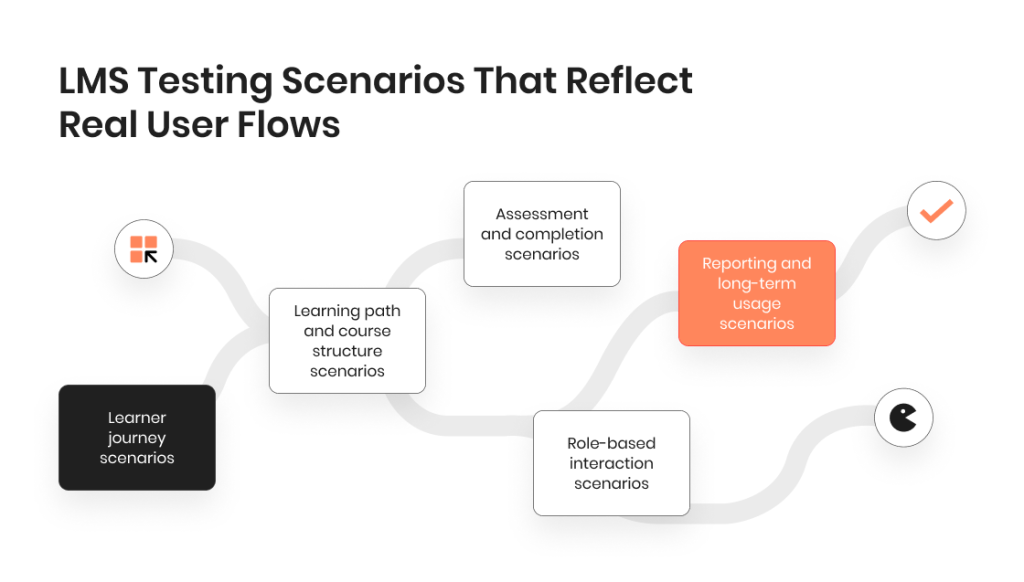
LMS Testing Scenarios That Reflect Real User Flows
Many LMS issues only appear when learners and administrators use the platform in real conditions over time. This is why testing scenarios should mirror these patterns instead of focusing on isolated actions or short sessions. Here is what testing an online learning management system can look like in practice.
Learner journey scenarios
These scenarios reflect how learners actually move through courses in day-to-day use:
Starting a course, pausing for an extended period, and returning later without losing progress
Switching devices or browsers mid-course and continuing from the correct point
Completing courses in short sessions spread across days or weeks
Repeating sections or revisiting completed content without resetting progress
Learning path and course structure scenarios
These scenarios focus on how structured learning programs behave under real conditions:
Following non-linear learning paths with optional or conditional modules
Completing prerequisites in a different order than originally planned
Reassigned or updated courses appearing correctly in learner dashboards
Courses with mixed content types behaving consistently within the same path
Assessment and completion scenarios
Assessments and completion rules often carry the highest business risk:
Submitting assessments close to deadlines or under unstable connections
Retaking assessments after an initial failure
Correct handling of pass/fail logic and grading rules
Issuing certificates only when all completion conditions are met
Role-based interaction scenarios
These scenarios cover how different roles interact with the same learning data:
Learners completing courses while instructors review results
Managers tracking progress across teams or cohorts
Administrators updating access rules without affecting active learners
Changes by one role being reflected correctly for others
Reporting and long-term usage scenarios
These scenarios surface issues that only appear over time:
Generating reports after weeks or months of learning activity
Tracking completion across multiple cohorts or repeated training cycles
Aggregating results for audits or internal reviews
Handling historical data after course updates or reassignments
QA automation for a training lab platform: 1,100+ tests automated in 6+ years
Integration and Analytics Risks in Modern LMS Platforms
Modern LMS platforms rarely operate on their own. They are part of a broader learning ecosystem that includes HR systems, identity providers, reporting tools, content libraries, and sometimes customer-facing applications. This interconnected setup introduces risks that are easy to overlook during day-to-day use.
Integration points are common failure zones
Integrations often play a central role during LMS implementation, especially when user data, enrollments, and permissions are managed outside the LMS. Issues tend to appear when data moves between systems rather than within the LMS itself.
Common risk areas include delayed user provisioning, incorrect user roles, missing course assignments, or completion data that does not reach downstream systems. These problems may not trigger visible errors in the LMS interface, making them difficult to detect without careful testing of the full data flow.
This is especially relevant for organizations using different LMS platforms across regions or business units, where integrations behave differently depending on configuration.
Analytics and reporting depend on consistent data flow
Analytics in an LMS depend on accurate and timely data from multiple sources. Course activity, assessments, grading, and completion status must be recorded consistently before they can be aggregated into reports.
When integrations fail or behave inconsistently, analytics may still appear complete while telling an inaccurate story. Differences between dashboards, exports, and historical reports are common symptoms. For management teams, this creates uncertainty around whether learning results can be trusted.
Testing focused on analytics helps ensure that reports reflect real learner activity and remain reliable over time.
“In most organisations, LMS issues don’t arise from the technology itself — they’re a result of the data that drives it… Outdated email addresses, duplicate profiles, inactive accounts, and missing role assignments — each small inconsistency causes ripples throughout the administrative, reporting, and learning experience.”
Test environments often hide integration issues
Many LMS projects rely on a dedicated testing environment or sandbox testing setup that differs from production. External systems may behave differently, contain limited test data, or use simplified configurations.
As a result, integrations can appear stable during checks but fail once real volumes, real users, and real course content are involved. This gap is one of the main reasons integration issues surface weeks after go-live rather than earlier.
Automation helps, but does not remove integration risk
Test automation and automated test flows are useful for checking recurring scenarios, especially where integrations are involved. However, automation alone cannot cover all edge cases related to data timing, role changes, or external system behavior.
A balanced approach combines automated checks with targeted manual review of integration-heavy flows, especially those affecting reporting and user access.
Why this matters for LMS quality
Integration and analytics issues rarely block a single user. They affect entire groups, departments, or regions at once. When learning data cannot be trusted, the LMS loses its value as a management tool, even if courses appear to function correctly. Addressing these risks requires focused attention on how systems work together, not just on individual LMS features.
How LMS Testing Fits Into Your Product Strategy
For many organizations, LMS testing is treated as a technical safeguard rather than a strategic activity. In practice, it plays a direct role in how confidently a learning platform can support growth, change, and long-term use.
Supporting predictable releases and updates
LMS platforms change frequently. New courses are added, existing content is revised, configurations are adjusted, and integrations are extended. Each change introduces risk, even when the core platform remains the same.
Testing provides a way to introduce updates without disrupting active learners or breaking reporting and access rules. This is especially important for organizations that run continuous learning programs or maintain large libraries of online courses.
Reducing operational and compliance risk
When an LMS supports mandatory training or regulated learning programs, quality issues quickly become business issues. Incomplete records, missing results, or incorrect access can lead to audit findings, rework, or loss of trust.
Testing helps reduce this risk by confirming that learning activity, assessments, and completion data behave consistently across the system. This makes the LMS a more reliable source of truth for both internal reviews and external requirements.
Enabling scale without loss of control
As learning programs grow, so does complexity. More learners, more courses, more roles, and more integrations increase the likelihood of small issues affecting large groups.
Testing supports scale by exposing weak points early, before they affect broad audiences. This is particularly relevant for organizations expanding learning programs across regions, departments, or partner networks.
Improving confidence in data-driven decisions
Many product and management decisions rely on LMS analytics, from tracking adoption to measuring program effectiveness. When data quality is uncertain, these decisions become harder to justify.
Testing focused on reporting and data flow helps ensure that insights drawn from the LMS reflect actual learning activity. This allows teams to act on results with greater confidence, rather than relying on assumptions or manual checks.
Making the LMS easier to change over time
An LMS is rarely static. Business priorities shift, learning approaches change, and technology stacks are updated. Testing supports this reality by making change safer and more predictable.
Instead of slowing progress, it helps organizations adjust their learning platforms without introducing hidden issues that surface later under pressure.
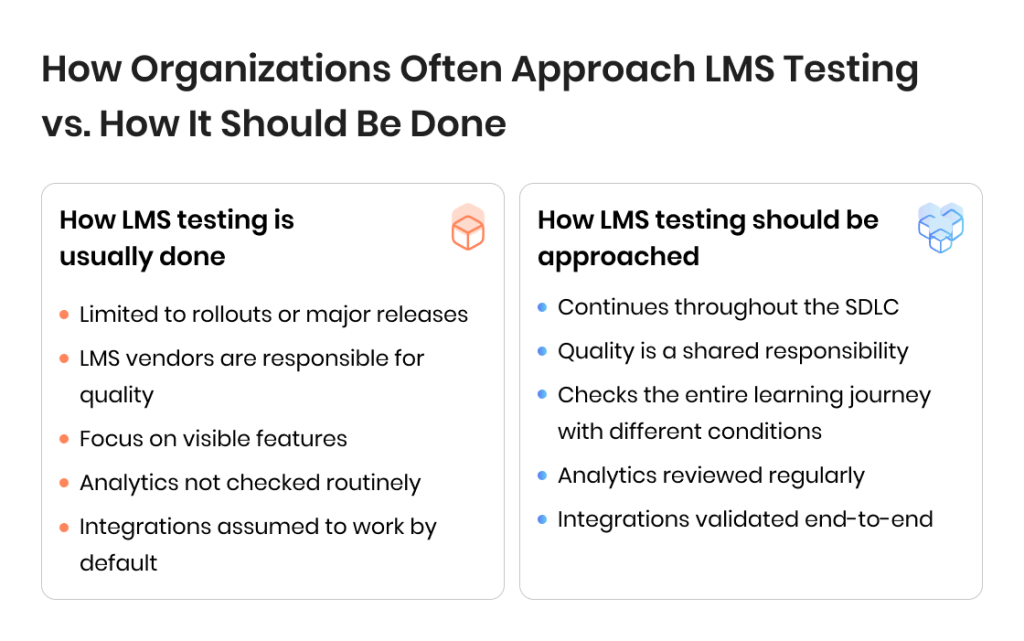
How Organizations Often Approach LMS Testing vs. How It Should Be Done
Organizations often approach LMS testing with reasonable intentions, focusing on launch readiness and visible functionality. However, the way testing is handled in practice does not always reflect how learning platforms are used over time. The contrast below highlights common patterns in LMS testing and outlines a more effective way to reduce risk as learning programs grow, change, and become more critical to daily operations.
How LMS testing is often handled
Testing is limited to initial rollout or major releases, with little attention afterward
Responsibility for quality is assumed to sit mainly with LMS vendors
Focus is placed on visible features rather than long-term learning flows
Reporting and analytics are checked only when issues are raised
Integrations are assumed to work if no errors are shown in the interface
How LMS testing should be approached
Testing continues as the LMS is used, updated, and expanded over time
Quality responsibility is shared between vendors and organizations using the platform
Learning journeys are checked across sessions, roles, and devices
Reporting and analytics are reviewed as business-critical outputs
Integrations are examined end-to-end, including data timing and edge cases
Let’s build a QA strategy that minimizes spending and maximizes impact
Reducing LMS risk does not require exhaustive testing or complex processes. It requires focusing attention on the areas where learning platforms most often fail in real use. These proven best practices reflect patterns seen in organizations that rely on their LMS for ongoing learning, compliance, and reporting:
Focus on learning flows, not isolated features. Testing should reflect how learners move through courses over time, including pauses, returns, reassigned content, and role-based actions, rather than checking individual screens in isolation.
Revisit testing after content and configuration changes. LMS risk increases when courses, learning paths, user roles, or rules change, even if the platform itself does not. These updates deserve the same attention as software releases.
Treat reporting and analytics as business-critical outputs. Progress data, assessment results, and completion records should be reviewed with the same care as financial or operational reports, since they often support audits and management decisions.
Pay extra attention to integrations and data flow. User provisioning, enrollments, and completion data moving between systems are common failure points. Issues here often remain hidden until they affect large groups.
Test under peak usage, not average conditions. The most disruptive LMS issues appear during onboarding waves, deadlines, or certification periods. Preparing for these moments helps avoid last-minute failures and manual workarounds.
Include different roles in testing scenarios. Learners, instructors, managers, and administrators interact with the same system in different ways. Checking how their actions affect one another helps surface permission and visibility issues early.
The best LMS testing strategies are less about adding effort and more about directing it wisely. When testing reflects real usage and real risk, it becomes a practical way to protect learning programs as they grow and change.
Our Approach to LMS Testing
Our work with LMS solutions starts with a simple premise: learning platforms succeed or fail based on how they behave in real conditions, not on how they look during isolated checks. That’s why we approach LMS testing as an exercise in understanding usage patterns, data dependencies, and operational pressure points, rather than as a checklist of features to review. We focus on how learning flows unfold over time, how data moves across systems, and how small inconsistencies can grow into larger risks once learning programs scale.
We also recognize that LMS platforms rarely stand alone. They sit at the intersection of content, users, reporting, and integrations, often supporting business-critical training or compliance programs. Our testing work reflects this reality by paying close attention to long-running scenarios, role-based interactions, and the integrity of learning data across weeks or months of activity. This perspective helps surface issues that are easy to miss during short testing cycles but can be expensive to resolve later.
In practice, our approach is guided by a few consistent principles:
Test around real usage patterns, not ideal paths. We prioritize scenarios that reflect how learners, managers, and administrators actually interact with the system over time.
Treat learning data as a first-class concern. Progress, assessments, and reporting mechanisms receive the same amount of attention as visible functionality.
Focus on risk concentration points. Integrations, learning rules, role changes, and peak usage periods receive disproportionate attention because that’s where failures accumulate.
Support change, not just stability. Testing is designed to help LMS platforms adapt to new content, users, and configurations without introducing hidden issues.
This approach allows us to support LMS platforms as living systems that change and grow, rather than as static products that are “done” once launched.
Final Thoughts
Learning platforms often sit quietly in the background of an organization until something goes wrong. When that happens, the impact is rarely limited to a technical issue — it affects learners, managers, reporting, and trust in the learning program itself. The quality of an LMS is not about perfection, but about confidence: confidence that learning continues smoothly, data can be relied on, and change does not introduce new risk.
Reflecting on how LMS testing is approached is an opportunity to move away from reactive fixes and toward a more deliberate mindset. When testing is based on real learning behavior and real operational risk, it becomes a practical quality enforcer for programs that are meant to grow, adapt, and support the organization over time.
FAQ
When should LMS testing be done?
Learning management system (LMS) testing should not be limited to initial rollout. It is especially important after content updates, configuration changes, integrations, or periods of heavy use. Treating testing as an ongoing activity helps catch issues before they affect learners or reports.
What does an LMS testing process usually include?
An LMS testing process typically focuses on learning workflows, assessments, reporting, integrations, and performance under realistic conditions. Rather than checking every feature, it concentrates on how learning data is created, stored, and used across the system.
How is LMS testing different from testing other business systems?
Testing an LMS requires attention to long-running learning journeys, interruptions, role-based behavior, and data accuracy over time. Many issues only appear weeks later or during peak usage, which makes LMS testing different from short, transactional systems.
Is LMS testing only relevant for large organizations?
No. Smaller organizations often feel the impact of LMS issues more strongly because they rely on fewer systems and have less capacity for manual fixes. Testing helps prevent small problems from turning into ongoing operational headaches.
What are the first signs that an LMS needs better testing?
Common signals include frequent learner complaints, manual fixes to reports, inconsistent completion data, or support tickets related to access and enrollments. These symptoms often indicate deeper issues that structured LMS testing can help uncover before they escalate.
Share:
Jump to section
Hand over your project to the pros.
Let’s talk about how we can give your project the push it needs to succeed!
Inna is a content writer with close to 10 years of experience in creating content for various local and international companies. She is passionate about all things information technology and enjoys making complex concepts easy to understand regardless of the readers tech background. In her free time, Inna loves baking, knitting, and taking long walks.
Michael has more than 10 years of experience in software testing and a strong technical background in e-commerce, telecom, and customer support projects. He excels in creating, reviewing and maintaining project documentation from requirements and functionality descriptions to test plans and checklists.







 When should LMS testing be done?
 When should LMS testing be done?