The tricky thing about telecom failures is how quiet they are. A network doesn’t usually crash in a way anyone notices right away. Instead, an activation hangs, a bill comes out wrong, or quality deteriorates a little at a time until thousands of people are affected and only then does someone flag it. When your whole business runs around the clock, a defect that small can still cost a lot, both operationally and financially.
Telecom testing exists to prevent just that, and it’s exactly what we’re talking about today. We’ll look at what testing for telecom really involves, what sets it apart from other domains, and how teams use it to deal with risk across networks, platforms, and business processes, keeping services reliable and worth the trust users put in them.
Key Takeaways
Telecom testing examines system behavior across networks, platforms, and business processes, since most failures arise from interactions rather than isolated components.
The complexity of telecom networks makes end-to-end testing more valuable than deep testing of individual modules.
Testing in the telecom industry is continuous by necessity, as services must stay available during upgrades and configuration changes.
Telecom domain testing emphasizes data flows, integrations, and long-running service states where high-impact defects often remain hidden.
Billing, rating, and usage processing are among the highest-risk areas, making telecom software testing critical for revenue protection.
Performance testing in telecom environments focuses on behavior under variable and unpredictable load, not ideal conditions.
OSS and BSS interactions are common failure points, increasing the value of integration-focused test scenarios.
The quality of telecom products depends more on a consistent testing process than on individual test cases.
What Is Telecom Testing? Understanding Telecom Testing and Its Importance
Telecom testing is the process of examining how a telecom system works across networks, software components, and supporting business processes. Unlike general software testing, testing in the telecom domain focuses on large, interconnected environments where changes in one area can affect many services at once.
This includes testing telecom applications, backend platforms, and telecom networks that support voice, data, messaging, and digital services. In practice, testing telecom systems means checking how technical behavior and business logic interact under real operating conditions.
Why telecom testing is important
Telecom services must be consistently available, even during upgrades, migrations, and configuration changes. Testing ensures that telecom products and services continue to work as expected while the system is under load or partially changing.
From a business perspective, telecom testing helps identify issues that affect revenue, customer trust, and regulatory compliance. This is why testing is essential throughout the testing lifecycle, not only before release but during ongoing changes within the telecom industry.
We’ll find and fill the gaps in your testing strategy to make it work in your favor.
Telecom software testing delivers value far beyond technical quality. Because telecom systems support revenue generation, customer communication, and regulatory obligations at a large scale, the impact of testing is felt across both technical and business functions. Understanding the benefits of telecom testing helps decision-makers assess where testing effort provides the greatest return and why it remains a critical part of operating reliable telecom services.
Reduced revenue risk
Telecom systems handle high volumes of usage data, pricing rules, and billing logic. Telecom software testing helps detect issues in rating, charging, and invoicing before they affect large numbers of customers. Early detection limits revenue leakage and prevents long-running billing errors that are costly to correct after release.
More reliable telecom services
Telecom services must be consistently available across different regions, devices, and network conditions. Performance testing and network testing help confirm that telecom services behave predictably under peak load, configuration changes, and partial outages. This level of testing supports stable network operations and fewer service disruptions.
Lower operational pressure
Defects that reach production often create additional work for support, operations, and engineering teams. Testing helps identify failures in telecom applications and backend systems earlier, reducing incident volume and follow-up effort. As a result, teams can focus more on planned improvements instead of reactive fixes.
Faster introduction of new services
The telecom industry is constantly introducing new offers, network services, and digital products. A structured testing process allows telecom companies to release updates with greater confidence, even when multiple systems are involved. This is especially important when launching services related to 5G network capabilities or complex bundled offerings.
Better customer experience and retention
Service interruptions, incorrect bills, and activation failures quickly and often irreparably affect customer trust. Thorough testing helps ensure that telecom products and services work as expected from the first interaction onward. Stable service behavior supports long-term customer relationships and reduces churn driven by avoidable issues.
Stronger control over complex systems
The complexity of telecom networks and integrations makes it difficult to predict the full impact of change. Comprehensive testing provides visibility into how different components interact, helping teams understand risk areas and plan changes more carefully. This is especially valuable when working with legacy systems alongside newer platforms.
Words by
Rick Elmore, CEO & Founder, Simply Noted
“The most critical quality risks I see [in telecom] are reliability and latency: even minor disruptions in carrier integrations can cascade into major customer-facing issues. Unlike many industries, telecom testing must prioritize scale, real-time performance, and interoperability across carriers, regions, and legacy systems.”
How Is Testing for the Telecom Industry Different From Other Industries?
Testing practices often look similar across industries at a high level, but the realities behind them differ significantly. In the telecom industry, testing is shaped by scale, continuous operation, and tightly connected systems that support critical communication services. Understanding how telecom testing differs from testing in other industries helps decision-makers avoid applying generic approaches to environments where they are unlikely to work.
“Telecom testing focuses on feature velocity less than on network resilience and uptime, since the breakdown of service impacts vital infrastructure. The failure of telecom can shut down emergency services or business communication, unlike in consumer software, where bugs lead to inconvenience. Chaos engineering and fault injection are the major aspects of testing, which intentionally destroy components to test redundancy and failover.”
Scale and concurrency as a baseline
In many industries, testing focuses on individual transactions or user sessions. In the telecom industry, testing starts with the assumption of high concurrency and constant activity. Telecom networks handle large volumes of simultaneous calls, messages, and data sessions, which makes performance testing and network testing a core requirement rather than an optional step.
Testing helps confirm that telecom services remain stable during traffic spikes, network changes, and maintenance windows, where even small misconfigurations can affect thousands of users at once.
Heavy dependence on integrations
Telecom systems rarely operate as standalone applications. Testing telecom environments means working with tightly connected OSS (Operations Support Systems), BSS (Business Support Systems), billing platforms, mediation systems, and customer-facing telecom applications. A change in one component often triggers effects across multiple systems.
Compared to industries with simpler architectures, telecom testing requires extensive interoperability testing to ensure that data flows correctly between platforms and that services behave consistently from activation through billing and support.
Long-lived systems and partial modernization
Many telecom providers operate systems that have been in place for years, sometimes decades. Testing in the telecom domain often takes place in environments where legacy platforms coexist with newer services, APIs, and cloud-based components.
This differs from newly built software projects, where testing can focus on a single technology stack. Telecom testing must account for backward compatibility, gradual migration, and the risk introduced by changes that affect long-running customer contracts and historical data.
Strong link between technical behavior and business impact
In other industries, defects may be limited to a specific feature or user flow. Within the telecom industry, failures in rating, charging, or provisioning can have immediate financial and regulatory consequences. Testing helps identify issues that are not always visible at the interface level but appear in backend data processing and reporting.
This close connection between technical behavior and business outcomes shapes the testing process and drives the need for specialized telecom testing services.
Continuous operation under regulatory pressure
Telecom services must be consistently available while meeting strict regulatory and security requirements. Security testing and compliance-related checks are not isolated activities but part of ongoing testing throughout the testing lifecycle.
Unlike industries with flexible downtime windows, telecom companies must perform testing in environments that reflect real operating conditions, where interruptions are limited and changes must be carefully managed.
Test more efficiently without increasing your QA budget — let us show you how you can have it all.
Business Processes in the Telecom Industry and How They Impact Testing
Telecom testing is closely tied to how telecom companies deliver and manage their products and services. Business processes in the telecom industry define how services are created, activated, billed, supported, and retired. Each of these steps introduces specific risks that testing must address to avoid service disruption, revenue loss, or customer dissatisfaction.
Service provisioning and activation
Service provisioning is one of the most sensitive processes in the telecom domain. It often spans multiple systems, from order management and network configuration to customer-facing telecom applications. Testing helps ensure that services are activated correctly across all involved platforms and that failures are handled without leaving partial or inconsistent states.
Test scenarios in this area focus on successful activation, delayed provisioning, rollbacks, and reactivation after changes. Errors at this stage frequently lead to customer complaints and increased operational workload.
Words by
Igor Kovalenko, QA Lead, TestFort
“In my experience, one of the most overlooked aspects of provisioning testing is the “partial success” scenario. We had a case where order creation succeeded, network configuration completed, but the final confirmation to the CRM failed silently. The customer received a “service active” SMS while the billing system showed them as inactive. It took three weeks and hundreds of affected customers before support patterns revealed the issue. Now we always include explicit verification checkpoints at each system boundary, not just at the start and end of the flow.”
Usage rating, charging, and billing
Rating and billing processes are at the center of telecom revenue. They depend on accurate usage data, complex pricing rules, and correct integration between mediation, billing, and finance systems. Testing is essential to confirm that charges are calculated correctly across different plans, regions, and usage patterns.
Telecom test cases for billing often include edge conditions such as high traffic volumes, roaming scenarios, discounts, and corrections. Without thorough testing, billing issues can remain hidden until they affect a large number of customers.
Words by
Igor Kovalenko, QA Lead, TestFort
“Billing edge cases are where telecom testing gets really interesting. I recall a project where everything worked perfectly in testing until we hit a customer who had been on the same plan for 12 years with accumulated legacy discounts, promotional credits, and a long-standing roaming deal. The rating engine was unable to handle the discount stacking order and charged them negative amounts. The lesson: always include ‘long-tenure customer’ profiles in your test data — fresh accounts behave nothing like accounts with years of service history.”
Network operations and service assurance
Network operations rely on continuous monitoring, configuration management, and incident response. Testing supports these processes by checking how the telecom system reacts to configuration changes, equipment failures, and traffic shifts.
Active testing of network services and realistic network traffic to test performance help teams understand how services behave under stress. This type of testing provides insight into system limits and supports more predictable network operations.
Customer support and issue resolution
Customer support processes depend on accurate service data and reliable system behavior. When information across systems is inconsistent, support teams struggle to diagnose issues and resolve tickets efficiently.
Testing helps identify gaps between network behavior, backend systems, and customer-facing information. By confirming that data remains consistent across platforms, testing reduces resolution time and improves the overall customer experience.
Service changes and lifecycle management
Telecom services are rarely static. Customers upgrade plans, add options, suspend services, or cancel contracts. Each change triggers updates across multiple systems and datasets.
A consistent testing process ensures that these transitions work correctly and that historical data remains intact. This is especially important in long-lived telecom systems where changes accumulate over time and can introduce unexpected behavior.
The role of OSS and BSS in telecom business processes
Many core business processes in the telecom industry are split between OSS and BSS platforms. Operational Support Systems typically manage network-related activities such as service provisioning, configuration, and service assurance, while Business Support Systems handle ordering, pricing, billing, and customer data.
From a testing perspective, this separation creates a critical dependency on data flow and process coordination. Actions initiated in BSS platforms often trigger changes in OSS systems, and feedback from the network must be reflected correctly back to customer-facing systems. Testing telecom environments therefore requires checking not only individual system behavior, but also how information moves between OSS and BSS across the full service lifecycle.
Gaps between these platforms are a common source of issues in telecom systems. Without testing that covers OSS and BSS interactions, defects may remain hidden until they affect billing accuracy, service availability, or customer support operations.
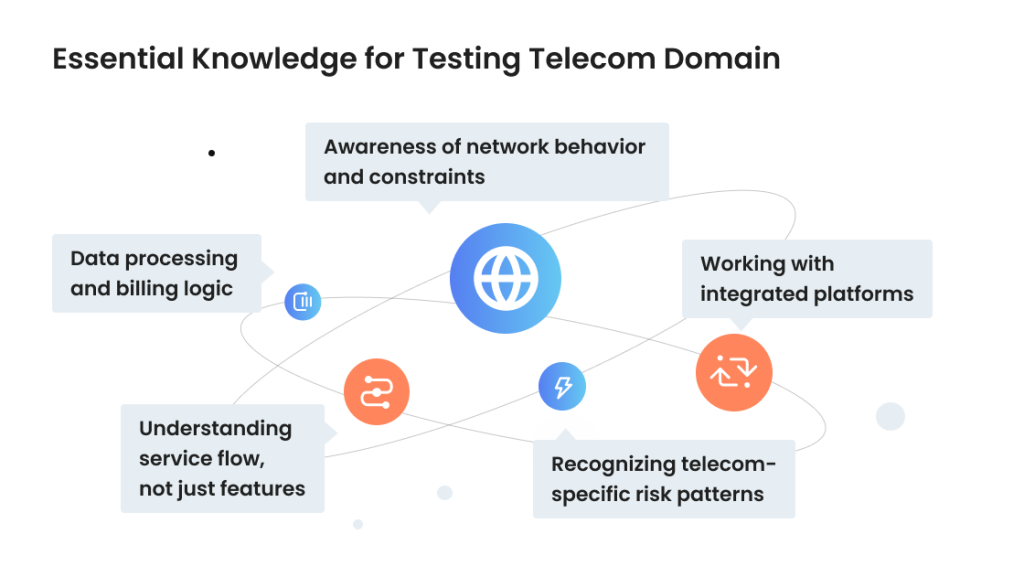
Essential Knowledge for Testing Telecom Domain
To test telecom systems well, you have to understand how the technical side, the way the network behaves, and the underlying business rules all impact each other once things are actually running. A feature passing a test in isolation doesn’t tell you much here. What actually counts is whether it still behaves when it’s embedded into a system that never sleeps and where everything affects everything else.
Understanding service flow, not just features
Telecom services follow long, multi-step flows that begin with ordering and continue through provisioning, usage, billing, and support. Testing telecom domain applications requires an understanding of how these steps connect and how errors in one stage affect the rest of the service lifecycle.
Without this perspective, test coverage may appear complete while critical paths remain untested, especially in scenarios involving service changes, retries, or partial failures.
Awareness of network behavior and constraints
Telecom applications operate on top of physical and virtual network infrastructure. Testing the telecom domain means recognizing how latency, packet loss, congestion, and configuration changes influence service behavior.
This knowledge shapes test scenarios for network services, performance testing, and compatibility testing across various devices and access types. It also helps teams interpret test results correctly instead of treating network-related behavior as random or environment-specific noise.
Data processing and billing logic
Much of the risk in telecom systems sits in data processing rather than user interfaces. Usage records, rating rules, discounts, and adjustments are processed across multiple systems and often in near real time.
Testing telecom domain applications requires familiarity with how this data is generated, transformed, and consumed. Without it, defects in billing logic, reporting, or reconciliation may pass through testing unnoticed until they affect revenue or compliance.
Working with integrated platforms
Telecom systems depend on extensive integration between network platforms, backend systems, and customer-facing applications. Testing various telecom applications in isolation does not reflect how services behave in production.
Knowledge of system boundaries, data ownership, and integration points is essential for designing test cases that reflect real conditions and for identifying where issues are likely to surface first.
Recognizing telecom-specific risk patterns
Telecom challenges often repeat across projects: delayed provisioning, inconsistent service states, duplicate charges, and mismatched customer data. Testing helps address these risks only when teams recognize them early and design tests around known failure patterns.
Words by
Rick Elmore, CEO & Founder, Simply Noted
“The hardest components to test [in telecom] are network-dependent services such as SMS routing, number validation, and failover handling, because outcomes can vary by carrier and geography. With 5G and IoT, testing complexity has increased due to higher device density and real-time expectations.”
This type of knowledge is built through experience with telecom technologies and previous incidents, not through generic software testing practices alone.
How 5G, IoT, and Other Developments in Telecommunications Influence Testing
Telecom is being heavily influenced by a wave of newer technology, and it’s changing how services get built, delivered, and tested. 5G networks, IoT platforms, virtualized infrastructure — they buy you flexibility and scale, but they also come with testing demands that the older telecom playbook was never designed to handle. Here is how new technologies affect telecom testing.
5G networks and dynamic service behavior
The move to 5G network architectures introduces higher data volumes, lower latency expectations, and more dynamic service behavior. Testing in 5G environments focuses on performance testing under variable load, compatibility testing across devices, and service stability during frequent configuration changes, where behavior may shift without a clear release boundary.
IoT and large-scale device diversity
IoT expands telecom systems to support large numbers of devices with different protocols, traffic patterns, and reliability profiles. Testing telecom applications that support IoT requires simulating irregular usage, long idle periods, and sudden traffic spikes. Network simulation tools are often used to create realistic network traffic to test how systems respond to device-driven behavior at scale.
Virtualized and software-driven infrastructure
Virtualized and software-driven telecom infrastructure replaces fixed network equipment with configurable components that change more frequently. Testing in these environments places greater emphasis on integration behavior, failover scenarios, and traffic to test security infrastructure, especially when multiple services share the same underlying platforms.
Security and exposure at scale
As telecom systems become more interconnected and open, security testing grows in importance. Increased exposure through APIs, device connectivity, and shared infrastructure requires network traffic to test security and access control under realistic conditions, rather than isolated checks.
Continuous change as a testing condition
Developments such as 5G, IoT, and cloud-based telecom platforms increase the pace of change. New services are introduced alongside existing ones, often without clear boundaries between generations of technology.
Testing is done in environments that are constantly changing, which places greater emphasis on efficient and reliable testing processes and end-to-end testing automation solutions. These approaches support ongoing testing without interrupting live telecom services.
New blog post: Software testing trends to watch out for in 2026
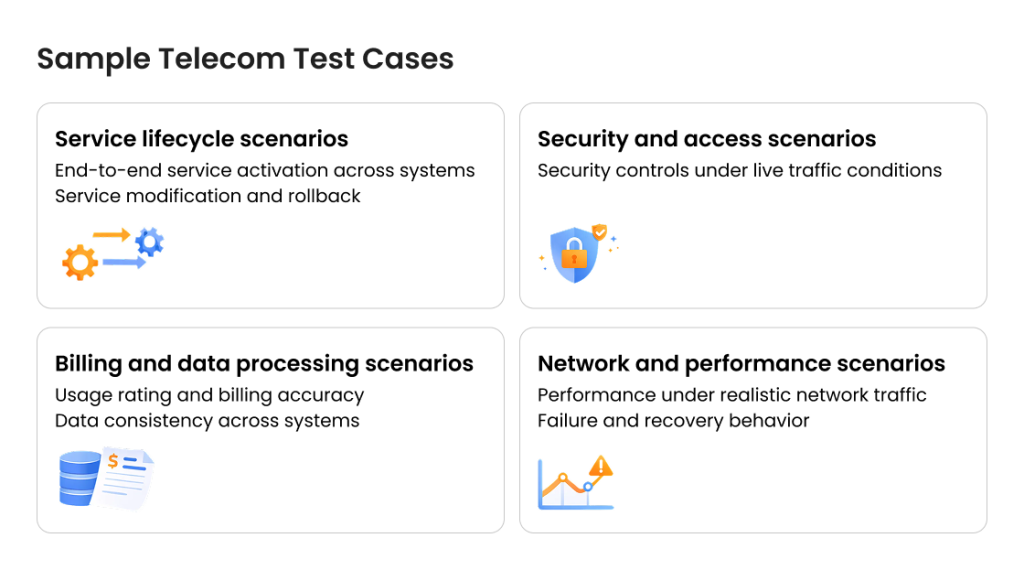
Telecom test cases are most useful when they reflect real service behavior rather than isolated features. The examples below illustrate how testing telecom systems focuses on end-to-end scenarios that combine network behavior, data processing, and business logic. These test scenarios show where testing helps identify risks that have the greatest operational and financial impact.
Service lifecycle scenarios
End-to-end service activation across systems
What is being tested: Service activation from order creation through provisioning in network platforms and confirmation in customer-facing telecom applications.
Why it matters: Incomplete activation leads to inconsistent service states, delayed billing, and increased support workload.
Service modification and rollback
What is being tested: Changes to an active service, including plan upgrades, add-ons, and rollback after a failed update.
Why it matters: Errors during service changes often leave residual configurations that affect future usage and billing accuracy.
Billing and data processing scenarios
Usage rating and billing accuracy
What is being tested: Processing of usage records through rating, charging, and invoicing under normal and peak conditions.
Why it matters: Testing helps to identify billing defects that may affect revenue and customer trust if left undetected.
Data consistency across systems
What is being tested: Synchronization of customer, service, and usage data between backend platforms and reporting systems.
Why it matters: Inconsistent data complicates customer support and hides defects until they escalate.
Security and access scenarios
Security controls under live traffic conditions
What is being tested: Network traffic to test security infrastructure, access control, and data protection during active service use.
Why it matters: Security testing helps identify exposure points that are not visible during isolated checks.
Network and performance scenarios
Performance under realistic network traffic
What is being tested: Service behavior under realistic network traffic to test throughput, latency, and stability.
Why it matters: Performance testing provides insights into system limits and prevents service degradation during peak usage.
Failure and recovery behavior
What is being tested: System response to partial network failures, retries, and recovery without full service interruption.
Why it matters: Predictable recovery behavior reduces the operational impact of outages.
The complete load testing guide: How to be fully prepared for any scenario
Telecom testing is not a linear sequence of steps, but rather a continuous activity shaped by system scale, service complexity, and ongoing change. The testing process focuses on reducing risk in areas that affect service continuity, revenue, and customer experience, while accounting for shared environments and tightly connected platforms across the telecom domain. This is how testing of telecom solutions is typically performed.
Define testing scope based on services and risk
Effective testing starts by identifying which telecom services and business flows carry the highest risk. Rather than testing every component in isolation, teams focus on critical service paths such as provisioning, usage processing, billing, and service changes. This approach ensures that testing is done where failures have the greatest operational and financial impact.
Prepare environments and data for realistic conditions
Testing telecom systems requires environments and data that reflect real usage as closely as possible. Shared or partially mirrored environments are common within the telecom industry, which makes it important to account for background traffic, configuration changes, and historical data. Preparing realistic datasets supports a consistent testing process and improves confidence in test results.
Test integrations and end-to-end service flows
Telecom services depend on coordinated behavior across OSS, BSS, network platforms, and customer-facing applications. Testing telecom domain applications therefore focuses on end-to-end flows rather than isolated functions. This stage of the testing lifecycle helps identify gaps in data exchange and process handoffs that are often missed by component-level testing.
Assess performance and network behavior
Performance testing and network testing play a central role in telecom environments. Testing is done under varying load conditions and realistic traffic patterns to understand how services behave during peak usage, configuration changes, and partial failures. Performance testing provides insights into system limits and supports more predictable network operations.
Apply regression testing and automation selectively
Regression testing is essential as telecom systems change frequently. Test automation supports repeatable testing of stable service flows and integrations, while manual testing remains important for complex scenarios and investigations. Balancing these approaches helps maintain coverage without creating excessive maintenance effort.
Review results in terms of operational impact
The outcome of telecom testing is best assessed by its effect on service stability and operational readiness. Instead of focusing only on defect counts, teams review how identified issues affect network services, customer experience, and support operations. This perspective connects testing results directly to business decision-making.
Popular Telecom Testing Tools and How to Pick the Right Ones
Telecom testing relies on a wide range of tools that support different parts of the testing lifecycle, from network behavior and performance to integration and security. Because telecom systems span networks, platforms, and applications, no single testing solution can cover all needs. The goal is not to use more tools, but to select testing tools that fit the structure and risks of a specific telecom system.
Tool
Key capabilities
Limitations
Best for
Integration & API testing tools
Postman/SoapUI
API testing across OSS, BSS, and mediation layers; supports contract and data consistency checks
Limited support for complex service flows and high-volume scenarios
Early integration testing and service flow verification
ReadyAPI
API testing with data-driven scenarios and integration chaining
Requires setup effort for large telecom environments
Testing complex OSS/BSS interactions
Network and performance testing tools
JMeter
Load and performance testing for telecom applications and APIs; supports protocol extensions
Requires customization for telecom-scale traffic patterns
Performance testing of backend services
LoadRunner
High-scale performance testing for telecom systems and network services
Licensing cost and operational complexity
Large-scale performance and stress testing
Network simulation tools
iTrinegy/Spirent
Network simulation tools for realistic latency, packet loss, and bandwidth conditions
Focused on network behavior rather than business logic
Realistic network traffic to test service behavior
Custom simulators
Simulate telecom devices, traffic profiles, and protocol behavior
High development and maintenance effort
IoT and specialized telecom scenarios
Security testing tools
Burp Suite
Security testing of telecom applications, APIs, and access control
Limited insight into network-level threats
Application-layer security testing
Nessus
Vulnerability scanning for telecom infrastructure and services
Requires interpretation in telecom context
Baseline security testing and exposure checks
Test automation frameworks
Selenium/Playwright
Automation of telecom app testing for customer-facing interfaces
Not suitable for network or backend-heavy scenarios
Stable UI-based service flows
Custom automation frameworks
Automation across APIs, workflows, and data checks
Higher setup and maintenance cost
Regression testing of core telecom services
How to choose the right tools for telecom testing
Choosing testing tools for telecom environments starts with understanding the telecom system rather than comparing feature lists. Tools should support the way services are delivered, tested, and changed in practice. Here is how to assemble a comprehensive toolset for your project.
Start with system coverage, not features. Testing tools should support the full telecom system, including OSS, BSS, network platforms, and customer-facing applications. Tools that focus on isolated components often leave gaps in end-to-end service testing.
Check support for realistic traffic and scale. Telecom testing tools must handle traffic volumes and patterns that reflect real usage. Solutions that perform well in small environments may not expose issues that appear under peak load or during service changes.
Evaluate integration and data handling capabilities. Tools should work well with complex data flows, asynchronous processing, and long-running service states. Weak data handling limits the ability to test billing, provisioning, and reporting scenarios.
Balance automation with operational effort. Test automation can improve repeatability, but only when maintenance effort remains manageable. Tools that require constant updates may reduce the effectiveness of testing over time.
Fit tools into an existing testing process. The best tools support how testing is already organized across teams and environments. Forcing a new testing solution to dictate processes often creates friction and delays.
Consider long-term sustainability. Telecom systems change continuously, so testing tools should adapt without frequent redesign. Sustainable tooling supports efficient and reliable testing processes across the testing lifecycle.
Common Challenges in Telecom Testing
Telecom testing is shaped by scale, continuous operation, and tightly connected systems. These conditions create challenges that differ from those in other industries and often limit the effectiveness of generic testing approaches. These are the challenges that telecom teams often encounter in testing.
Complexity of telecom networks
The complexity of telecom networks makes it difficult to isolate issues during testing. Telecom systems combine network equipment and services, backend platforms, and customer-facing telecom applications that must operate together without interruption. Small changes can affect multiple services at once, which increases the need for comprehensive testing across the full system.
Unstable and shared test environments
Testing in the telecom domain often takes place in environments that are shared with live systems or only partially reflect production. Background traffic, configuration changes, and external dependencies can influence test results. This makes it harder to distinguish real defects from environment-related behavior during testing.
Words by
Igor Kovalenko, QA Lead, TestFort
“Shared test environments are a constant battle. On one project, our test results became unreliable every Thursday afternoon. After weeks of investigation, we discovered that another team was running load tests on the same shared database component at the exact same time. We now maintain an environment usage calendar and tag all test runs with environment state snapshots. It’s extra overhead, but it saves countless hours of chasing phantom defects.”
OSS and BSS integration risks
Many core processes depend on data passing correctly between OSS and BSS platforms. Gaps in integration testing can lead to inconsistent service states, delayed provisioning, or billing issues that are difficult to detect through isolated test cases. Testing telecom systems must therefore account for cross-platform behavior, not just individual components.
Difficulty reproducing real network traffic
Many telecom issues appear only under specific load or usage conditions. Creating realistic network traffic to test performance, reliability, and security requires specialized tools and resources. Without this, performance testing and network testing may miss problems that surface only at scale.
Data volume and lifecycle complexity
Telecom systems process large volumes of data over long periods, often across changing services and plans. Testing helps identify issues in data processing and reporting, but only when test data reflects real usage patterns and service history. Simplified datasets frequently hide defects.
Continuous change across services and infrastructure
The telecom industry is constantly introducing new services, technologies, and regulatory requirements. Testing must be done alongside ongoing system changes, which increases pressure on teams to maintain stability without slowing delivery. This requires careful prioritization and a consistent testing process.
We’ll help ensure your testing budget is spent on what actually protects quality.
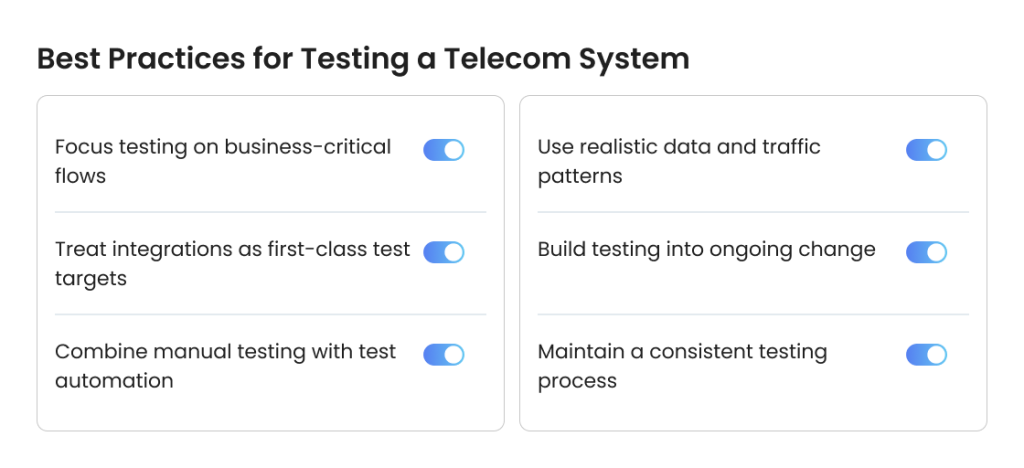
Standard QA techniques will only get you so far with telecom. These are systems running at an enormous scale, deeply connected with each other, and never really switched off, which means testing has to weigh not just how something behaves technically but what it costs the business when it goes wrong. The practices below are the ones experienced teams tend to use to keep risk in check and keep telecom services reliable.
1. Focus testing on business-critical flows
Testing telecom systems is most effective when it follows real service flows rather than isolated features. Prioritizing scenarios such as service activation, usage processing, billing, and service changes helps teams concentrate testing effort where failures have the greatest business impact. This approach supports thorough testing without attempting to cover every possible variation.
2. Treat integrations as first-class test targets
Telecom systems depend heavily on integration between OSS, BSS, network platforms, and customer-facing applications. Best practices for telecom testing include designing test cases that span multiple systems and verify how data moves across boundaries. Integration issues are a common source of production defects and require explicit attention in the testing process.
3. Combine manual testing with test automation
Test automation plays an important role in telecom testing, especially for regression testing and repeated service flows. At the same time, manual testing remains critical for complex scenarios, configuration changes, and investigations that depend on system behavior rather than predefined steps. Using both approaches supports a more comprehensive testing strategy.
4. Use realistic data and traffic patterns
Testing is more reliable when it reflects how telecom services are used in real conditions. This includes realistic customer data, long-running service states, and network traffic patterns. Network simulation tools and controlled traffic generation help teams understand system behavior under load and reduce surprises after release.
5. Build testing into ongoing change
Telecom systems rarely stand still. Best practices emphasize testing throughout the testing lifecycle, including upgrades, migrations, and configuration changes. Regular testing during change helps teams detect issues earlier and reduces risk when multiple updates occur in parallel.
6. Maintain a consistent testing process
A consistent testing process helps teams manage complexity across long-running telecom systems. Clear test ownership, documented test scenarios, and shared visibility into results support repeatable testing even as systems and teams change. Consistency improves confidence in results and supports efficient decision-making.
Words by
Igor Kovalenko, QA Lead, TestFort
“A practical tip: map your test priorities to the support ticket categories. When we analyzed six months of production incidents, we found that 60% of high-severity tickets came from just three service flows — plan migrations, number portability, and bundle activations. We restructured our entire regression suite around these flows and reduced escaped defects by 40% in the following quarter. Let your production data guide your testing focus.”
Our Approach to Testing Telecom Solutions
Telecom testing works best when it reflects how telecom systems actually fail in production. TestFort’s approach is shaped by practical experience with large, interconnected environments where issues usually appear at scale and often outside individual features. Here is how our QA team handles complex telecom testing projects.
Risk-driven test prioritization
We do not try to test everything at the same time. Testing effort is directed toward areas where failures cause the most damage, such as billing, rating, and charging, along with high-frequency flows like service activation and plan changes. Integration points between OSS and BSS systems and known incident patterns are treated as priority risk zones.
End-to-end service flow testing
Telecom services are tested as full service journeys, not isolated features. We follow how a service moves from order to provisioning, activation, usage, billing, and support, with particular attention to handoff points between systems. A feature that works on its own but fails in the flow is still considered a defect.
Production-like data as a baseline
New test accounts rarely reflect real customer behavior. We rely on realistic data that includes long service histories, legacy pricing rules, discount combinations, roaming cases, and past plan changes. These conditions expose issues that clean datasets tend to hide.
Integration-first test design
Most serious telecom incidents come from integration gaps rather than individual features. Our tests focus on API behavior, asynchronous processing, retry logic, and data consistency across systems. This helps surface issues that only appear when platforms interact under real conditions.
Environment stability as a quality factor
Unstable environments make test results unreliable. We address this early by coordinating environment usage, establishing baseline states, and separating functional and performance testing windows. Stable environments are treated as part of testing quality, not just infrastructure.
Selective automation with long-term value
Automation is used where it delivers lasting benefit. Stable service flows and billing scenarios are automated, while complex investigations and new integrations are handled manually. Automation is maintained actively to avoid becoming a maintenance burden.
Business-focused test reporting
Test results are presented in terms of business impact. Instead of focusing on execution metrics, we highlight revenue risk, customer experience impact, operational load, and compliance readiness. This keeps testing outcomes relevant to decision-making.
Final Thoughts
Everything about telecom testing comes back to the specifics of the telecom industry: huge scale, always on, and every system tied to the next. A generic approach can verify individual features, but it tends to come apart in an environment where network behavior, data processing, and business processes can’t really be separated.
Strong testing here is aimed at one thing above all — keeping operational and financial risk low while the system keeps changing in real time. That takes real domain knowledge, conditions that mirror what actually happens in production, and a testing process steady enough to hold up as services grow. This is why telecom companies can’t treat testing as a box to check at the end. It’s ongoing work, and it’s what keeps services stable, customers trusting the network, and the whole system healthy over the long haul in an industry where all of that is hard-won and easily lost.
FAQ
What is telecom testing, and why is it different from general software testing?
Telecom testing focuses on systems that combine software, networks, and business processes operating continuously at scale. Unlike general software testing, it must account for integrations, real network behavior, billing accuracy, and service continuity across many interconnected platforms.
Is telco testing the same as telecom testing?
Yes, telco testing is commonly used as an informal term for telecom testing. Both refer to testing telecom systems, networks, and services. In practice, they are interchangeable and describe the same testing scope within the telecommunications industry.
When should telecom testing start in a project?
Telecom testing should begin as soon as service design and system changes are defined. Early testing helps identify integration risks, data issues, and configuration problems before they affect network operations, billing, or customer-facing telecom applications later in the testing lifecycle.
What does telecom domain testing usually cover?
Telecom domain testing covers service provisioning, usage processing, billing, integrations between OSS and BSS, network behavior, and customer support flows. It focuses on how services behave end to end rather than testing individual components or features in isolation.
What are the biggest risks of skipping thorough telecom testing?
Skipping thorough telecom testing increases the risk of service outages, incorrect billing, inconsistent customer data, and operational overload. Because telecom services run continuously, defects can spread quickly and affect many users before they are detected and corrected.
Share:
Jump to section
Hand over your project to the pros.
Let’s talk about how we can give your project the push it needs to succeed!
Inna is a content writer with close to 10 years of experience in creating content for various local and international companies. She is passionate about all things information technology and enjoys making complex concepts easy to understand regardless of the readers tech background. In her free time, Inna loves baking, knitting, and taking long walks.
An experienced QA engineer with deep knowledge and broad technical background in the financial and banking sector. Igor started as a software tester, but his professionalism, dedication to personal growth, and great people skills quickly led him to become one of the best QA Team Leads in the company. In his free time, Igor enjoys reading psychological books, swimming, and ballroom dancing.








 What is telecom testing, and why is it different from general software testing?
 What is telecom testing, and why is it different from general software testing?