Here is a scenario that happens more often than you can imagine. A global retailer launches a long-awaited holiday campaign only to see their website buckle under the pressure of millions of shoppers rushing in at once. Pages freeze, carts fail to update, and within hours, what should have been their biggest sales day turns into an expensive lesson in unpreparedness. Situations like this aren’t rare — and they underline why businesses can’t afford to ignore how their systems behave under real-world demand.
That’s where load testing comes in. More than a technical checkbox, it’s a way to understand how your website or app responds when user activity peaks, whether during seasonal sales, product launches, or sudden spikes in interest. In this guide, we’ll look at what load testing is, how it differs from other types of performance tests, and most importantly, why it’s a crucial part of ensuring reliability, scalability, and customer satisfaction.
Key Takeaways
Load testing is a type of performance testing that measures how a website or app performs under realistic load conditions, helping businesses avoid downtime and protect revenue.
Unlike performance testing or stress testing, a load test focuses on expected user traffic and response time, ensuring stability without reaching the breaking point.
Different load testing types — such as spike, soak, concurrency, and distributed testing — address specific business risks like sudden traffic surges, long user sessions, or global rollouts.
Load testing is important because it safeguards brand reputation, supports scalability, reduces hidden costs, and strengthens digital transformation initiatives.
Businesses should do load testing early in the software development lifecycle and continue before major releases, campaigns, infrastructure changes, or growth milestones.
Choosing the right load testing tool depends on integration capabilities, scalability, cost, and reporting features — ensuring meaningful results aligned with business goals.
A strong load testing strategy defines objectives, scenarios, thresholds, and reporting processes while integrating testing into continuous delivery practices.
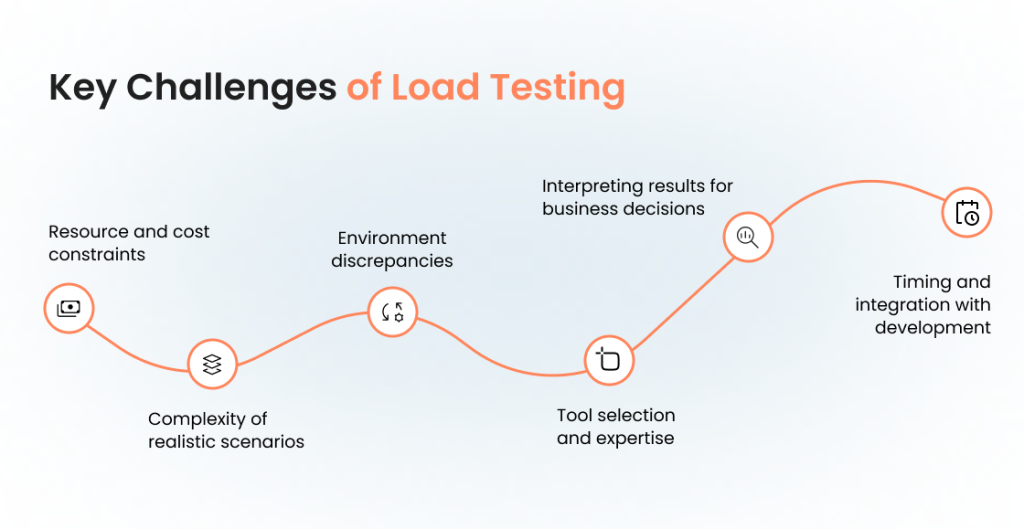
Key challenges of load testing include cost, environment discrepancies, realistic scenario creation, tool expertise, result interpretation, and late adoption.
What Is Load Testing?
Load testing is a type of performance testing that shows how your website or app behaves when multiple users interact with it at the same time. In business terms, it’s a way to check whether your digital product can handle the traffic it’s expected to face during normal operations or under a sudden spike in demand. A load test allows teams to simulate the number of concurrent users and measure critical indicators like response time and system stability.
Unlike functional testing, which verifies if individual features work correctly, load testing involves applying a realistic load to the entire system to see whether it performs reliably under different conditions. It helps decision-makers understand if their platform can meet customer expectations, support business growth, and avoid downtime during peak load periods.
For businesses of all calibers, load testing ensures the system is ready for significant load without reaching its breaking point. It’s not just a purely technical task — it’s a way to protect revenue and reputation by confirming that your product can effectively serve a real user base.
Maintain user trust and increase revenue with load and performance testing services.
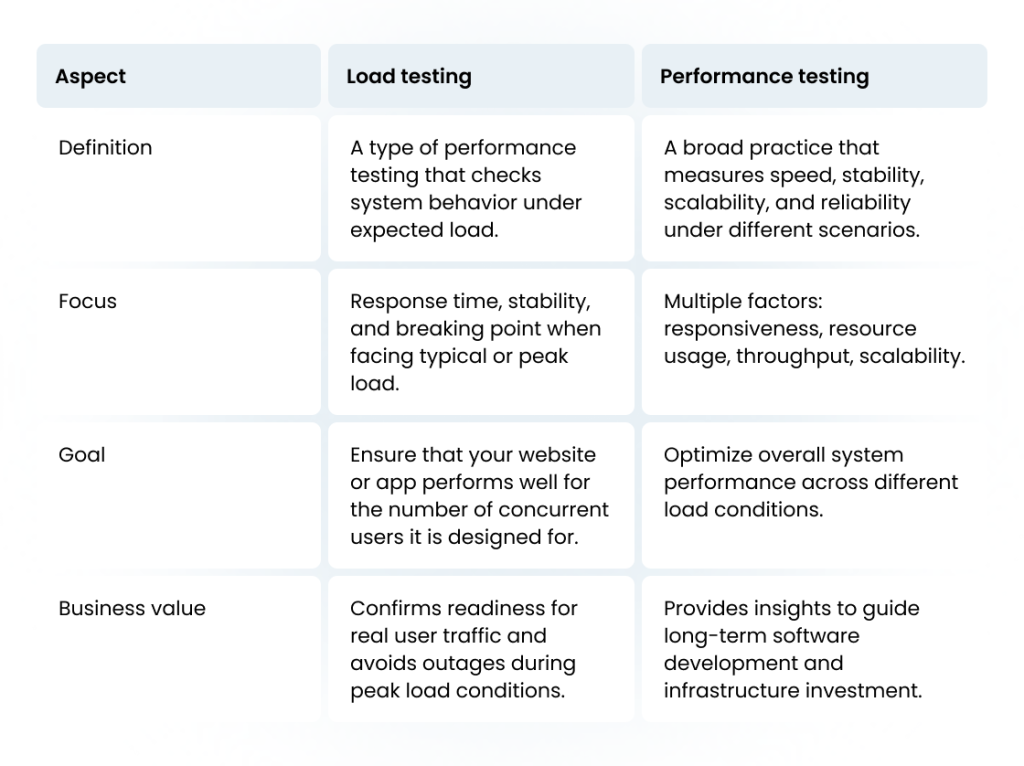
Both terms are often used interchangeably, but they aren’t the same. Performance testing is a broader discipline that looks at how a system behaves under various conditions, while a load test focuses specifically on how it performs under expected load levels. From a business perspective, performance testing tools give the full picture, but load testing identifies how ready your system is for real-world user traffic.
Load testing vs stress testing
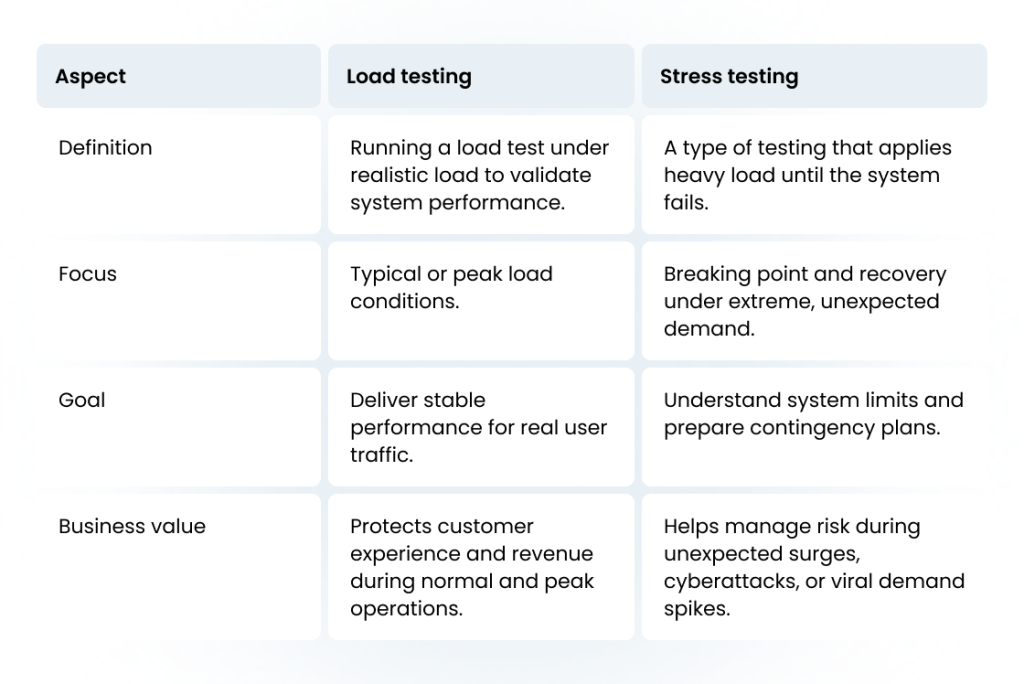
Load testing is often confused with stress testing, but the goals differ. While a load test enables you to confirm that your system can handle the expected load, a stress test pushes it beyond the breaking point to see how it fails and recovers. For businesses, both are valuable: load testing ensures reliable day-to-day operations, while stress testing helps plan for worst-case scenarios.
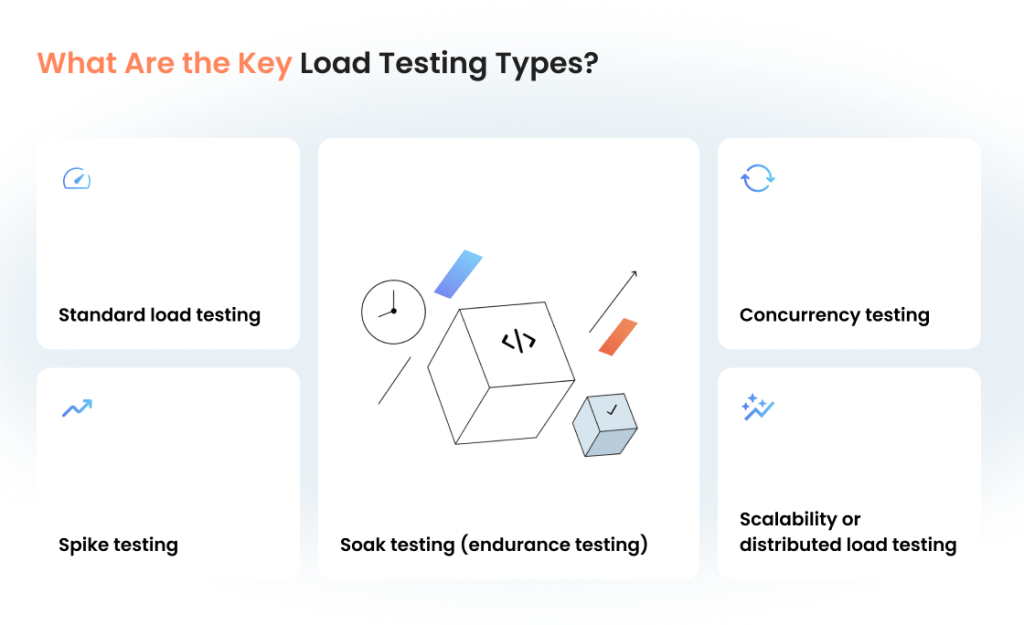
What Are the Key Load Testing Types?
Load testing is a crucial step in understanding how your system behaves under different load conditions. Since a single load test cannot cover every risk, businesses often combine several types of testing to ensure reliability, stability, and readiness for growth.
Here are the main load testing types and the business scenarios they address:
Standard load testing – Applies a realistic load that reflects the expected load of typical user behavior. This helps ensure that your website or app can handle the number of concurrent users during everyday operations.
Spike testing – Introduces a sudden, heavy load to measure how the system reacts to abrupt traffic growth. Useful for campaigns, product launches, or viral events that push the system close to its breaking point.
Soak testing (endurance testing) – Places load over an extended period to uncover memory leaks or stability issues. Ideal for SaaS or streaming platforms where users remain active for long sessions.
Concurrency testing – Evaluates how the system performs when many actions or transactions happen at the same time. Common in eCommerce checkouts, online banking, or booking systems during peak load conditions.
Scalability or distributed load testing – Uses a cloud-based load testing platform to simulate load from multiple regions. This approach to load testing is critical for businesses planning global rollouts or preparing for high seasonal demand.
Why Is Load Testing Important?
Load testing is often the difference between a seamless digital experience and a costly outage. For businesses, it’s not just a technical checkpoint — it’s a safeguard for revenue, customer trust, and brand reputation. Here is why load testing is important:
Protects revenue during peak demand. Load tests enable you to see if your system can handle peak load without crashing. For eCommerce, this means ensuring that your website or app can process thousands of concurrent users during holiday sales or campaigns.
Prevents brand damage. Downtime or poor response time under heavy load directly impacts customer satisfaction. Load testing helps you avoid bad press, negative reviews, and user churn.
Supports business growth. Load testing ensures the system can scale as your user base grows. Without it, even a successful marketing campaign could overwhelm your infrastructure.
Reduces hidden costs. Investing in load testing helps you catch performance issues early. This prevents higher support costs, lost transactions, and expensive firefighting after launch.
Strengthens digital transformation. Whether moving to the cloud or adding new features, load testing helps identify performance risks and ensures that transformation projects succeed.
What Are the Objectives of Load Testing?
While the importance of load testing lies in protecting revenue and customer trust, its objectives are more specific. Load testing involves setting clear targets to confirm that your system performs reliably under expected load and peak load condition.
Key objectives of load testing include:
Measure response time under realistic load. Ensuring that customers experience fast, seamless interactions even with a significant load on the system.
Validate system stability at different levels of load. Confirming that the application remains functional without errors or crashes during both typical load and heavy demand.
Identify the breaking point. Finding the threshold where performance starts to degrade or the system fails, so you can plan capacity upgrades before it occurs below the peak load.
Optimize resource usage and costs. A load test enables you to see whether infrastructure is over- or under-provisioned, helping to balance performance and budget.
Support scalability planning. Testing your system under increasing load to understand how it scales with the number of concurrent users and ensure readiness for growth.
Generate reliable load tests results for decision-making. Providing data that helps executives make informed choices about software development priorities, infrastructure investment, and marketing readiness.
When Should You Do Load Testing?
Load testing is not a one-time task — it’s an ongoing part of the testing process that ensures your system continues to meet user expectations as the business evolves. While many organizations wait until right before launch, early load testing provides far greater value. By catching performance bottlenecks early in software development, you reduce the risk of costly rework and ensure smoother releases.
Here is when you should consider introducing load test for your product:
Before a major release or update. Running a load test as part of the testing process ensures that new features don’t hurt performance.
Words by
Michael Tomara, QA Lead, TestFort
“Ideally, load testing should be a part of a regular regression run, as bug fixes can also affect the application’s performance. If that isn’t feasible, then it should at least be done after every major update — especially after migration to a new platform or codebase.”
Ahead of marketing campaigns or seasonal peaks. Conducting load tests prepares your website or app for a sudden influx of traffic so it can withstand peak load conditions without failures.
During cloud migration or infrastructure changes. Load testing helps identify risks before systems go live in a new environment.
After scaling or growth milestones. When you’ve started with load testing in earlier phases, repeating it as the number of concurrent users grows helps confirm long-term scalability.
For business continuity planning. The first load test may reveal breaking points that occur below the peak load, guiding decisions about capacity upgrades and investments.
In practice, the best approach is to incorporate load testing regularly throughout the testing process. Whether you’re conducting load tests early or repeating them as systems evolve, the goal is the same: to ensure that your digital platforms remain resilient under real user demand.
Ensuring uninterrupted performance for 100+ simultaneous users: End-to-end testing for 15 Seconds of Fame
What to Consider When You Choose a Load Testing Tool for Your Project?
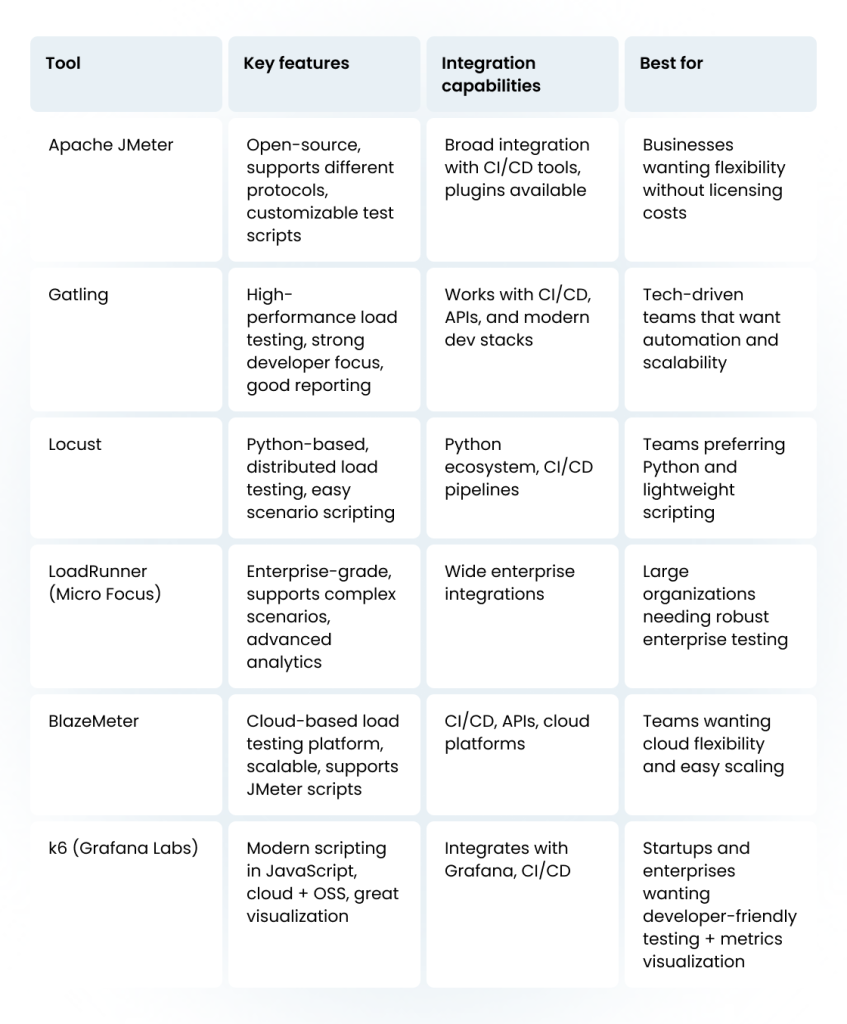
The right load testing tool can make the difference between meaningful results and wasted effort. For businesses, the goal isn’t just using a load testing tool — it’s choosing one that aligns with your testing strategy, budget, and growth plans. A tool like JMeter, Gatling, or a cloud-based load testing platform may offer powerful features, but the real question is how well it supports your objectives.
When evaluating load testing tools, consider:
Reporting and insights: Testing helps identify not just response time issues but also trends in resource usage and potential breaking points.
Ease of use and integration: Can it be used for load testing alongside tools you already use in software testing and development? Does it fit into your existing testing practices?
Scalability: Will the tool support distributed load testing to simulate thousands of concurrent users across regions?
Realism of scenarios: Does it allow the creation of complex load conditions and realistic load tests that reflect actual customer behavior?
Cost-effectiveness: Cloud-based load testing can reduce upfront investment and provide flexibility compared to on-premise solutions.
Words by
Michael Tomara, QA Lead, TestFort
“I always make sure to consider the team’s skill set as well.If there are QAs on your team with the necessary expertise, you’re good. You can also introduce this tool to those who are able and willing to learn how to work with it. But if there is no one in your team ready to master this tool, investing in it may end up being just a waste of money.”
Choosing a load testing tool is not just about features — it’s about enabling an effective load testing strategy. The right testing platform ensures that your business can perform load tests consistently, make load testing part of continuous improvement, and turn results into actionable business decisions. Here is a quick breakdown of tools commonly used in the load testing process.
How to Get Started With Load Testing: Strategy Creation
A successful load testing initiative begins with a clear strategy. Without a well-defined testing strategy, load tests can produce incomplete insights or fail to align with business goals. From a business perspective, the strategy should focus on ensuring that your website or app can deliver consistent performance under realistic load conditions and scale as your user base grows.
Key elements of a load testing strategy include:
Define business objectives and KPIs – Identify what matters most: response time, system stability, or capacity for the number of concurrent users. Load testing helps you ensure these targets are met, supporting revenue, customer satisfaction, and operational efficiency.
Identify critical scenarios and peak load conditions. Determine the typical load, expected load, and realistic load tests that mirror real user behavior. This ensures testing addresses the scenarios that could impact business outcomes the most.
Select the appropriate load testing types. Incorporate spike testing, endurance testing, concurrency testing, and other types of testing to cover all potential performance risks.
Determine test environment and data needs. Plan the test environment to reflect production as closely as possible. Using a realistic setup reduces discrepancies between testing results and real-world performance.
Establish thresholds and exit criteria. Define acceptable response times, load capacity, and breaking points. These criteria guide decisions about whether your system is ready for launch or requires optimization.
Plan reporting and decision-making process. Decide how results will be communicated to stakeholders and which actions will follow. Load tests results should drive software development, infrastructure scaling, and business decisions.
Integrate with continuous testing practices. Load testing should be incorporated into the broader testing process, not treated as a one-off task. Early load testing and repeated testing help catch issues before they impact real users.
What Are the Key Challenges of Load Testing?
While load testing is a crucial part of ensuring system reliability, it comes with challenges that businesses need to consider before starting. Recognizing these obstacles helps leadership plan effectively and maximize the return on investment.
Resource and cost constraints
Comprehensive load testing often requires dedicated infrastructure, cloud-based platforms, or specialized tools. Load testing may become expensive if organizations try to simulate high-concurrency or distributed scenarios without proper planning.
Complexity of realistic scenarios
Creating realistic load tests requires a deep understanding of actual user behavior. Testing software under overly simplified or artificial conditions can produce misleading results. Accurate load testing helps identify bottlenecks only when scenarios mirror peak load, typical load, and expected load.
Environment discrepancies
Differences between the test environment and production can impact results. Without a proper test environment, load tests may overestimate system performance or miss critical failures.
Tool selection and expertise
Choosing the right load testing tool and configuring it effectively is often a challenge. Using a tool like an open-source solution without experienced staff can limit testing effectiveness and reduce the business value of the results.
Interpreting results for business decisions
Load tests results are only valuable if they inform actionable business decisions. Testing serves the business when findings guide scaling, infrastructure investments, or software development priorities.
Timing and integration with development
Load testing is often performed too late in the software development lifecycle. Early load testing ensures issues are caught sooner, reducing costly fixes post-launch and enabling more confident planning for peak load conditions.
What Are Some Load Testing Best Practices?
To get the most value from load testing, it’s not enough to simply run tests — you need a thoughtful approach that aligns with your business goals. Load testing allows you to identify potential performance issues, validate system stability under peak load, and ensure that your website or app can handle real user traffic reliably. By following proven load testing best practices, organizations can reduce risk, optimize infrastructure, and make data-driven decisions that support growth and customer satisfaction.
Align load testing with business objectives
The most effective load testing strategy starts with a clear understanding of what the business needs to achieve. Load testing should focus on ensuring that key user journeys, peak load scenarios, and critical systems meet response time and stability targets that matter to revenue, customer satisfaction, and brand reputation.
Start load testing early and continuously
Early load testing helps identify potential performance issues before they escalate into costly problems. Incorporating load testing into the regular testing process allows teams to monitor performance throughout software development, ensuring the system evolves to handle increasing user load over time.
Use realistic load scenarios
Testing software under realistic load conditions ensures that results accurately reflect user behavior. This includes accounting for the number of concurrent users, typical and expected load patterns, and peak load conditions. Realistic load tests help decision-makers plan capacity and reduce the risk of outages.
Choose the right tools for your needs
Selecting the right load testing tool or platform is essential. Whether it’s an open-source solution, a cloud-based load testing platform, or a commercial tool, the focus should be on scalability, integration with existing systems, and the ability to generate actionable insights from load test results.
Define clear thresholds and success criteria
Load tests should have predefined metrics for acceptable performance, including response time limits, system stability, and load capacity. Establishing clear thresholds ensures that testing helps identify when a website or app is ready for peak traffic or requires optimization.
Invest in automation and reporting
Automated testing and robust reporting streamline the load testing process, making it easier to reproduce tests, track performance trends, and communicate results to stakeholders. Effective load testing allows leadership to make informed decisions about scaling, infrastructure investments, and feature releases.
Use professional load testing services when needed
Not every organization has the in-house expertise or infrastructure to carry out comprehensive load testing. Partnering with specialized providers of load testing services can help ensure realistic scenarios, distributed testing at scale, and expert interpretation of results. This approach reduces the burden on internal teams while delivering higher confidence in performance outcomes.
Let’s make sure your app is ready even for the most unexpected scenarios.
For modern businesses with a digital presence, performance is as critical as functionality. A website or app that works flawlessly under normal conditions but collapses during peak demand can undermine months of development and erode customer trust in an instant. Load testing is more than just a technical safeguard — it’s a strategic practice that ensures your systems deliver consistent value when it matters most.
By making load testing an integral part of your software development and operational strategy, you go beyond fixing bottlenecks. You gain clarity about real user expectations, confidence in your infrastructure’s resilience, and the ability to scale with business growth. In this way, load testing is less about preventing failure and more about building the reliability and agility that modern businesses need to compete.
Share:
Jump to section
Hand over your project to the pros.
Let’s talk about how we can give your project the push it needs to succeed!
Inna is a content writer with close to 10 years of experience in creating content for various local and international companies. She is passionate about all things information technology and enjoys making complex concepts easy to understand regardless of the readers tech background. In her free time, Inna loves baking, knitting, and taking long walks.