Database problems are often discovered indirectly. A finance team questions a report that no longer reconciles. An analytics dashboard starts producing contradictory trends. An integration behaves correctly, but only for certain records. In many cases, nothing is technically “broken” — the system is running, queries return results, and releases go out on schedule. What’s missing is certainty about how the data behaves beneath the surface.
Database testing exists precisely to cover that gap. It focuses on how data is structured, transformed, and preserved as systems change, rather than on how features appear to function at a given moment. In this article, we look at database testing from that perspective: what it actually covers today, where teams tend to underestimate risk, how test data and automation influence outcomes, and why examining database behavior over time matters more than checking isolated correctness.
Key Takeaways
Database issues tend to accumulate gradually, making them harder to detect than application-level defects.
Many data-related failures originate from assumptions that remain untested as systems and usage patterns change.
Changes in the database often affect historical data in ways that are not immediately visible.
Test data quality has a direct impact on the credibility of database test results.
Differences between test environments and production environments reduce the reliability of test outcomes.
Effective database testing focuses on long-term behavior rather than isolated correctness.
Why Is Database Testing Important From a Business Perspective?
For most modern digital products, the database system is where revenue calculations, reporting, compliance data, and operational history ultimately live. When database behavior is incorrect, the impact is not limited to technical defects. This is why database testing increasingly affects financial accuracy, regulatory exposure, and decision-making at the leadership level.
Silent failures create the highest business risk
Database issues rarely cause immediate system crashes. A product may continue to operate while database records become inconsistent, relationships within a database table break, or SQL queries return incorrect results under specific conditions. In these cases, the database performs its core functions, but the data in the database no longer reflects reality.
From a business perspective, this is more damaging than an outage. Incorrect data influences reports, billing, forecasts, and compliance submissions before anyone notices. A database test focuses on detecting these risks below the application layer, where UI testing offers limited visibility.
Growth amplifies database complexity
As organizations scale, more applications are using database servers, more concurrent users are accessing the database, and more automated processes rely on database operations executing correctly. Changes in the database — such as updates to database schema, database constraints, or database code — can introduce cascading effects across systems.
Without systematic database testing, these risks accumulate and surface late, often when remediation is costly and disruptive.
Database testing as a control mechanism
At an executive level, database testing is the process that protects confidence in core business assumptions. It helps ensure the database operates reliably under real conditions, supporting trust in reports, transactions, and integrations. For this reason, database testing is crucial not as a technical exercise, but as a safeguard for data-driven business decisions.
We’ll make sure your enterprise software drives your business, not holds it back
In complex software systems, database testing is no longer limited to checking whether data can be written or retrieved. Today, database testing is the process of examining how data behaves across the entire system lifecycle — under change, load, integration, and real operational conditions. From a business perspective, it focuses on whether the database system consistently supports the outcomes the organization depends on.
Beyond application-level testing
Application and UI testing confirm that workflows appear correct from the user’s point of view, but they do not fully reflect what happens to data once it reaches the database. Testing the database addresses questions that UI testing cannot answer: whether database operations execute reliably, whether SQL queries behave consistently over time, and whether data stored in the database remains accurate as volume and complexity grow.
This distinction becomes critical in environments where multiple applications are using database servers simultaneously, or where background jobs, integrations, and analytics pipelines operate directly on the database. In such scenarios, issues may not surface in the interface at all, yet still affect reports, billing, or downstream systems.
What database testing includes in practice
At a high level, database testing includes verification of data structures, business rules enforced at the data layer, and the behavior of database logic under realistic conditions. It spans data testing, structural database testing, and non-functional testing, each addressing a different category of risk.
Effective database testing also examines how changes in the database — such as schema updates or modifications to database code — affect existing data and dependent systems. This is where organizations often discover that testing cannot rely on isolated checks alone and must reflect real usage patterns.
A business-oriented definition
In practical terms, database testing encompasses everything required to ensure that data in the database remains trustworthy as the system evolves. Its value lies not just in technical completeness, but in reducing uncertainty around decisions that depend on reliable, consistent data.
Core Database Testing Components
Not all database issues pose the same level of risk. In business-critical systems, database testing components are best understood in terms of how directly they affect financial accuracy, system stability, and data reliability. A database test that focuses on these components helps organizations identify problems that may not be visible at the application level but still have far-reaching consequences.
Data structures and schema integrity
At the foundation of every database system is its structure. Database schema design determines how data is stored, related, and constrained. Errors at this level — such as incorrect data type definitions, missing database constraints, or inconsistent relationships between a database table — can compromise large volumes of database records without triggering immediate failures.
Schema testing and structural database testing focus on whether changes in the database preserve data consistency over time. From a business standpoint, these checks are essential whenever systems scale, integrations are added, or historical data must remain reliable for reporting and audits.
Database code, triggers, and transactional behavior
Modern systems rely heavily on database code, including stored procedures and database triggers, to enforce business rules and automate database operations. When these mechanisms fail, the effects are often subtle: partial updates, inconsistent database state, or broken dependencies between records.
Database transactions introduce additional complexity, especially with concurrent users accessing the database. A database test at this level examines whether transactional logic behaves correctly under realistic conditions, ensuring that failures do not leave the system in an inconsistent state.
SQL logic and query behavior
SQL queries are where performance, correctness, and scalability intersect. Even well-formed queries can produce incorrect results when data volumes grow or usage patterns change. Testing SQL queries is therefore not limited to syntax checks, but to understanding how queries behave across different database servers and workloads.
For organizations using SQL Server or other SQL database platforms, this component of database testing validates assumptions about data retrieval, aggregation, and reporting accuracy — areas where small discrepancies can have outsized business impact.
We turn software and infrastructure complexities into opportunities for growth
In complex systems, not every database issue has the same consequences. Some defects remain isolated, while others affect reporting, system stability, or long-term data reliability. Understanding database testing components through this lens helps focus a database test on areas where failures are harder to detect and more expensive to correct.
Data structures and schema integrity
The database schema defines how data is organized and constrained. Issues such as incorrect data type usage, missing database constraints, or broken relationships within a database table can affect large sets of database records without triggering obvious failures. Schema testing and structural database testing help ensure that changes in the database do not compromise long-term data consistency.
Database code, triggers, and transactional behavior
Database code and database triggers often enforce rules that applications rely on implicitly. Failures here tend to surface as inconsistent database state rather than visible errors. Database transactions further increase complexity when concurrent users are accessing the database, making transactional behavior a critical focus of any database test.
SQL logic and query behavior
SQL queries determine how data is retrieved and aggregated. Queries that work correctly at low volumes may behave differently as datasets grow. Testing SQL queries focuses on result accuracy and predictability across database servers, including platforms such as SQL Server, where subtle query behavior can affect downstream reporting and analysis.
What Are the Common Types of Database Testing?
Different types of database testing address different categories of risk. In practice, teams combine several types of testing based on how the database system is used and how frequently it changes. These are the types of testing most frequently used for testing database systems:
Functional database testing. Functional testing ensures that rules enforced at the data layer are applied correctly. It validates database calculations, relationships, and constraints by examining how database operations affect data in the database directly, without relying on UI testing.
Integration testing. Integration testing examines how data moves between applications, services, and the database. Integration testing often includes mapping testing and highlights scenarios in which the database is shared across multiple systems.
Non-functional testing. The non-functional group of test address behavior under real operating conditions rather than specific inputs. This type of testing covers database performance testing, load testing, and stress testing, where concurrency and volume expose weaknesses in database operations.
Security testing. Security testing involves testing access controls, permissions, and exposure paths at the database level, ensuring that data stored in the database remains protected regardless of how applications interact with it.
Structural database testing. Structural testing concentrates on schema-related risks, including database schema changes, data type consistency, and structural relationships within a database table. This type of testing helps detect issues caused by changes in the database over time.
Stages of Database Testing in Mature Organizations
The stages of database testing reflect how risk shifts as systems change and scale. Rather than treating database testing as a single activity, mature teams apply it at multiple points in the delivery lifecycle.
Early-stage testing. Performed alongside development to catch issues in database schema, database code, and SQL queries before they reach shared environments. At this stage, testing is carried out in isolated setups where changes in the database are frequent and assumptions are still forming.
Pre-release testing. Focuses on how the database behaves in a controlled test environment that resembles production. This stage of the database testing process examines data consistency, database operations, and interactions between applications and the test database before deployment.
Release-level regression testing. Conducted when changes in the database are introduced. Database tests here help ensure that existing database records, integrations, and reporting logic remain intact after updates.
Post-release monitoring and verification. Occurs after deployment, where testing verifies that the database performs as expected under real usage. This stage helps detect issues related to concurrent users accessing the database, data growth, and long-running processes.
Together, these stages support a database testing process that adapts to system change, rather than reacting to failures after they occur.
Frequently Occurring Issues During Database Testing and How to Handle Them
Many of the frequently occurring issues during database testing do not stem from missing effort, but from how databases behave under real conditions. These issues often remain unnoticed until data volume, usage patterns, or system dependencies change. These are the issues that database testers often encounter in the process of DB testing:
Hidden data inconsistencies. Database records may appear correct in isolation, while relationships across a database table gradually drift. This often happens when testing focuses on application flows rather than data in the database itself.
Words by
Igor Kovalenko, QA Lead, TestFort
“One of the most insidious database issues I’ve encountered was a foreign key that technically existed but wasn’t enforced at the database level — it was handled ‘by application logic.’ Over 18 months, we accumulated 47,000 orphaned order line items pointing to deleted products. The application worked fine, but every financial report required manual reconciliation. The fix took three days; the data cleanup took three months. Now we always verify constraints exist at the database level, not just in the application code.”
Query behavior that changes over time. SQL queries that return correct results in early testing may behave differently as datasets grow. Without targeted database tests, these shifts go undetected until reports or downstream systems produce unexpected results.
Incomplete coverage of database operations. Testing that focuses on visible features may miss background jobs, batch processes, or automated workflows. As a result, critical database operations execute without meaningful verification.
Assumptions around database changes. Changes in the database, such as schema updates or modified constraints, are often treated as low risk. Without structured database testing, these changes can quietly affect historical data and dependent systems.
Concurrency-related defects. Issues caused by concurrent users accessing the database rarely appear in isolated testing. These problems emerge under load, where timing and transaction order influence database state.
Words by
Igor Kovalenko, QA Lead, TestFort
“Concurrency bugs are the ghosts of database testing — you know they exist, but they rarely appear on demand. On one eCommerce project, we had an ‘impossible’ bug: customers occasionally got charged twice. Months of investigation revealed it only happened when two browser tabs submitted payment within 300 milliseconds of each other. Our functional tests never caught it because they ran sequentially. Now we include deliberate race condition scenarios in every payment-related database test suite — it’s uncomfortable testing, but it’s where the real money leaks hide.”
Overreliance on application-level checks. UI testing and API testing confirm expected behavior at the interface level, but they cannot fully reveal how data stored in the database behaves across scenarios in which the database is accessed indirectly or asynchronously.
Testing database IDE with 300,000 users globally: Our recent project
Why Test Data Is Your Strategic Asset, Not Just a Technical Detail
Test data shapes the outcome of every database test. Even well-designed test cases and testing tools provide limited value if the data used during testing does not reflect how the database system is actually used.
Test data determines what database testing can reveal
Every database test is constrained by the quality of the test data behind it. When test data is too limited, too clean, or poorly structured, database testing validates only ideal scenarios. Issues related to real data types, volume, and relationships remain hidden, even when test cases appear to pass.
Words by
Igor Kovalenko, QA Lead, TestFort
“We once had a client whose test database contained exactly 500 records per table — perfectly round numbers, no nulls, no edge cases. All database tests passed beautifully. In production, with 12 million records and 15 years of data migrations, the same queries that ran in milliseconds during testing took 45 seconds. Even worse, we discovered date calculations broke for records created before a 2015 timezone policy change. Production-representative test data isn’t a luxury — it’s the difference between testing and pretending to test.”
Poor test data creates false confidence
Inadequate test data can make it look like a database performs correctly when it does not. SQL queries, database operations, and reporting logic may appear reliable simply because the data does not reflect real usage. As a result, testing verifies behavior that rarely occurs once systems are in active use.
Test databases influence risk visibility
A well-prepared test database exposes how changes in the database affect existing database records over time. When the test environment differs significantly from production, critical behaviors related to data growth, historical consistency, and dependency chains remain untested.
Data constraints and compliance shape testing options
Direct use of production data is often restricted. Masked or synthetic test data must still preserve database schema structure, data type consistency, and database constraints to support meaningful data testing without introducing compliance risk.
Repeatable test data supports reliable testing
Stable, reusable test data enables consistent execution of database test cases across releases. Without it, regression testing becomes unreliable, and database testing is reduced to isolated checks rather than sustained confidence in data stored in the database.
Automated Database Testing and Database Testing Tools: What Role Do They Actually Play?
Automated database testing and testing tools are often treated as a shortcut to reliability. In practice, their value depends on how well they support the realities of the database system they are applied to. Tools and automation can increase consistency and speed, but only when used with clear intent and realistic expectations. Understanding the role they actually play helps prevent overreliance on automation while still capturing its benefits where it matters.
Automation supports scale, not understanding
Automated database testing is most effective when it supports repeatability and coverage, not when it replaces analysis. An automated database approach helps execute the same database test scenarios consistently across releases, especially where changes in the database are frequent. However, automation does not determine what should be tested or why — those decisions still require a clear understanding of the database system and its risks.
Where database testing tools add value
A database testing tool is typically used to support activities such as testing SQL queries, checking database schema consistency, or verifying expected database operations after changes. These tools reduce manual effort and improve consistency, particularly in regression scenarios. They are most effective when applied to stable, repeatable checks rather than exploratory or one-off investigations.
Limitations of tool-driven testing
Testing tools cannot compensate for poor test data, an unrealistic test environment, or unclear testing goals. Automated checks may confirm that a query executes or a constraint exists, while missing whether the result reflects real-world usage. This is why database testing frameworks are often tailored to specific systems, combining tool sets with custom logic that reflects actual data behavior.
Automation as part of a broader testing process
In mature setups, automation is embedded within the broader testing process rather than treated as a standalone solution. Automated database tests complement functional testing, integration testing, and non-functional testing by providing fast feedback on known risks. Used selectively, they strengthen coverage without creating a false sense of completeness.
30 automation testing trends for 2026: New blog post
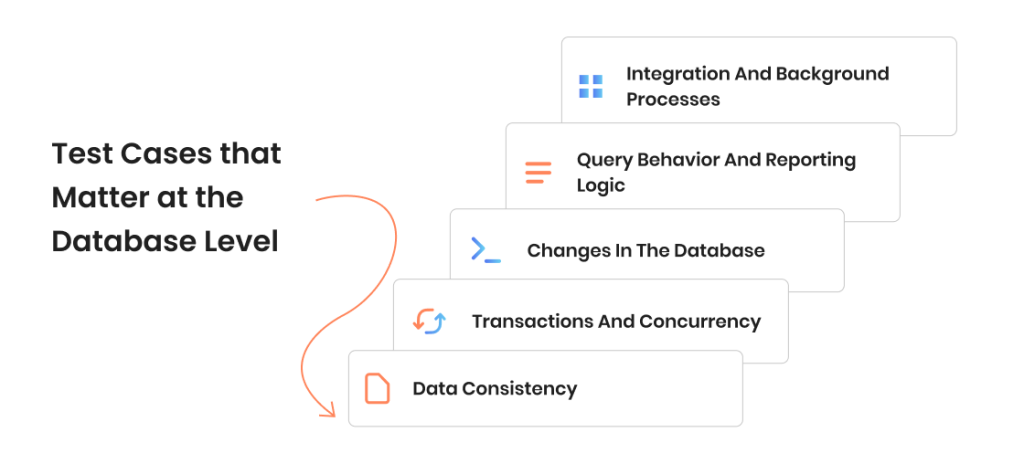
At the database level, a test case represents a risk scenario rather than a user action. These database test cases focus on how data behaves across structures, transactions, and time, often in ways that UI testing cannot expose. Here are a few examples of test cases designed to verify database performance, integrity, security, and more.
Test cases focused on data consistency
These test cases explore whether related data remains consistent as database operations occur:
Orphaned records appearing after updates or deletions
Mismatched values across related database tables
Inconsistent aggregation results caused by partial data updates
Test cases covering database transactions and concurrency
Concurrency-related test cases examine how the database system behaves when operations overlap:
Failed transactions leaving the database state partially updated
Locking or deadlock scenarios under concurrent users accessing the database
Rollback behavior when one operation in a transaction chain fails
Test cases targeting changes in the database
These test cases address regression risks introduced by changes in the database:
Schema updates affecting existing database records
Modified database constraints invalidating historical data
Changes in database code altering previously stable behavior
Test cases for query behavior and reporting logic
These test cases focus on the correctness of data retrieval and aggregation:
SQL queries returning different results as data volume grows
Filtering or grouping logic behaving differently across releases
Reporting outputs diverging from source data stored in the database
Test cases spanning integration and background processes
Some database test cases involve indirect access rather than user-driven actions:
Background jobs writing incomplete or duplicated data
Integration flows creating inconsistent data mappings
Batch processes failing silently during peak load
When Database Testing Failed and When It Worked: Examples from the Market
Database-related failures rarely make headlines for the database alone. They surface as reporting errors, prolonged outages, data exposure incidents, or unexplained inconsistencies that take weeks to investigate.
Looking at publicly documented cases and industry research helps clarify a recurring pattern: when database behavior is not examined deeply enough, problems persist undetected; when it is, the impact of failures is contained or avoided altogether. The examples below draw on respected publications, post-incident analyses, and research to illustrate both sides of that equation.
Silent data corruption and unnoticed database defects
Even at a massive scale, silent data corruption can undermine systems in ways that standard checks miss. Studies of large infrastructure services have documented how latent storage errors seep through database systems, requiring extensive investigation to diagnose and correct, often long after they initially occurred.
In one large-scale research context, silent corruption events spread through data pipelines because underlying systems trusted flawed data without detection. Efforts to detect such issues are part of more advanced database test strategies, and the fact that they were not caught early underscores the limitations of superficial testing alone.
High-profile outages tied to database reliability gaps
Industry reporting suggests that a significant proportion of data operations have experienced outages in recent years, many of which are traceable to replication, failover, or database availability issues rather than application bugs alone. One survey indicated a notable share of outages affecting core database operations over a multi-year window, highlighting how fragile data infrastructure can be without robust checks.
Data corruption as an underreported risk
Research repositories show that data corruption isn’t just a theoretical risk, but one with measurable impact. An analysis of storage systems found that firmware bugs and hardware-induced corruption contributed materially to silent data issues — including in contexts like cloud storage platforms — illustrating the need for database test cases that look beyond simple success/failure criteria.
Breaches linked to database exposure and weak controls
While not a direct failure of functional database testing, the 2018 SingHealth data breach illustrates how gaps in system controls related to database access and query handling can lead to significant loss events. In that incident, attackers used crafted SQL queries to access sensitive records on a health database, resulting in the theft of personal data from over 1.5 million patients.
Incidents like this highlight that testing tools and test case coverage need to encompass security-oriented scenarios where data stored in the database may be manipulated or exposed.
Data quality statistics show ongoing challenges
Independent research indicates that poor data quality is far from an isolated concern:
A Gartner-referenced estimate suggests that organizations incur an average cost of about $12.9 million per year due to poor data quality issues, with associated losses stemming from decision errors, rework, and inefficiencies.
Legacy research from IBM and Harvard Business Review articles has placed the historical economic impact of bad data in the U.S. economy at roughly $3.1 trillion annually, reflecting both business and operational losses tied to flawed data.
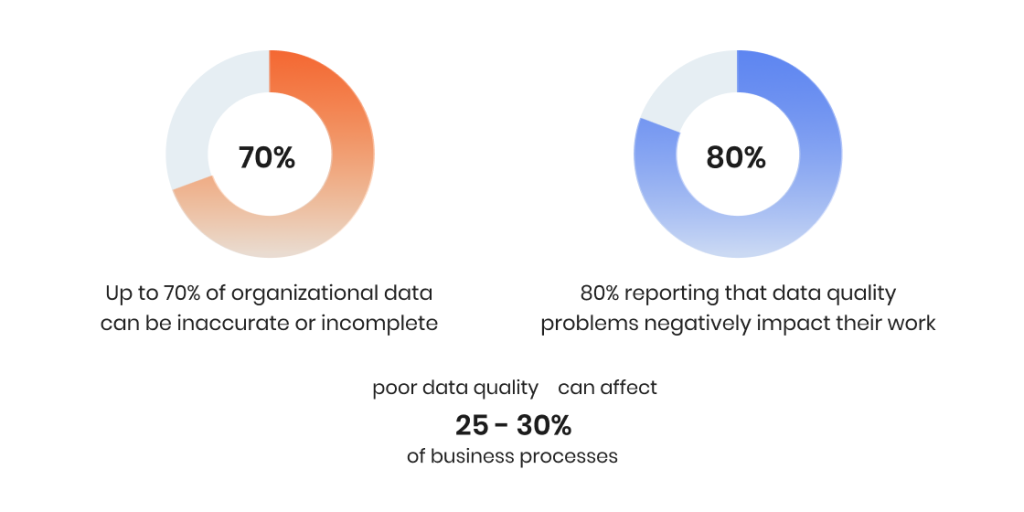
Up to 70% of organizational data can be inaccurate or incomplete, and poor data quality can affect 25-30% of business processes, according to aggregated data quality studies.
Surveys of data scientists find 80% reporting that data quality problems negatively impact their work, highlighting how pervasive these issues are in analytics and decision support.
When database reliability practices matter
Research on disaster recovery and resilience, especially in sectors like banking, finds that well-tested database backup and restore processes materially improve recovery outcomes. Studies of disaster recovery strategies — for example, in financial institutions — emphasize the value of systematic database backup testing as part of broader continuity planning.
How We Approach Database Testing
In real projects, database testing rarely fails because teams don’t know what to test. It fails because everything looks stable until scale, history, or integration pressure exposes assumptions that were never questioned. Our approach starts from the premise that databases accumulate risk over time, not at a single release point. That means testing the database is not treated as a one-off phase, but as an ongoing examination of how data behaves as the system changes, grows, and ages.
We also avoid treating database testing as a purely technical exercise. In practice, the most costly issues we see are not syntax errors or broken constraints, but mismatches between how the database is used and how it was originally designed. These gaps surface when reporting logic relies on implicit rules, when integrations bypass application safeguards, or when historical data is processed under assumptions that no longer hold. Effective database testing requires being familiar with the database structure, but also with how the system is actually operated.
What consistently makes the difference in mature database testing efforts includes:
Risk-driven prioritization over exhaustive coverage. We focus database test cases on areas where incorrect data would be hardest to detect and most expensive to correct, rather than attempting to test every possible operation.
Testing behavior over time, not just correctness at a point. Many database issues only appear after multiple releases, data growth, or repeated transformations. We explicitly test how changes in the database affect existing data stored in the database.
Attention to indirect access paths. Background jobs, integrations, and automated processes often modify data without passing through the same controls as user-driven flows. These paths are a frequent blind spot.
Treating test data as part of the system design. We invest in test data that reflects real distributions, edge cases, and historical patterns, rather than minimal datasets that only confirm ideal behavior.
Selective automation with clear intent. Automated database testing is applied where it increases signal and repeatability, not as a substitute for analysis or judgment.
Don’t Let Software Issues Stand in the Way of Growth.
Partner with us to make software reliable, scalable, and future-proof.
As systems become more interconnected and data-driven, the cost of database issues grows quietly over time. Most failures are not the result of dramatic errors, but of small inconsistencies — changes that seemed safe, assumptions that were never revisited, or data patterns that no longer reflect real usage. Database testing helps surface these risks early, before they spread across systems and processes.
Resilient systems are defined less by the number of checks they perform and more by how deliberately they examine the data they depend on. When database testing focuses on behavior over time, interaction between components, and realistic conditions, it reduces uncertainty in systems that are expected to scale, remain stable, and support decisions long after their original design choices were made.
FAQ
What is database testing, in simple terms?
Database testing is the process of checking how data is stored, processed, and retrieved within a database system. It focuses on data accuracy, consistency, performance, and behavior beyond what application or UI testing can reveal.
What types of database testing are most commonly used?
Common types of database testing include functional testing, integration testing, non-functional testing, security testing, and structural database testing. Each type of testing addresses different risks depending on system complexity and data usage patterns.
When should database testing be performed in the testing process?
Database testing is carried out across multiple stages of database testing, from early development through release and post-release verification. Treating it as a one-time activity increases the risk of issues caused by changes in the database.
Can database testing be fully automated?
Automated database testing supports repeatability and scale, but it cannot replace judgment. A database automated testing tool is most effective when used alongside manual analysis, particularly for complex database operations and changing data patterns.
Who is typically responsible for database testing?
A database tester often collaborates with developers, QA engineers, and data specialists. Effective database testing requires familiarity with the database structure, testing techniques, and how the database system is actually used in production.
Share:
Jump to section
Hand over your project to the pros.
Let’s talk about how we can give your project the push it needs to succeed!
Inna is a content writer with close to 10 years of experience in creating content for various local and international companies. She is passionate about all things information technology and enjoys making complex concepts easy to understand regardless of the readers tech background. In her free time, Inna loves baking, knitting, and taking long walks.
An experienced QA engineer with deep knowledge and broad technical background in the financial and banking sector. Igor started as a software tester, but his professionalism, dedication to personal growth, and great people skills quickly led him to become one of the best QA Team Leads in the company. In his free time, Igor enjoys reading psychological books, swimming, and ballroom dancing.








 What is database testing, in simple terms?
 What is database testing, in simple terms?