AI is no longer just assisting testers — it’s beginning to think like one. With the rise of agentic AI, software testing is moving beyond automation scripts and dashboards into a new era where autonomous systems can reason, plan, and act. These systems don’t just follow instructions; they make testing decisions on their own.
But here’s the paradox: the more autonomous testing becomes, the more human it needs to stay. Agentic AI can analyze every line of code, predict risk, and execute thousands of tests without pause, yet it still can’t understand business intent, user emotion, or ethical consequence. At this point, it’s clear that the future of quality won’t be defined by who’s faster — machines or people — but by how well they learn to work together.
In this article, we’ll look into the concept of agentic AI in testing, assess its current state, give practical tips for its adoption, and answer the ultimate question: can it replace human testers after all?
Key Takeaways
Agentic AI marks a major shift in software testing, bringing reasoning and autonomy into what was once a scripted, mechanical process.
Unlike traditional automation, agentic AI systems can interpret goals, plan tests, and adapt to changing conditions in real time.
These intelligent agents turn testing into a continuous, learning-driven activity embedded throughout the software development lifecycle.
Self-healing tests and adaptive execution significantly reduce maintenance, helping QA teams focus on strategy instead of repetitive fixes.
When applied to complex or regulated industries, agentic AI improves coverage, consistency, and compliance without increasing workload.
The most advanced systems can even test AI-driven products, validating model accuracy, bias, and reliability at scale.
Human expertise remains essential for interpreting results, defining quality standards, and ensuring ethical and business alignment.
The most effective approach is hybrid: AI handles speed, scale, and data; humans provide context, reasoning, and trust.
Organizations must prepare by investing in high-quality data, governance frameworks, and upskilling their QA teams.
The future of testing isn’t just automated — it’s self-evolving, where software and testing intelligence improve together over time.
What Is Agentic AI and How Does It Redefine Test Automation?
Artificial intelligence has already reshaped test automation, but agentic AI marks a much deeper shift. It introduces reasoning and intent into testing, allowing systems to act not just as tools but as intelligent collaborators. In this chapter, we’ll explore what agentic AI means in the context of software testing, how it differs from earlier automation approaches, and how it transforms the relationship between testers, machines, and quality itself.
Understanding agentic AI in software testing
Agentic AI represents the next evolution of AI in software testing — systems that don’t just automate steps but understand objectives. Unlike traditional AI that executes predefined tasks, an AI agent can reason about a goal, plan its own actions, and adjust its strategy based on feedback.
In testing, this means moving beyond AI-powered test automation that simply runs scripts faster. A testing agent can read requirements, infer test cases, decide what to validate first, and even explain why a specific test matters. These systems can interact with their test environment, analyze outcomes, and adapt future runs accordingly, forming a continuous learning loop rather than a repetitive cycle of execution.
The result is a new generation of AI in software that’s not just responsive but proactive. Agentic AI brings awareness to testing: it can connect product goals, user behavior, and risk factors to testing actions. This shift transforms QA from a validation function into a strategic intelligence layer within the software development lifecycle.
Cutting testing time by 80% with AI: QA for Creative Console Systems
For decades, QA teams have relied on a mix of manual test execution and traditional automation frameworks. These methods accelerated delivery but were limited by static scripts and fragile test suites. When interfaces or data structures changed, maintenance skyrocketed, and testers had to re-create coverage by hand.
Agentic AI in software testing replaces this rigidity with adaptability. Through self-reflection and planning capabilities, autonomous testing systems can rewrite or “self-heal” test steps when the underlying application changes. They learn from prior test runs, defect patterns, and changes in the product to continuously improve their own test strategies.
Unlike traditional testing, which depends on human direction, agentic AI introduces an ecosystem of AI agents that collaborate: one may generate tests, another executes, another analyzes coverage or failure clusters. Together, they form a dynamic network of intelligent testers that evolve alongside the product.
In this model, QA becomes less about following scripts and more about orchestrating intelligence. The ultimate goal isn’t to remove people from testing — it’s to let machines handle the mechanical parts so humans can focus on what still requires judgment: defining meaning, risk, and trust in software quality.
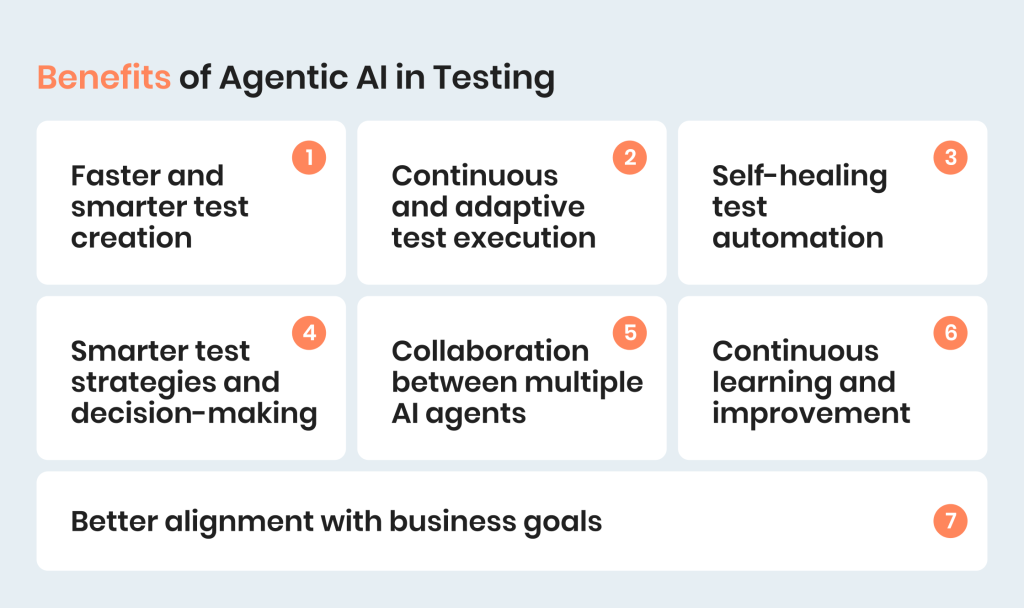
Benefits of Agentic AI in Testing
Agentic AI doesn’t just make testing faster — it makes it smarter and more resilient. By integrating reasoning, planning, and collaboration into test automation, it helps organizations achieve greater confidence in quality while accelerating delivery across the software development lifecycle. Below are the most significant benefits that agentic systems bring to modern QA.
Words by
Maxim Khimiy, AQA Lead, TestFort
“Agentic AI is the difference between doing tests and understanding testing. It turns automation into a living system that adapts, collaborates, and keeps improving.”
1. Faster and smarter test creation
AI-powered testing enables systems to generate test cases from requirements, user stories, or even code changes automatically.
AI agents prioritize which areas need the most attention based on risk and recent updates.
This results in faster test cycles, shorter feedback loops, and earlier defect detection in development.
Instead of spending days preparing regression suites, teams can start testing almost immediately.
2. Continuous and adaptive test execution
Traditional automation runs fixed scripts. Agentic AI transforms this into autonomous testing that learns and evolves.
Testing agents monitor code, data, and UI changes to adjust their own execution plans.
They decide when to rerun tests, when to expand coverage, and when to pause for human review.
This adaptability ensures testing stays aligned with constant product updates.
3. Self-healing test automation
Maintenance has always been a bottleneck in software testing. With agentic AI, that changes.
When a locator, API, or workflow changes, the system detects and repairs the test automatically.
These self-healing tests minimize manual maintenance and dramatically reduce false failures.
Teams can focus on strategic improvements rather than script upkeep.
Test faster and smarter with our automation QA expertise
Agentic AI connects test execution with business relevance.
It identifies critical user paths, frequently failing modules, and risk-heavy areas.
Using insights from logs, metrics, and production behavior, it continuously refines test strategies.
The outcome is not just more testing, but testing that mattersmost.
5. Collaboration between multiple AI agents
Agentic systems can work as intelligent teams, each agent with its own specialty.
One may design test scenarios, another execute them, while another performs analytics and defect triage.
This collaborative approach creates a distributed yet coordinated test environment.
It also makes testing scalable, handling thousands of cases faster than traditional or manual tests ever could.
6. Continuous learning and improvement
Every execution helps an agent become smarter.
Through feedback loops, agents learn from both successes and failures.
They adapt to project patterns, defect trends, and product evolution.
This transforms QA into a self-improving system that strengthens over time.
7. Better alignment with business goals
By reasoning about intent rather than just instructions, agentic AI in software testing ensures QA reflects real user and business priorities.
Testing shifts from technical validation to value validation.
AI agents help bridge product goals, customer experience, and compliance expectations, connecting testing to strategic outcomes.
Key Use Cases of AI-Powered Testing for Different Industries
Agentic AI’s impact becomes most evident when applied to industries that demand both precision and adaptability. In these environments, testing is not just about verifying code — it’s about ensuring reliability, compliance, and user trust at scale. Here are the examples of how AI-powered testing transforms quality assurance across key domains.
Fintech: Intelligent compliance and risk validation
In FinTech testing, regulatory precision and real-time reliability are non-negotiable. Agentic AI in software testing helps institutions verify complex financial workflows, from loan approvals to anti-fraud systems, without human micromanagement.
By using AI agents capable of analyzing transaction patterns, adaptive scoring models, and dynamic rule sets, financial organizations can continuously validate compliance with standards like PSD2 or PCI DSS. These agents also detect anomalies faster than traditional scripts, identifying subtle changes in transaction behavior that might indicate risk. The result is a safer, more resilient ecosystem where QA evolves as quickly as financial innovation does.
Healthcare: Autonomous validation of safety and interoperability
Healthcare applications operate in high-stakes environments where software quality can directly affect patient safety. Agentic AI testing supports this by performing continuous, automated verification of EHR systems, diagnostic platforms, and telemedicine apps, even as those systems evolve.
Instead of static regression suites, autonomous testing agents can interpret medical data flows, API interactions, and security protocols, validating both functionality and interoperability across systems. They can also monitor updates for potential compliance breaches related to HIPAA or GDPR. This ongoing adaptability ensures that healthcare software remains reliable, compliant, and secure, even as regulations and integrations change.
eCommerce: Optimizing user journeys and personalization
In eCommerce, user experience directly influences revenue. AI-powered test automation helps retailers deliver seamless digital journeys by monitoring and improving personalization, checkout flows, and recommendation engines.
Agentic AI agents continuously analyze customer behavior, test conversion paths, and simulate thousands of real-world user scenarios. When pricing logic or catalog data changes, self-healing tests automatically adjust, ensuring uninterrupted coverage. These adaptive systems keep the testing process synchronized with rapid releases, enabling faster innovation without sacrificing reliability.
Logistics: Intelligent orchestration of connected systems
Modern logistics relies on deeply interconnected platforms — IoT devices, predictive analytics, and real-time tracking systems. Agentic AI enables autonomous testing of these distributed environments, where manual coverage would be impractical.
Testing agents can coordinate across APIs, vehicle sensors, and communication layers, identifying latency issues, routing errors, or data inconsistencies as they arise. They can also simulate diverse conditions — from weather disruptions to inventory surges — to ensure system resilience. This level of dynamic validation is key to maintaining reliability in a global, data-driven supply chain.
Intelligent QA solutions for eCommerce, Logistics, Healthcare, Fintech, and more
AI tools: Recursive testing for intelligent systems
Testing AI with AI is no longer hypothetical. As companies integrate large language models and generative systems into products, AI-powered testing becomes essential for ensuring consistency, transparency, and trust.
Agentic AI can monitor prompts, model responses, and data drift, continuously verifying that intelligent systems behave predictably across contexts. It can even form “multi-agent test networks,” where one agent generates scenarios, another evaluates responses, and another measures accuracy against expected outcomes.
In this space, AI for testing is not just about automation — it’s about creating an ecosystem where testing itself learns, reasons, and evolves alongside the intelligent software it validates.
What AI Agents Can and Cannot Do in Testing
Even as agentic AI transforms software testing, it’s important to draw a clear line between what today’s and near-future systems can achieve and what still requires human oversight. The following breakdown highlights the real strengths and inherent limits of AI-powered test automation, showing why true quality still depends on collaboration between human reasoning and machine intelligence.
Things agentic AI can do
Agentic AI in software testing extends far beyond traditional test automation. Its strength lies in scale, adaptability, and the ability to automate the entire testing lifecycle, from test creation to test execution and maintenance. Here is what agentic AI can do for the QA process:
Autonomously generate and prioritize test cases based on historical test data and changing business logic, dramatically improving test efficiency.
Execute comprehensive test scenarios across APIs, UIs, and mobile environments, maintaining end-to-end visibility throughout the testing process.
Update test scripts and perform self-healing tests when the UI or APIs change, minimizing test maintenance effort.
Analyze test data and optimize test strategies, deciding where new coverage is needed to achieve a truly intelligent test framework.
Collaborate as autonomous AI agents, forming distributed networks that perform planning, validation, and reporting in parallel.
Integrate into DevOps and CI/CD pipelines, enabling continuous test cycles that enhance software delivery speed.
Implement AI-driven test automation to detect anomalies, performance drops, and regression issues before release.
Support advanced scenarios such as agentic AI architectures for penetration testing, agentic AI stress testing, and even agentic AI for software testing of adaptive or learning systems.
Use reasoning models, including generative AI models, to create test cases, interpret outputs, and improve test coverage autonomously.
By combining AI-powered test automation with reasoning and decision-making, agentic AI for testing offers unprecedented scalability and reliability, making it capable of handling entire test cycles faster and more intelligently than any traditional testing approach.
Things agentic AI cannot do
Despite the power of agentic test automation, the limitations of agentic AI in testing are equally crucial to acknowledge. These systems still lack the human intuition and ethical reasoning that define genuine software quality. Here is what agentic AI still cannot do within the testing lifecycle:
Interpret ambiguous requirements or incomplete documentation within the software development lifecycle.
Understand business intent or emotional impact, which remain outside the scope of even the most advanced AI systems.
Evaluate user experience or accessibility, tasks that demand empathy and domain understanding beyond current testing tools.
Guarantee ethical compliance or legal accuracy — even agentic AI software testing requires expert review for regulated domains.
Operate without reliable test data; poor inputs still produce poor outcomes, even when using AI to enhance the testing approach.
Define the meaning of done — only humans can judge when the entire testing process has delivered sufficient confidence for release.
Replace human accountability, as autonomous systems cannot assume ownership of testing decisions or risk assessments.
Ensure system resilience in unpredictable conditions without human-led exploratory insight — for instance, agentic AI for penetration testing still requires human ethical hackers to guide it.
Ultimately, agentic AI in software development amplifies human expertise but cannot replace it. AI testing tools and AI agentic testing tools will continue to evolve, potentially cutting human-led testing efforts almost in half, but meaning, trust, and responsibility will always belong to people.
Words by
Maxim Khimiy, QA Lead, TestFort
“Agentic AI makes testing faster and smarter, but it’s the partnership with human insight and experience that turns automation into real quality.”
Leading Tools and Frameworks for Agentic AI Testing
While agentic AI in software testing is still emerging, several AI-powered testing platforms and frameworks already demonstrate how intelligent systems can reason, learn, and adapt within the testing lifecycle. The tools below vary by focus — some automate existing workflows, while others push toward fully autonomous testing and reasoning-driven test automation.
Tool
Key capabilities
Best for
Testim (Tricentis)
ML-driven self-healing tests, visual test case creation, cross-browser execution
Teams scaling web and UI test automation
Functionize
Natural-language test creation, autonomous test execution, analytics dashboards
QA teams adopting agentic test automation for cloud products
Mabl
Low-code AI testing tool with adaptive learning and test data management
Product teams running continuous test pipelines
Appvance IQ
Multi-agent AI test platform supporting generative AI models for planning and execution
Enterprises exploring agentic AI for testing at scale
ACCELQ
No-code AI-driven test automation and predictive analytics
Mid-to-large teams replacing traditional automation
TestGPT & ChatGPT-based frameworks
Conversational AI agentic testing tools generating test scenarios and reasoning chains
Teams experimenting with agentic AI in testing
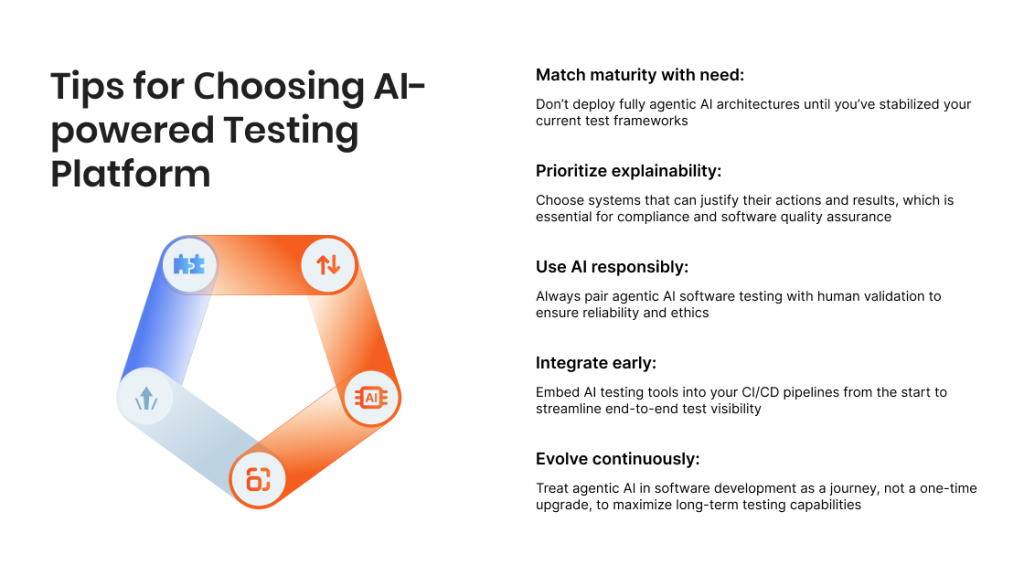
So, how do you pick the right tool for your project? Ultimately, it comes down to the tool’s AI testing capabilities and what you are looking to achieve with it. Here are some quick tips for choosing a tool to take advantage of AI agents and process automation:
Match maturity with need: Don’t deploy fully agentic AI architectures until you’ve stabilized your current test frameworks.
Prioritize explainability: Choose systems that can justify their actions and results, which is essential for compliance and software quality assurance.
Use AI responsibly: Always pair agentic AI software testing with human validation to ensure reliability and ethics.
Integrate early: Embed AI testing tools into your CI/CD pipelines from the start to streamline end-to-end test visibility.
Evolve continuously: Treat agentic AI in software development as a journey, not a one-time upgrade, to maximize long-termtesting capabilities.
We’ll help you cut testing time and increase QA efficiency with the right AI testing strategy
Agentic AI testing represents a shift from automation to orchestration — from tools that follow instructions to systems that reason, plan, and act independently. Instead of executing predefined test scripts, these systems understand the why behind testing. They connect test cases, business goals, and software quality metrics to build a dynamic, evolving testing ecosystem.
Words by
Maxim Khimiy, QA Lead, TestFort
“Goal reasoning and adaptive execution make agentic AI powerful, transforming testing into an ecosystem that improves itself.”
Within the software development lifecycle, agentic AI introduces intelligence at every level of the testing process: generating new test scenarios, adapting coverage in real time, and analyzing outcomes to inform continuous improvement. In short, autonomous testing powered by AI agents doesn’t just accelerate validation — it transforms testing into a self-managing, self-learning discipline.
Goal-to-action setup
In traditional testing, QA engineers define objectives and manually map them to specific tests. Agentic AI for testing changes this dynamic by allowing AI agents to interpret goals themselves.
Using AI capabilities such as reasoning and memory, an agentic test automation system can read requirements, identify dependencies, and generate tests that align with functional and business priorities.
It can even analyze historical test data to predict risk areas and optimize test coverage.
The testing agent then builds a structured plan, selecting relevant tools, datasets, and environments for execution.
This “goal-to-action” translation forms the foundation of agentic AI software testing, where automation becomes intelligent decision-making. As a result, the testing approach evolves from scripted execution to adaptive learning within the testing lifecycle, improving both test efficiency and confidence in delivery.
Adaptive execution and continuous learning
Once objectives are mapped, the autonomous AI agents execute and evolve. During test execution, they monitor performance, detect anomalies, and adjust on the fly, creating a truly intelligent test ecosystem.
AI agents analyze patterns in failures, response times, and test data to refine future cycles automatically.
When conditions change, they update test scripts or generate new ones to maintain full end-to-end automation.
Each cycle strengthens the next, as the system learns from outcomes and integrates insights into the next iteration.
This continuous feedback turns agentic AI in software testing into a living system — one that adapts, reasons, and grows with each release. By using AI for adaptive learning, organizations can cut testing efforts almost in half, while achieving faster, safer, and more consistent software delivery.
Using AI to Test AI: Possibilities and Challenges
As AI is becoming an integral part of modern applications, testing can no longer be limited to verifying static logic or predictable workflows. The next evolution in software testing lies in using agentic AI testing to evaluate other AI systems — reasoning models, generative AI models, and adaptive algorithms that continuously evolve.
Traditional frameworks fall short in this domain because they expect fixed inputs and outputs. Agentic AI for software testing, however, introduces autonomous AI agents capable of observing model behavior, analyzing decision-making patterns, and dynamically adjusting their test strategies. This ability to test systems that learn or reason makes agentic AI in testing one of the most transformative forces in the future of software quality assurance.
Possibilities: how agentic AI enhances AI validation
Using agentic AI for testing AI-driven systems opens new frontiers in automation, scalability, and precision:
Continuous verification: Agents can run thousands of test cases simultaneously, tracking model drift, hallucination rates, or performance regressions in real time.
Automated feedback loops: AI agents analyze outputs from AI models, comparing them to desired logic or benchmark datasets to ensure consistency across releases.
Dynamic test coverage: As models evolve, agentic test automation automatically expands or refines test scenarios to reflect new capabilities or risks.
Exploratory testing at scale: Through reasoning and pattern recognition, AI-powered testing agents can simulate diverse user inputs and edge cases, discovering hidden model flaws that manual tests often miss.
Ethical and bias detection: By combining generative AI with intelligent analysis, agentic AI software testing can identify bias, data imbalance, or unintended outputs that affect fairness.
Challenges: the limits of AI testing AI
Despite the promise, using AI for testing introduces complex challenges that demand human judgment and domain insight.
Opaque reasoning: Even advanced agentic AI architectures may not fully explain how an AI model reached a given decision, complicating validation.
Dynamic unpredictability: Self-learning systems change with data; test frameworks must adapt constantly to avoid outdated test scripts and invalid assumptions.
Defining expected behavior: Unlike traditional logic, there’s no single right answer in generative AI output, only degrees of quality or alignment.
Ethical oversight: AI agents and process automation can reveal anomalies but not interpret their moral or regulatory implications.
Dependence on test data quality: Inadequate or biased test data leads to unreliable conclusions, even in the most advanced agentic AI architectures for penetration testing or stress testing scenarios.
How to Achieve the Perfect AI/Human Harmony
The evolution of agentic AI testing doesn’t signal the end of human-led QA — it marks a shift toward collaboration. The most effective testing ecosystems combine AI agents capable of reasoning and adaptation with experienced engineers who understand context, risk, and user value. Together, they create a testing model that is faster, more intelligent, and infinitely more trustworthy.
In this hybrid world, AI in testing provides the scale, speed, and analysis power, while human experts bring creativity, ethics, and interpretation. The result isn’t competition but the power of agentic collaboration — a partnership that strengthens every part of the software development lifecycle.
Where AI leads
Agentic AI in software testing excels at everything measurable, repeatable, and data-intensive:
Automated test generation and execution: AI can automatically analyze code, requirements, and historical test data to generate tests and optimize test coverage.
Self-healing tests: Intelligent testing agents continuously update test scripts as applications evolve, reducing test maintenance effort and improving reliability.
Continuous analytics: AI agents analyze logs, results, and test data to identify performance regressions, security gaps, and risk patterns faster than any manual test cycle.
Scalable decision-making: Autonomous AI agents coordinate across frameworks and environments, enabling end-to-end automation that transforms QA speed and precision.
Predictive insights: By learning from every test execution, AI-driven test automation helps anticipate failure points and prevent issues before deployment.
In essence, agentic AI for testing takes on the repetitive and high-volume testing efforts, freeing human experts to focus on areas that require strategy and judgment.
Where humans lead
Even the most advanced agentic AI software testing systems rely on human direction and governance:
Defining business intent: Humans understand priorities, value, and acceptable risk — the “why” behind each test case.
Interpreting complex behavior: When AI systems detect anomalies, humans determine whether they’re real issues, expected variance, or user-driven outcomes.
Ensuring ethics and compliance: Testers validate that AI models and outputs align with regulations and moral expectations, especially in healthcare or financial domains.
Exploratory testing: Creative human insight reveals usability issues and emotional reactions that agentic test automation cannot replicate.
Accountability: Humans remain the ultimate arbiters of software quality assurance, responsible for interpreting metrics and approving releases.
While agentic AI in testing can execute millions of test scenarios, only humans can define what “quality” truly means within a business context.
The ideal collaboration
The future of modern software development is neither AI-only nor human-only — it’s hybrid:
Humans set intent; AI executes intelligently. Testers define objectives and boundaries, while AI-powered testing systems translate them into action.
Shared feedback loops. Insights from AI test automation refine test strategies, while human oversight ensures results remain meaningful and ethical.
Mutual learning. Humans learn from AI capabilities and analytics; the AI agents continuously evolve from human feedback.
Integrated governance. Transparency, explainability, and traceability become the framework for sustainable cooperation across the entire testing lifecycle.
This setup redefines software testing from a task-oriented discipline into a comprehensive test intelligence function. The harmony between human reasoning and agentic AI ensures that as testing becomes faster and smarter, it also remains accountable, empathetic, and deeply aligned with the principles of software quality.
Let’s build the perfect human/AI testing setup and start a new era of software quality
Preparing Your Organization for Agentic AI Software Testing
Adopting agentic AI in testing is as much about people and process as it is about technology. Success depends on building strong foundations, aligning teams around shared goals, and introducing change gradually.
1. Assess your current testing maturity
Start by reviewing how testing works today. Identify where automation ends and manual work still dominates. This helps determine which areas are ready for AI adoption and which need improvement in data quality, coverage, or frameworks.
2. Invest in data and observability
Agentic systems learn from information, not assumptions. Reliable test data and strong observability pipelines allow AI agents to monitor performance, detect issues early, and refine future cycles based on evidence, not guesswork.
3. Integrate AI with DevOps
Testing becomes most powerful when it’s continuous. Connect AI testing tools with CI/CD, version control, and deployment analytics so the system can validate changes automatically and deliver feedback faster.
4. Establish governance and ethics
AI adds new dimensions of responsibility. Define clear ownership for test outcomes, ensure data transparency, and include human checkpoints in every stage. Governance keeps automation trustworthy and accountable.
5. Upskill your QA teams
QA professionals must evolve from scriptwriters to intelligence orchestrators. Train them to interpret AI insights, guide test strategies, and collaborate closely with DevOps and ML teams to make the most of agentic capabilities.
6. Adopt gradually and measure impact
Pilot AI-assisted testing in small, low-risk projects first. Track improvements in coverage, speed, and maintenance effort. Use these results to refine your approach before scaling across the organization.
7. Plan for continuous evolution
Agentic AI systems improve through iteration — and so should your organization. Regularly review how well AI testing supports your goals, update governance models, and expand training as tools evolve. Treat this as an ongoing transformation, not a one-time upgrade.
Beyond Traditional Automation: Self-Evolving Software Quality
The arrival of agentic AI marks a turning point in how we think about testing. What began as a way to speed up execution is becoming a system that can reason, learn, and improve continuously. Testing will no longer be a phase in the software development lifecycle — it will be an ever-present intelligence embedded in every part of it.
As testing across modern systems becomes more autonomous, human expertise remains irreplaceable. Testers define intent, ethics, and relevance — the elements AI cannot replicate. The future of software quality assurance lies in this partnership: AI handles scale and precision; humans ensure purpose and trust.
Organizations that embrace this balance early will see the biggest transformation — they will move from validating software to evolving it to a state where quality grows, adapts, and improves alongside the product itself. In this future, agentic AI won’t just make testing faster or cheaper; it will make it wiser.
FAQ
What is agentic AI testing?
Agentic AI testing uses intelligent agents that can reason, plan, and act autonomously throughout the testing lifecycle. Unlike traditional automation, these systems analyze goals, generate test cases, and adapt coverage dynamically to maintain high software quality with minimal human intervention.
How is agentic AI different from traditional test automation?
Traditional test automation executes predefined scripts. Agentic AI, on the other hand, understands intent and context. It can update test scripts, adapt to new features, and optimize test strategies automatically, reducing maintenance and improving reliability across the software development lifecycle.
Can agentic AI fully replace human testers?
No. Agentic AI enhances testing capabilities but can’t replace human judgment. Humans interpret context, validate usability, and make ethical and business decisions. The most effective testing approach combines agentic systems for speed with human oversight for trust and accountability.
What are the benefits of agentic AI in software development?
Agentic AI improves test efficiency, accelerates delivery, and ensures more consistent quality. It enables continuous test execution, self-healing test cases, and adaptive learning, helping organizations respond to rapid product changes while maintaining compliance and user satisfaction.
What skills do QA teams need to work with agentic AI?
QA professionals should understand AI concepts, data management, and automation tools. Skills in interpreting AI outputs, refining test cases, and collaborating with development and DevOps teams help them transition from executors to originators of intelligent testing.
Share:
Jump to section
Hand over your project to the pros.
Let’s talk about how we can give your project the push it needs to succeed!
Inna is a content writer with close to 10 years of experience in creating content for various local and international companies. She is passionate about all things information technology and enjoys making complex concepts easy to understand regardless of the readers tech background. In her free time, Inna loves baking, knitting, and taking long walks.








 What is agentic AI testing?
 What is agentic AI testing?
 What skills do QA teams need to work with agentic AI?