What Is Test-Driven Development in 2026: A Complete TDD Guide
Test-driven development (TDD) guide: master the test-driven development approach. Learn to test-drive software development with TDD and improve software quality.
Test-driven development is a software development practice in which you write a test before writing the code. The test defines what the code should do. Then you write the minimum code to pass that test. Then you clean up. Repeat.
The idea has been around since the late 1990s — Kent Beck formalized it as part of Extreme Programming.
In 2026 it is getting a second look, partly because AI-assisted coding made the “write fast, test later” approach even more tempting, and partly because teams that tried it are now dealing with codebases where nobody is sure what the tests actually validate.
This guide to test-driven development is worth your time if you’re:
Evaluating whether your team’s testing approach actually catches what matters before production;
Dealing with growing technical debt and wondering if the problem is in how (or when) tests get written;
Considering TDD, but not sure if the upfront investment pays off for your team size and release cadence;
Managing a codebase with AI-generated code and looking for a way to keep quality predictable.
This guide covers how the TDD cycle works, which frameworks support it, the two main approaches (Inside Out and Outside In), practical benefits with a test-driven development example, best practices, common mistakes, and how to adopt TDD in your software development process without stalling your team for a quarter.
Key Takeaways on Test-Driven Development
TDD = Red-Green-Refactor. Write a failing test, write the minimum code to make the test pass, clean up. That’s the whole cycle.
Tests written before code define intended behavior. Tests written after code confirm existing implementation — bugs included.
TDD produces modular, loosely coupled code as a side effect. Code that’s easy to test is usually easy to change.
Two approaches: Inside Out (start from units, architecture emerges) and Outside In (start from user behavior, mock inward). Most real codebases need both.
Expect a 2–4 week productivity dip when adopting TDD. Teams that know this upfront are far more likely to stick with it.
TDD catches logic bugs early in the development process. It won’t catch integration, UI, or performance issues — those need other test levels.
When AI generates 30–40% of your codebase, TDD is the thing that defines what “correct” means before the code exists.
Most TDD failures come from the same three mistakes: testing implementation instead of behavior, over-mocking, skipping refactor.
Start with one high-risk module, not the entire codebase. Early wins buy you the political capital to expand.
In this guide, you will get not only theory on test-driven development methodologies, strategies, implementation mistakes and best practices, but also a few on-point test-driven development examples from real QA and dev practice.
What Is Test-Driven Development in Software Testing
TDD is a development technique, not a testing methodology. The distinction matters. You’re not writing tests to verify finished code. You’re writing tests to define what the code should do — and then writing the code to meet that definition. The tests drive the design. The code follows.
The approach was formalized by Kent Beck in the late 1990s as part of Extreme Programming, though the idea of writing expected outputs before code dates back further. What Beck codified was the discipline: a tight, repeating development cycle that keeps development focused on small, verifiable steps.
The red-green-refactor cycle explained
The entire TDD process fits into three stages. Each cycle takes minutes, not hours.
Red — Write a test that fails. You start by writing a test case for behavior that doesn’t exist yet. You run it. It fails. That failure is the point — it confirms the test is valid and the feature isn’t accidentally already covered by existing code.
Say you’re building a function that validates credit card expiration dates. Your first test: pass in a card that expired last month, expect the function to return invalid. You run the test. It fails because the function doesn’t exist. Good. You know the test is checking something real.
Green — Write the minimum code to make the test pass. You write just enough code to pass the test — and nothing more. The goal is to pass the test, not to write elegant code. For the card validation example, that might be a function that compares the expiration month/year to today’s date and returns invalid or valid.
The temptation here is to build out the entire validation — handle edge cases, add formatting checks, support multiple card types. Don’t. Write what the test asks for. Nothing more.
Refactor — Clean up while the tests protect you. With a passing test in place, you can safely improve the code. Extract a helper function. Rename variables for clarity. Remove duplication. After each change, run the test again. If it still passes, your refactor is safe. If it breaks, you know exactly what you just changed.
This cycle repeats. Each new behavior gets a new test. Each test gets the minimum code. Each passing test earns a refactoring opportunity. TDD follows this loop — red, green, refactor — over and over. Across a feature, you might run through it 10, 20, 50 times.
Let’s take a development team working on a payment gateway, applying this cycle to their transaction validation module. Each validation rule — card format, expiration, CVV length, velocity checks — starts as a failing test.
After 15 cycles, they have a validation pipeline built from small, individually tested rules
When a new card network requires different CVV handling three months later, they add two tests and modify one function
The change takes 40 minutes. The previous (non-TDD) version of that module would have required touching six files and a full regression run
What Makes Agile TDD Different from Traditional Testing
Most teams write tests. Fewer teams write tests first. The order changes everything.
In traditional development, you write tests after the code is done. You’re working backward from what exists. You look at the function, see what it returns, and write an automated test that expects that return value.
If the function has a bug — if it handles 90% of cases correctly but silently drops a specific edge case — your after-the-fact test will likely confirm the buggy behavior. You’re testing what the code does, not what it should do.
TDD reverses this. In test-driven development, a test that defines expected behavior comes first — and the code has to meet it. The test comes from the requirement, not from the code. You write the test based on what the feature is supposed to do. The code hasn’t influenced your expectations yet.
Here’s how TDD vs traditional testing compare in practice:
Aspect
TDD (Test-First)
Traditional Testing (Test-After)
Test source
Written from requirements/specs
Written from existing code
What tests verify
Intended behavior
Current implementation
When bugs surface
During development, immediately
During QA or in production
Impact on design
Tests shape the architecture
Architecture shapes the tests
Refactoring confidence
High — tests exist before changes
Inconsistent — coverage gaps are common
Typical cost of a bug
Low (caught in the same session)
Higher (caught days or weeks later)
This is why TDD follows a test-first development technique: writing a test that defines the requirement before any implementation begins makes the test an objective check, not a subjective confirmation.
The cost difference is practical, not theoretical. A developer who catches a validation bug while writing the code fixes it in minutes. The same bug caught in QA takes a ticket, a context switch, and a re-deployment. Found in production, it adds an incident, a postmortem, and customer impact.
There’s a bias built into test-after workflows that’s hard to see until you’ve worked both ways. When the code is already written and working, “testing” becomes an exercise in confirming that it works. You’re not incentivized to find the cases where it breaks. TDD builds that incentive into the software development process — because the test exists before the code, and the code is written specifically to satisfy the test.
Words by
Igor Kovalenko, QA Lead, TestFort
“Most teams we audit have decent coverage numbers on paper. The gap is always in what those tests actually validate. When tests are written after the code, they end up describing the code’s current behavior — which might include bugs nobody noticed. TDD changes that: the test describes what you intended, and the code has to earn the green.”
TDD Frameworks and the Development Environment
TDD depends on a testing framework that runs fast, reports failures clearly, and fits into your existing workflow. Choosing a TDD framework also means choosing a software development methodology that supports short development cycles and automated test execution.
The framework itself won’t make or break your TDD practice — consistency matters more than the tool. But some frameworks are better designed for the tight Red-Green-Refactor loop than others.
The core requirement is speed. If running a single unit test takes more than a few seconds, developers stop running tests between changes. If the full suite takes 20 minutes, it only runs in CI — and by then the feedback comes too late to be useful.
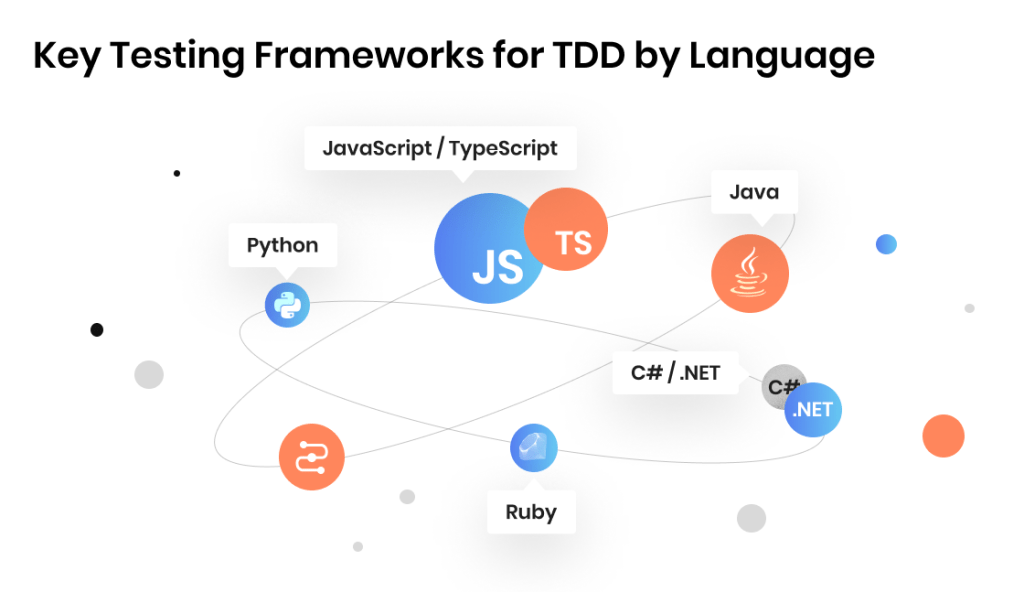
Key Testing Frameworks for TDD by Language
JavaScript / TypeScript
Jest — the default for most React and Node.js projects. Built-in mocking, snapshot testing, and watch mode that re-runs only affected tests on file save. Most teams can start writing TDD cycles immediately without additional config.
Vitest — built for Vite-based projects. Faster cold starts than Jest, compatible API. If your front-end stack is on Vite, this is the more natural fit.
Python
pytest — the go-to for most Python teams doing TDD. Minimal boilerplate, readable assertion syntax, powerful fixture system. A failing test in pytest tells you exactly what went wrong without digging through stack traces.
unittest — Python’s built-in option. More verbose, class-based structure. Works fine for TDD but requires more setup code per test.
Java
JUnit 5 — the standard for Java TDD. Supports parameterized tests, nested test classes, and has good IDE integration across IntelliJ and Eclipse. The @DisplayName annotation lets you write test names as plain sentences — useful when tests double as behavior documentation.
TestNG — more configuration options than JUnit, better suited for complex test setups. Some teams prefer it for larger enterprise codebases, though JUnit 5 has closed most of the feature gap.
C# / .NET
xUnit — lightweight, convention-based. The preferred choice for .NET Core projects and the framework most .NET TDD tutorials use.
NUnit — more mature, more attributes and configuration options. Solid choice if your team is already using it.
Ruby
RSpec — behavior-focused syntax (describe, it, expect) that reads almost like plain English. A natural fit for TDD because the test structure mirrors how you think about behavior.
Minitest — ships with Ruby, minimal setup. Faster than RSpec for simple projects, but less expressive for complex test scenarios.
Setting up a TDD-ready development environment
The framework is one piece. The environment around it determines whether TDD feels productive or painful.
Watch mode is non-negotiable. Every framework listed above supports some form of auto-run on file change. Jest has –watch, pytest has pytest-watch, JUnit integrates with IDE auto-build. When you save a file and see test results in under 2 seconds, the Red-Green-Refactor cycle feels natural. When you have to switch windows and manually trigger a run, it breaks the flow — and people stop doing it.
Writing test cases with behavior-focused names. should_reject_expired_card tells you what the system does. testValidateCard3 tells you nothing. Good test names are documentation. Each test case describes one specific requirement. When a test fails six months from now, the name should tell the next developer what broke without opening the test file.
CI runs the full suite on every commit. Locally, developers run the tests they’re working on. CI catches everything else. If your CI pipeline takes 45 minutes, TDD will feel like it’s slowing you down — but the problem is the pipeline, not TDD. Fast CI (under 10 minutes for unit tests) is a prerequisite.
Pre-commit hooks catch the obvious stuff. A hook that runs affected tests before each commit adds maybe 15 seconds to the commit flow. It prevents the “forgot to run tests” PR comment that wastes everyone’s time.
TDD Approaches and Development Methodologies — Inside Out vs Outside In
Two schools of TDD have shaped how teams practice test-first development for over a decade. They agree on the Red-Green-Refactor cycle. They disagree on where you start and how much you mock.
This isn’t an academic distinction. The approach you choose affects how your architecture evolves, how resilient your tests are to refactoring, and how much setup each test requires. Most experienced TDD practitioners use both — the question is which fits where.
Inside Out (Detroit School / Classicist)
What it means: You start testing at the smallest unit level — individual functions, classes, pure logic. No mocking of your own code. The higher-level architecture emerges organically as you compose tested units together. Design decisions happen at the refactor stage.
What you gain: Simple test setup, minimal dependencies, tests that are easy to read and maintain. Because you’re testing real code (not mocks), a passing test means the actual logic works.
Challenges: You build bottom-up, which means the big picture emerges late. Sometimes you test 15 small units, compose them into a feature, and realize the integration doesn’t work the way you expected.
In practice: Let’s take a fintech team building a transaction validation module.
They start with individual rules: card format, expiration check, velocity limit, amount threshold
Each rule is a standalone function with its own tests. No mocks
After 15 rules are individually green, they compose them into a validation pipeline
The pipeline needs two small adjustments at integration level — but each rule is already proven
Regulators require a new check eight months later. One function, four tests, plugged in. One afternoon
Outside In (London School / Mockist)
What it means: You start from user-facing behavior and work inward. The first test describes what the user (or API caller) expects. Inner dependencies that don’t exist yet get mocked or stubbed. Design decisions happen at the red stage — you define the interface before you build it.
What you gain: Early alignment with business requirements. Your outermost test is essentially an acceptance test — it validates what the feature does from the user’s perspective before you’ve finished the internals.
Challenges: Mocking. If you mock too much, your tests validate the mocks — not the code. Kent Beck put it directly: going too deep with mocking kills your ability to refactor.
In practice: Let’s say a healthcare SaaS team is building a patient intake flow.
Their outermost test: submit a form with specific fields, expect a confirmation with a patient ID
Behind that, the API handler, validation layer, and database write are all mocked initially
Over the next sprint, each mock gets replaced with a tested implementation
The outer test passes the entire time — user-facing behavior stays consistent while the internals get built
How to choose — and when to mix both
A simple heuristic: if the module is mostly business logic with few external integrations, Inside Out usually fits better. If it’s mostly orchestration between services, APIs, or user interfaces, Outside In gives you faster feedback on whether the pieces connect correctly.
Most production systems have both kinds of modules. A checkout flow might use Outside In for the user-facing purchase sequence, and Inside Out for the pricing calculation engine underneath. Picking one school as a team-wide policy and applying it everywhere is a common source of friction.
Test-driven development in software testing provides flexibility here. The TDD process doesn’t mandate one school — it promotes matching the approach to the module. The developers who sustain TDD long-term tend to think in terms of “what kind of feedback do I need from this test?” rather than “which school am I following.” If you need to know that the internal logic is correct — test the logic directly. If you need to know that the user gets the right result — test from the outside.
Words by
Mykhailo Tomara, QA Lead
“The mocking debate eats more team hours than it should. We see teams that mock everything and teams that refuse to mock anything — and both end up frustrated. Mock what you can’t control: external APIs, payment providers, third-party services. Test your own code directly. That one rule resolves about 80% of the arguments.”
Benefits of Test-Driven Development with Examples
The benefits of test-driven development are well-documented: fewer bugs, better design, safer refactoring. You’ll find these in every article on the topic. What’s more useful is understanding how they show up in a real team’s workflow — and what happens when you read them together instead of one by one.
Individual Benefits at a Glance
Benefit
What you gain
Typical result
What TDD won’t catch
Fewer production bugs
Defects caught during development, not after deployment. A bug fixed while coding costs minutes; the same bug in production costs an incident, a context switch, and sometimes a customer apology.
An e-commerce team adopts TDD for checkout — cart-related incidents drop from ~8/month to 2 in one quarter.
Integration failures, UI rendering issues, performance bottlenecks — those need other test levels.
Better code design
Code written to pass defined tests tends to be more modular. If a function is hard to test in isolation, that’s a design signal — too many dependencies, unclear interfaces.
Logistics platform team sees PR review time drop ~25% after 6 months of TDD. Reviewers read tests first to understand intent, then check implementation
Over-modularization if teams test too granularly. Not every helper function needs its own test.
Faster, safer refactoring
Comprehensive test suite is a safety net. Modify internals, run tests, know immediately whether anything broke.
Team A (TDD) refactors a 3,200-line permissions module in 4 days. Team B (no TDD), same module complexity: 3 weeks plus 2 regressions that take another week to fix.
Tests protect against regressions in tested behavior. Untested code paths remain unprotected regardless of methodology.
How to read this table: the middle column is where TDD pays for itself. The right column is where teams get disappointed if they expect TDD to solve everything. TDD strengthens the unit-level foundation — but it’s one layer in a testing strategy, not the whole strategy. Integration tests, end-to-end tests, and performance tests cover the gaps in that last column.
TDD enhances each of these areas individually, but TDD offers the biggest return when they compound. TDD promotes a development cycle where confidence grows with each passing test, not just with each shipped feature.
How TDD benefits compound — combination analysis
Individual benefits are useful to understand. But the real payoff comes from how they interact.
[Low bug rate] + [fast refactoring] = compounding development velocity
Low bug rate alone doesn’t speed you up if every code change still feels risky. Fast refactoring without tests means you’re introducing new bugs faster. TDD gives you both at once: fewer reasons to fix things later, and confidence to change things now. Over months, that compounds — each sprint builds on stable ground instead of shifting sand.
[High test coverage] + [low test quality] = false confidence
This is the pattern that catches teams off guard. A dashboard says 85% coverage. Leadership feels good. But the tests validate implementation details — they check that method X calls method Y with argument Z. They don’t check that the user gets the right result. A team with 60% coverage of behavior-focused tests will catch more real production issues than a team with 90% coverage of implementation-coupled tests. TDD naturally produces behavior-focused tests, because the test is written from the requirement, not from the code.
If your test count goes up but your bug rate doesn’t go down, the new tests aren’t testing what matters. This is a common signal in teams that mandate coverage targets without TDD — developers write tests to hit the number, not to validate behavior.
In 2026, there’s an additional dimension. When AI generates a significant share of your codebase, the combination of [AI-generated code] + [tests written after the fact] produces a specific risk: the tests confirm what the AI wrote, not what the feature requires.
Although TDD requires more upfront effort, TDD helps teams avoid the expensive cycle of ship-then-fix. TDD encourages developers to define what “correct” means before writing a single line — or before accepting what an AI generated.
We’ll map your current test coverage against actual production risk — not just lines covered, but behaviors validated.
TDD best practices are simple to list and hard to sustain. The difference between teams that keep practicing TDD after three months and teams that quietly drop it usually comes down to five things.
1. Start with the most critical path, not the easiest code
Don’t begin TDD adoption on utility functions or config files. Start with the module that causes the most production pain. The question to ask:
Which module generated the most support tickets last quarter?
Where do production incidents cluster?
What part of the codebase does the team avoid touching because “it works, don’t break it”?
That’s where TDD gives the fastest, most visible return. Let’s say a logistics company starts TDD on their shipment routing engine — their #1 source of support tickets.
After 3 sprints, routing-related bugs drop 60%
That result gets shared in a leadership review
Two more teams ask to try TDD on their modules
Adoption spreads from evidence, not a mandate
One catch: high-risk code is usually the most complex and hardest to test. Pair someone experienced with TDD alongside a developer who knows the module. The combination works better than either alone.
2. Test behavior, not implementation
This is the practice that makes or breaks long-term TDD success. The question is simple: does your test describe what the code does for its caller, or how it does it internally?
Does your test check that calculate_shipping returns the right cost for an express delivery? → Behavior. Good.
Does your test check that calculate_shipping calls getBaseRate, then applyDiscount, then addTax in that order? → Implementation. Fragile.
The first test survives six refactors. The second breaks every time someone touches the method internals. Writing a unit test that checks behavior instead of implementation is the single most impactful practice for long-term TDD success. When a test fails, the name should tell you what broke for the user — not which line of code changed.
3. Keep the red-green-refactor cycle short
Each cycle should take minutes, not hours. If you’re spending 30 minutes writing a single test, the scope is too large — break the test requirements into smaller pieces.
What you gain: Continuous, rapid feedback. Small corrections instead of long debugging sessions.
Where it gets tricky: Complex business logic sometimes feels like it needs a big test. It doesn’t. It needs several small tests that each validate one aspect of the behavior.
In practice: Let’s take a payments team that caps TDD cycles at 10 minutes.
If a cycle exceeds 10 minutes, they split the test into two or more smaller ones
Average cycle: 4–7 minutes
Result: roughly 3x more iterations per day compared to their previous approach
Each cycle should produce a passing test within minutes — bugs are smaller and caught faster because each test covers a narrow slice
4. Refactor the tests, not just the code
What it means: Test code is code. It needs the same care — clear naming, no duplication, readable setup. A messy test suite is a test suite nobody trusts.
What you gain: A comprehensive test suite the team actually reads and maintains, instead of one they run but never look at.
Where it gets tricky: Teams almost always treat test code as second-class. Tech debt in tests accumulates faster than in production code — and it erodes trust in the whole TDD practice.
In practice: One approach that works: monthly test health reviews.
Identify flaky tests — fix or remove
Find redundant tests — two tests checking the same behavior? Keep the clearer one
Improve naming — a 15-minute pass through test names pays off for months
One team retired 20% of their suite during a review. Remaining tests caught more bugs because the signal-to-noise ratio improved
5. Use TDD as a design tool, not a coverage target
TDD’s primary output is better design. Coverage is a side effect.
Teams that chase coverage percentages write tests to hit a number. Teams that practice TDD write tests to define behavior — and coverage follows naturally. The danger of making coverage the KPI is that developers optimize for the metric, not the outcome.
Let’s say a team drops from 92% to 78% coverage after removing implementation-coupled tests in a health review. Leadership gets nervous. But production bug rate actually improves 15% over the next quarter. The remaining tests are behavior-focused — each one validates something a user would notice if it broke. The team starts reporting “behaviors covered” alongside the percentage, which gives stakeholders a more honest picture of what the number means.
Track defect rates and cycle times alongside coverage. Those numbers tell a more complete story than any single percentage.
We’ll assess your team’s testing maturity and build a phased TDD adoption plan that fits your release cycle — not a textbook
Common TDD Mistakes in Traditional and Modern Development
TDD focuses on a simple loop, but teams find creative ways to break it. TDD fails more often from bad practice than from bad theory. The TDD cycle itself is straightforward — red, green, refactor. The mistakes are in how teams apply it. And most of them are predictable enough to avoid if you know what to watch for.
Writing tests that mirror code structure
This is the most common mistake in teams that are new to test-driven development, and it’s the one that causes the most damage over time.
It looks like this: a developer writes a test that checks whether processOrder calls validateCard, then checkInventory, then calculateTotal in that specific order. The test passes. The code works.
A month later, someone refactors the internals — combines two steps, renames a method — and the test breaks. Not because the behavior changed, but because the test was coupled to the implementation.
When this happens repeatedly, the team spends more time fixing tests than fixing code. TDD starts to feel like overhead. People blame the methodology, but the problem is the test design.
What to do instead: Test through public interfaces. The test should answer “what does this return when I give it these inputs?” — not “which methods does this call internally?” If you can’t describe what the test validates without referencing internal method names, the test is too coupled.
Over-mocking dependencies
Mocking has a legitimate place in TDD — you mock external services you can’t control, third-party APIs with rate limits, payment gateways you don’t want to hit during a test run. The problem starts when teams mock their own internal code.
Let’s say a test for an order processing function mocks the inventory service, the pricing engine, and the notification system — all of which are internal modules the team owns. The test passes. But what did it actually validate? That the function calls three mocks in the right order. The real inventory logic, the real pricing calculation, the real notification flow — none of them were tested. The test suite is green, production breaks anyway.
This pattern is increasingly visible in teams working with AI-generated code. The AI writes a function, a developer writes tests with mocks for every dependency, everything passes — but nobody tested whether the actual components work together. TDD requires you to think about what’s real and what’s simulated in each test.
What to do instead: Mock what you can’t control (external APIs, third-party services, infrastructure). Test your own code with real implementations wherever practical. If a test needs five mocks to run, that’s a design signal — the function probably has too many responsibilities.
For teams that have already shipped AI-generated code without test-first discipline, the path forward usually involves two things: retroactively adding behavior-focused tests to the riskiest modules, and reviewing the AI-written code itself for hidden assumptions.
That’s the kind of work where a dedicated development partner — like QArea’s AI code review and stabilization practice — saves months of trial and error.
Skipping the refactor step
This one is quiet and cumulative. Under time pressure, the cycle becomes Red → Green → next feature. The refactor step gets dropped. Nobody notices for a while.
Six months later, the codebase has the same structural problems it would have without TDD — duplication, unclear naming, tangled responsibilities. The tests exist, but the design benefits don’t. The team is doing test-first development without the design improvement that makes TDD worth the investment.
What to do instead: Treat refactoring as part of “done.” A feature isn’t complete at green — it’s complete after refactor. If time pressure is constant (and when isn’t it), keep refactors small. Rename a variable. Extract a helper. Simplify a conditional. Five minutes of cleanup after each green keeps the codebase healthy without blocking the sprint.
Testing too much or too little
Two failure modes, opposite directions, same result: a test suite that doesn’t match actual risk.
Too much: The team targets 100% coverage on everything. Every getter, every config loader, every display function has tests. The suite is slow, brittle, and full of tests that validate trivial behavior. Maintaining it becomes a project of its own.
Too little: The team tests the easy parts — utility functions, formatters, simple calculations — and skips the complex business logic because “it’s too hard to test.” The code that actually breaks in production has the least coverage.
What to do instead: Prioritize by risk:
Payment processing, authentication, data transformations → test thoroughly, TDD fits well here
Business rules that drive revenue or compliance → high priority, worth the effort of writing tests first
Configuration display, static content, simple UI rendering → lighter coverage is fine, TDD is optional
Infrastructure glue code → integration tests are more valuable than unit tests here
The goal isn’t maximum coverage. The goal is maximum coverage where it matters.
For initial development of a new feature, TDD fits naturally — each test requirement maps to a behavior. For legacy code, start with comprehensive tests around the riskiest paths and expand from there.
A note on AI-generated code: this “testing too little” pattern gets amplified when parts of the codebase are AI-generated. Teams tend to trust AI output more than they should — the code looks clean, the variable names make sense, it probably works. But “probably works” and “validated against requirements” are different things. Integrating testing into the development process — not bolting it on afterward — is what separates teams that catch bugs early in the development from teams that find them in production.
Implementing TDD in Your Software Development Process
Adopting TDD across a development team is a process change, not a tooling change. You can install a testing framework in an afternoon. Getting a team to write tests before code — consistently, under deadline pressure, across different skill levels — takes deliberate planning.
The teams that succeed treat adoption as a phased rollout. The teams that fail try to mandate it org-wide in a single sprint.
Phase 1 — Pilot on one module (Weeks 1–4)
Pick the module with the highest production bug rate. Not the most interesting module, not the one the senior dev wants to rewrite — the one that’s generating the most pain right now.
Assign 2–3 developers. Ideally one with TDD experience, even if it’s just personal projects or a previous team
Define what you’re measuring: bugs found pre-deploy vs post-deploy, time to debug an issue, cycle time per feature
Keep the scope tight. One module, one team, four weeks
Don’t expect perfection. Expect learning. The first two weeks will feel slow — that’s normal
The goal of Phase 1 isn’t to prove TDD works in theory. It’s to produce one concrete result — “this module had 12 bugs last quarter and 3 this month” — that justifies expanding.
The goal is to make a test pass for each critical behavior in the module — and measure whether those passing tests translate to fewer production issues.
Building a QA strategy from scratch or rethinking your current one?
We’ll match testing approaches to your product’s actual risk profile.
Phase 1 gave you a result and a small group of developers who know how TDD feels in practice. Phase 2 is about making it repeatable.
Establish team conventions: test naming patterns, where test files live, what gets mocked vs tested directly
Code review now includes test quality. Not just “do tests exist?” but “do these tests describe behavior?”
Run pair programming sessions: someone from the Phase 1 team pairs with a developer adopting TDD for the first time. This transfers tacit knowledge — the stuff that’s hard to put in a wiki page
Expect the productivity dip. Weeks 2–4 of a developer’s TDD adoption are the slowest. They’re learning a new workflow while still shipping features. It recovers by week 5–6 for most people
Phase 3 — Integrate into CI/CD and team culture (Weeks 9–12)
By now, TDD is a practice for some of the team on some modules. Phase 3 makes it part of how the team works, not a side project.
Tests run on every commit, not just pre-merge. Fast feedback requires fast CI — if your unit test suite takes more than 10 minutes, optimize before expanding TDD scope
Add a test health review to your sprint retrospective. Five minutes: any flaky tests? Any tests that keep breaking for the wrong reasons? Any untested high-risk areas?
Build a simple metrics dashboard: defect rate (pre and post TDD), average cycle time, test suite run time. These numbers tell the adoption story better than any status report
Celebrate the first save. When TDD catches a bug that would have been a production incident, make sure the team (and leadership) knows about it. That story is worth more than any training deck
An extensive test suite that runs on every commit becomes the team’s safety net throughout the development process.
What your metrics tell you together
Individual metrics can mislead. Read them in combination:
[Test suite run time increasing] + [defect rate decreasing] = healthy adoption. Tests are catching more real issues. But watch the run time — if it crosses 10 minutes for unit tests, start optimizing before it becomes a bottleneck.
[Coverage increasing] + [defect rate unchanged] = test quality problem. You’re adding tests that don’t validate real behavior. Review what’s being tested — it’s likely implementation details or trivial code.
[Developer velocity dropping] + [first 3 weeks of adoption] = normal. The learning curve. If velocity hasn’t recovered by week 6, revisit training approach and test scope — the team may be over-testing or testing at the wrong level.
[Developer velocity dropping] + [week 8+] = process problem. Something is off. Common causes: test suite too slow, too much mocking overhead, or TDD being applied to code where it doesn’t fit (like UI layout or infrastructure glue).
Words by
Nora Layevska, Partnership and Growth Director, TestFort
“TDD adoption always looks like a productivity loss in weeks 2 and 3. That’s the dip every team hits. The ones that come out stronger are the ones where leadership expected it and planned for it — instead of panicking and pulling the plug at the first velocity drop.”
Our Approach — How TestFort Helps Teams Build Testing That Works
The argument through this entire guide has been consistent: start with understanding what you have, define what “correct” means before writing code, and adopt practices in phases rather than mandates.
That’s how we work with clients too.
We start with an audit, not with testing. Before recommending TDD or any other methodology, we assess what’s actually happening in your QA process. What does your test suite cover? Where do production bugs cluster? How much of your testing effort is going toward code that rarely breaks, and how much toward the modules that break every release? The audit gives both sides — your team and ours — a shared picture of where the real risk lives.
We build a phased strategy. Based on the audit, we define which areas benefit most from test-first development, which need integration testing reinforcement, and where the team needs training or tooling support.
We don’t recommend TDD for everything. Some modules are better served by integration tests. Some need end-to-end coverage. Some just need better monitoring. The strategy matches the approach to the problem.
We integrate into your workflow, not alongside it. Our QA engineers work within your CI/CD pipeline, your sprint cadence, your code review process. The goal is to make testing better inside your existing system.
We bring pattern recognition from across industries. After working with teams in fintech, healthcare, e-commerce, logistics, and SaaS, we’ve seen where TDD delivers strong ROI, where a hybrid approach makes more sense, and where the bottleneck isn’t testing methodology at all — it’s environment setup, flaky CI, or a team structure that puts QA at the end of the pipeline instead of inside it.
For teams working with AI-generated code and looking for a systematic way to maintain code quality, we also work closely with QArea’s development team on code review, refactoring, and stabilization of AI-assisted codebases — making sure the speed of AI-generated code doesn’t come at the cost of long-term maintainability.
QArea’s development team specializes in reviewing, refactoring, and stabilizing codebases built with AI assistance — turning vibe-coded prototypes into production-grade software.
Test-driven development is a development technique and software development practice where you write a test before writing the code. The test describes what the code should do. You then write the minimum code to make that test pass, clean up the code, and repeat. The cycle has a name — Red-Green-Refactor — and each loop typically takes a few minutes.
What are the key benefits of test-driven development?
The main ones: ✅ Bugs get caught early in the development process, when they’re cheapest to fix ✅ Code ends up more modular because testable code is naturally less coupled ✅ Refactoring is safer — you change the internals, run the tests, and know immediately if something broke ✅ New team members onboard faster because the test suite acts as executable documentation of intended behavior
TDD provides faster feedback loops and TDD promotes cleaner architecture as a side effect of writing tests first. It also reduces the gap between what product asked for and what engineering built.
How does TDD compare to behavior-driven development (BDD)?
TDD operates at the unit test level — a developer writing tests for specific functions and modules. BDD extends the test-first idea to business-readable scenarios, usually in Given/When/Then format, that non-technical stakeholders can review. BDD lives at the acceptance test level.
They’re not competing approaches. Many teams use both: TDD for the developer workflow, BDD for cross-team alignment on feature requirements. TDD tells you the code works correctly. BDD tells you the code does what the business intended.
What testing frameworks work best for a TDD approach?
The specific framework matters less than two things: fast test execution (seconds, not minutes) and clear failure output that tells you what broke without digging through logs.
Can you use TDD with agile development?
TDD fits naturally into agile software development. The short Red-Green-Refactor cycles align with sprint-based work — each user story can start with acceptance criteria translated into tests. Teams practicing TDD within agile sprints typically see fewer bugs escaping to QA and shorter feedback loops during sprint reviews.
TDD also supports iterative development well. As requirements shift mid-sprint (and they do), the existing test suite tells you immediately whether a change breaks something that was already working.
What is a test-driven development example?
Let’s say you’re building a function that calculates shipping cost based on package weight and delivery speed.
✅ First, write a test: a 2kg package with express delivery should cost $15.99. Run it — it fails because the function doesn’t exist yet ✅ Write the minimum code to pass the test: a function that takes weight and speed, returns $15.99 for express 2kg. Run the test — it passes ✅ Write the next test: a 2kg package with standard delivery should cost $8.99. Fails ✅ Add a condition for standard delivery. Make the test pass ✅ Refactor: extract the rate lookup into a separate function. Run both tests — still green
After five cycles, you have a tested shipping calculator built from small, verified steps. Each test defines one specific behavior.
What is a test-driven development example in software testing?
Let’s say you’re building an authentication module. First write a test: a user with valid credentials should receive a session token. The test fails — the function doesn’t exist. Write the minimum code to make the failing test pass. Then write the next test: invalid credentials should return an error.
Write the code to make that test pass too. Refactor both paths. After several cycles, you have a tested authentication flow built from small, verified steps — each test driven by a specific requirement, not by the code that already exists.
What are the common reasons TDD fails in teams?
The usual pattern:
▶️ Testing implementation details instead of behavior — tests break on every refactor, team gets frustrated ▶️ Over-mocking internal code — tests pass but don’t validate real logic ▶️ Skipping the refactor step — code quality degrades despite having tests ▶️ Trying to adopt TDD across the entire codebase at once — too much change, too fast ▶️ No leadership support during the initial productivity dip — the team gets 3 weeks in, velocity drops, someone pulls the plug
Making the failing test pass is the easy part. The hard part is maintaining the discipline — refactoring after green, keeping tests focused on behavior, and resisting the temptation to skip tests when deadlines tighten. Most teams need 4–6 weeks to feel comfortable with the rhythm.
What does a QA audit include, and how does it help with TDD adoption?
A QA audit reviews your current test coverage, test quality (not just quantity), CI/CD integration, defect patterns, and team workflows. It identifies where testing effort is misaligned with actual risk — heavy coverage on low-risk features, gaps in critical paths.
For teams considering TDD, an audit gives you the baseline: where are bugs coming from, which modules would benefit most from test-first development, and what does the team need (training, tooling, process changes) to adopt it effectively. It turns “we should try TDD” from a general idea into a specific plan with measurable starting points.
Share:
Jump to section
Hand over your project to the pros.
Let’s talk about how we can give your project the push it needs to succeed!
A commercial writer with 13+ years of experience. Focuses on content for IT, IoT, robotics, AI and neuroscience-related companies. Open for various tech-savvy writing challenges. Speaks four languages, joins running races, plays tennis, reads sci-fi novels.











 What is test-driven development in simple terms?
 What is test-driven development in simple terms?