
There are still two persistent misconceptions about testing: that developers alone can handle it to save money, and that little has changed since automation testing first appeared.
But today’s reality proves the opposite: a single overlooked defect can cost millions. From a major airline forced to halt departures due to a flawed update, to a global tech outage triggered by a security-software patch that impacted millions of devices, and a leading bank forced to compensate customers after persistent system glitches — these recent incidents show how automation testing and modern software testing strategies are no longer optional. In every case, the root cause wasn’t a lack of talent — it was a lack of proper, modern software testing and automation coverage.
The truth is that the testing landscape is evolving faster than ever. From AI-powered verification to self-healing tests and continuous production monitoring, testing automation is no longer optional — it’s the only scalable way to keep up with complex architectures, rapid deployments, and rising user expectations. In this article, we break down the top automation testing trends to watch in 2026 and show how adopting them can strengthen your overall testing strategy, reduce risk, and future-proof your digital products.
Key Takeaways
- Automation testing is evolving rapidly, requiring teams to keep up with new tools, methods, and intelligence-driven practices.
- AI-powered capabilities like autonomous agents and self-healing tests are reshaping how test cases are created, executed, and maintained.
- Shift-left testing continues to grow as companies push testing earlier in the software development life cycle.
- Shift-right testing and constant monitoring bring real-time validation and production insights into the QA strategy.
- Codeless automation testing and scriptless tools expand testing participation beyond engineering roles.
- Synthetic data, AI-based mocking, and environment containerization reduce testing bottlenecks and improve accuracy.
- Mobile, API-first, and microservices architectures increase the need for scalable, reliable automation testing approaches.
- Cloud-based browser testing and cross-platform execution help teams reach broader device and OS coverage.
- Ethical testing and AI governance ensure fairness, transparency, and compliance in intelligent systems.
- Continuous testing strengthens release pipelines, enabling faster and more confident deployments.
- Security automation and AI-powered vulnerability analysis are becoming essential for modern applications.
- The overall automation testing trends 2026 are defined by adaptability, intelligence, and proactive quality assurance at every stage.
30 Automation Testing Trends for 2026
Some trends are just a flash in the pan. In theory, they are full of promise, but come real-case tasks, they often reveal their limitations and impracticality. We’ve hand-picked the latest trends in QA automation for 2026 that seem both realistic to implement and have the potential to truly make a difference in how we assure quality.
1. QAOps Is Gaining Popularity
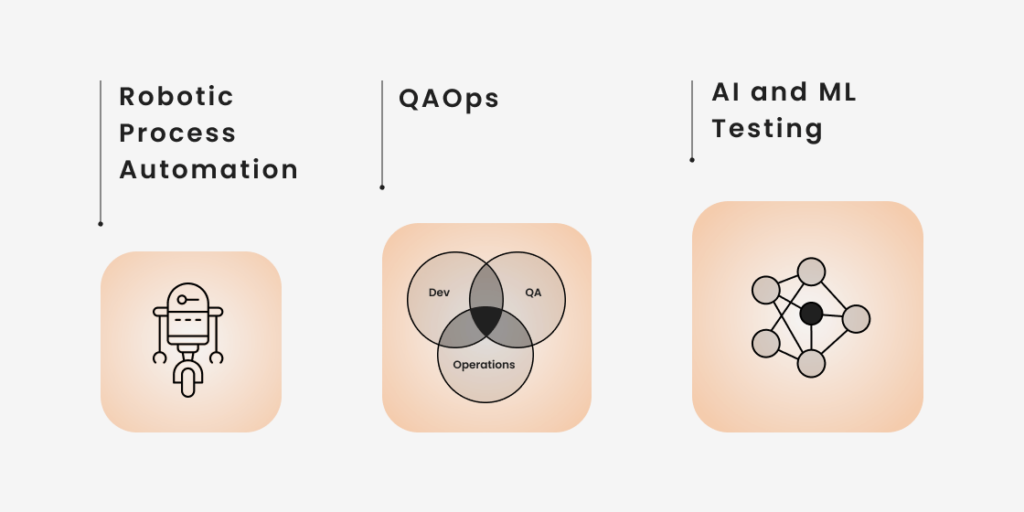
QAOps continues to be a booming trend in 2026, as evidenced by the many test automation news and discussions. As the name suggests, this methodology combines a QA approach and IT operations to speed up automation testing and integrate it deeper into the software development pipeline. In other words, it integrates quality assurance and testing into the DevOps process, introducing thorough testing at every stage of the software development life cycle, not just at the end.
To elaborate, the QAOps framework allows developers and testers to work together. Through this close-knit collaboration, companies can pinpoint different test scenarios that real users might encounter when they start interacting with the app, thereby improving the testing process.
Some companies have given this approach their own twist. They organize so-called “testing parties”, inviting all interested team members to take part in testing. By doing so, they not only ensure there’s no bias in testing, but also get the opportunity to test their products from different perspectives, allowing them to ultimately achieve better outcomes.
It’s like building a house where developers build the foundation, walls, and the roof, and testers ensure from the beginning that all of these components are made strong. Later, when the house is ready for occupancy, no major rework will be required.
Benefits
- Improved collaboration between testers, developers, and IT operations teams.
- Boosted productivity of the team through ongoing knowledge sharing.
- Faster release of new products and features due to the quick detection of bugs.
- Enhanced customer experience achieved by delivering quality software.
2. Extensive Adoption of Robotic Process Automation
One of the prominent test automation trends for 2026 that is growing in popularity is the use of robotic process automation. RPA, also known as software robotics, has the ability to mirror testers’ interactions with software applications. By recording actions performed by testers and learning testing sequences, it can imitate the same process, saving you lots of time performing repetitive testing activities.
RPA has become widely popular due to the ease and speed of its implementation. Compared to traditional automation testing tools, which require specialized hardware and software to automate repetitive tasks, RPA uses bots. They can be trained quickly, making RPA a more cost-effective testing solution.
RPA testing techniques are being used across various industries and will become even more widespread in the near future. According to Statista, the RPA market will grow to $13.39 billion by 2030, which is a huge jump from $3.17 billion in 2022.
Moreover, RPA will become much more intelligent thanks to the advances in artificial intelligence and machine learning soon. This means that RPA will not only copy human actions but also understand information, learn from experience, and proactively address issues. Ultimately, this will allow it to execute more complex decision-making processes without much guidance on the tester’s part.
Benefits
- Reduced labor costs due to the automation of repetitive test cases.
- Less of a risk for human error, as RPA accurately replicates testers’ interactions.
- Significant time and resource savings due to RPA bots’ ability to execute tests across multiple systems and applications.
- Scalability that allows organizations to perform small, large, or even enterprise-level test execution on demand.
3. Active Use of AI and ML in Software Testing
AI and ML tools are making a splash in the software testing industry and are therefore impossible to ignore when discussing current trends in automation testing. With their ability to automate virtually every aspect of testing automation, from test case creation and test execution to test maintenance, they have become indispensable for QA teams.
Practical applications of AI and ML include NLP-based test cases, visual browser testing, automated triage, and AI-driven security testing. AI also improves regression testing by predicting areas likely to fail.
Test smarter and faster with our AI testing services

Other examples of using AI and ML in testing include:
- Natural language processing. NLP algorithms can extract and analyze requirements from natural language documents, helping with test case creation and ensuring that tests align with the project’s goals.
- Visual testing with computer vision. AI-driven computer vision systems can automatically compare UI elements and screens to identify visual defects or inconsistencies in applications.
- Automated bug triaging. ML models can help prioritize and categorize incoming bug reports.
- Behavior-driven testing with AI. AI can understand user behavior patterns and generate test scenarios that mimic real-world user interactions, enabling QA teams to cover more test cases.
- Security testing. AI can simulate cyberattacks and identify vulnerabilities in software.
Aside from that, AI excels at predicting outcomes. By analyzing historical data and patterns, it can identify with a high probability what bugs and issues are likely to occur and help prevent them before they become major issues.
Benefits
- Faster release cycles;
- Quick test case generation;
- Automatic test maintenance;
- Predicting the likelihood of bugs and testing outcomes based on historical data;
- An extensive test coverage across various devices ensures that the software is thoroughly tested and no bugs slip through the cracks.
4. Explainable AI Is Gaining Traction
While AI is confidently working its way into testing, helping QA teams improve the accuracy of the results and mitigate errors, the main thing that makes this testing useful is transparency. QA engineers need to be able to understand why this or that decision was made and act on it accordingly. That’s where explainable AI plays a pivotal role.
In layman’s terms, explainable AI (often referred to as “explainability”) is the ability of testers to determine what exactly accuracy means in each particular case and predict future decisions based on derived results. With clear definitions of AI results, they can prevent bugs, defects, and biases, ensure their products are regulatory compliant, and build trust with key stakeholders.
In the coming years, explainable AI will become an integral part of testing. We will see the emergence of many new AI frameworks and tools like SHAP, TensorFlow, Lime, and similar, which will speed up the adoption of explainable AI in software testing.
Benefits
- Early detection of bugs, reducing the cost and time to fix them.
- Higher quality software as testing is performed from the start of development.
- Shorter development cycles due to faster feedback on code changes.
- Reduced risk of late-stage failures that can delay product releases.
5. Ethical Testing Is Viewed as the Future of Testing
Ethical testing is becoming a major testing trend due to the need for fair, unbiased, and transparent algorithms. As testing will increase in scope for AI-driven systems, QA teams must actively identify biased patterns during the early stages of the software development cycle.
The main concern with AI is that it’s been operating as a “black box” for a long time. It generates results, but why and how it has made these decisions is not always clear, often leading to biases and discriminatory outcomes. Ethical testing addresses these concerns. With ethical testing, QA teams focus on mitigating biases early in development, ensuring that algorithms are fair, transparent and do not perpetuate discrimination related to race, gender, or socioeconomic factors.
Seeing how much attention is paid to AI ethics today, ethical testing is moving from a nice-to-have to a must-have practice and becoming one of the significant trends in automation testing for 2026 and beyond.
Benefits
- Provides clear insights into how AI systems make decisions.
- Helps identify and address potential biases early in development.
- Ensures alignment with global regulations and standards.
- Builds confidence among users and stakeholders.
6. A Shift to Self-Healing AI Automation Testing Tools
One of the biggest hurdles in automated testing is flakiness. When tests show different results after each run, knowing which one of them is accurate becomes a challenge. Self-healing tools address flaky automation testing by automatically fixing selectors, adjusting flows, and stabilizing automation scripts. As intelligent automation grows, these tools help QA teams maintain fewer tests and deliver more reliable outcomes.
The best thing is, self-healing tools constantly learn. With each run, they process more data and patterns and identify recurring issues, becoming more efficient at creating tests. This, along with their ability to process volumes of data going through developers’ pipelines, makes them essential for modern QA processes requiring both accuracy and reduced downtime.
Benefits
- Proactive issue detection, minimizing downtime.
- Seamless integration with CI/CD pipelines, ensuring up-to-date and reliable test scripts.
- AI-driven prioritization of test cases.
- Continuous adaptation to application changes, requiring minimal manual intervention.
7. More Organizations Will Implement Shift-Left Testing
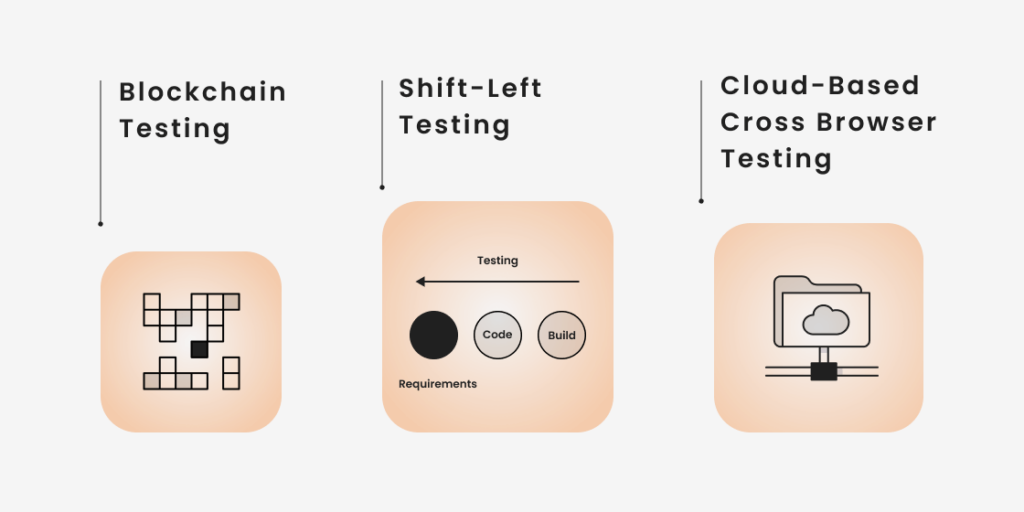
Shift-left testing continues to grow in relevance as teams prioritize early software testing. Writing test cases before coding helps identify issues when fixes are cheap. This method strengthens collaboration between development and testing teams and supports scalable testing methods.
Involving testers early in the development cycle offers some undeniable advantages. And one of the most important of them is cost reduction. By checking the validity of the code early on, teams can identify and fix bugs while the cost to fix them is still rather low, rather than letting them escalate to later stages, where it can reach $7,600 and more.
The Shift-Left approach also encourages the use of intelligent analytics. The Shift-Left approach also encourages the use of intelligent analytics. Testers can gauge customer satisfaction by monitoring their interactions with the software. If they find that the software needs some changes, they can introduce them during the initial stages of software development when they won’t cost much.
It’s worth noting that despite the benefits shift-left testing offers, it’s not always appropriate to involve testers early in the development process. The decision to involve QA testing teams should be made based on the state of a project.
Benefits
- Reduced development costs through early detection and correction of bugs and errors.
- The possibility of automating test cases earlier and streamlining the entire testing process.
- Faster time to market thanks to the optimized QA process.
Shift-Left Testing: Principles, Benefits, and How to Adopt It Right

8. The Demand for Cloud-Based Cross-Browser Testing Is Increasing
Among the growing trends in test automation adopted by organizations this year, cloud-based cross-browser testing stands out. As the variety of devices increases yearly, it’s become essential for companies to thoroughly test their solutions across all of them.
However, in practice, achieving such extensive coverage is often out of reach for many small companies because it is expensive to build such an extensive testing infrastructure. As a result, an increasing number of companies are turning to third-party providers that offer access to cloud technologies and thousands of virtual environments for testing.
Sure enough, with the emergence of cloud testing platforms, the market has also witnessed a rise in cloud-based testing tools. These tools provide support for all popular browsers and devices, enabling QA teams to create and run cross-compatible tests.
The global cloud application market’s value is expected to rise from $171 billion in 2020 to $365 billion by the beginning of 2026.
Benefits
- No need for costly in-house testing infrastructure, which means companies pay only for the resources they use.
- An extensive testing coverage, including a wide range of devices, browsers, operating systems, and screen sizes.
- The ability to scale testing resources up or down based on the project’s needs.
- Support for parallel testing across most cloud-based platforms, which significantly reduces testing timelines and speeds time to market.
9. Exploratory Testing Will Become Even More Integral
Exploratory testing has emerged as a practice that veers away from rigid test cases and scripts. Instead, it gives testers the freedom to explore and test software intuitively. This element of randomness not only allows QA teams to uncover unique use cases that haven’t been described by scripted testing but also find issues in areas where they wouldn’t typically look.
Benefits
- Eliminating the need to document test cases or features speeds up testing.
- The ability to catch issues and bugs that other testing methods and techniques might miss.
- Quick start due to the lack of extensive test case preparation. This is especially important in situations where there’s limited documentation or time for test case creation.
10. Microservices Testing Rapidly Evolves
The popularity of microservices architecture has given rise to microservices testing. This testing approach is aimed at testing the software as a suite of small, individual functional pieces rather than the entire architecture, and closely monitoring the ongoing performance.
Seeing how microservice-based applications rapidly appear on the market, microservices testing will continue to evolve, and the skill of testing microservices will be in high demand.
Benefits:
- The ability to test individual components and changes in one microservice without affecting others.
- Faster development cycles due to the option to release and iterate right on microservices.
- Faster project delivery thanks to the ability to work on multiple microservices at the same time.
- Optimized usage of resources, which leads to cost savings.
11. In-Sprint Automation Is Expected to Grow
According to the Annual State of Agile Report, 71% of organizations are adopting agile methodologies, and more companies are considering embracing agile in the coming years. This shift has driven the rise of in-sprint automation testing, where testers automate within each sprint to maintain velocity. Integrating automated test creation and execution into short cycles ensures faster releases, improved visibility, and more reliable testing process outcomes across the entire software development workflow.
Benefits:
- In-sprint automation, which allows for faster and more frequent releases.
- Automated tests run continuously during development, enabling early detection of defects and issues.
- Real-time feedback on the quality of the software allows for more accurate project planning, better resource allocation, and improved forecasting of project timelines.
- Automated tests created during one sprint can be reused in subsequent sprints for regression testing.
- Quick validation of new requirements and the ability to tailor the testing approach accordingly.
12. Integration of Crowdsourced Testing
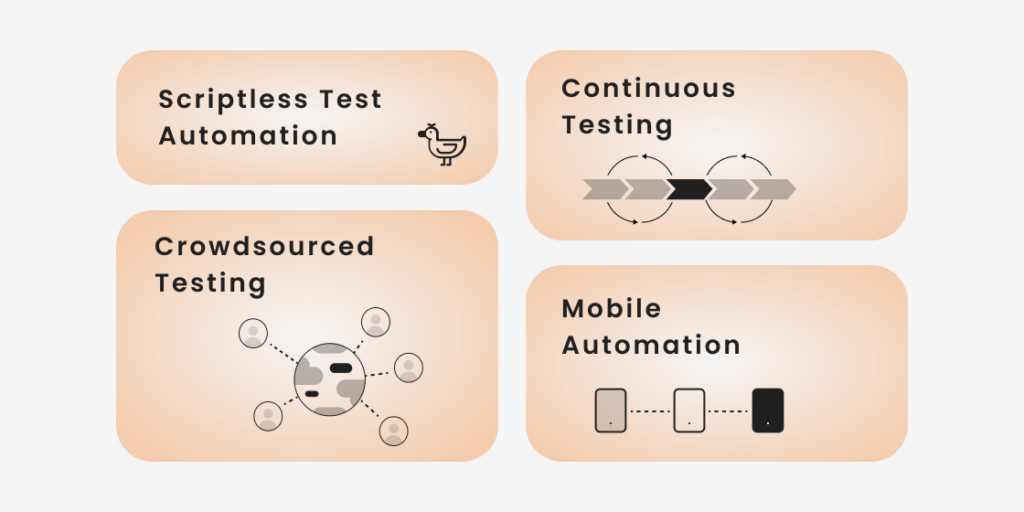
Crowdsourced testing is a progressive approach to software QA that engages a diverse community of testers, often from around the world, to test products under real-world conditions on real devices.
The great thing about crowdsourcing is that it allows companies to avoid resource constraints. They don’t have to worry about whether the tester has the right test automation tools or skills. Instead, tasks are distributed according to the resources that the tester already has, which greatly speeds up the time to market.
Crowdsourced testing is often used to accelerate automation, in particular when the company is on the brink of a product release and/or is looking to extend its reach to global markets. In the future, it will be used more extensively as companies realize the positive impact of involving end users in the testing process.
Benefits
- The ability to tap into a diverse testing experience and testing platforms.
- An extended test coverage comprising an array of devices, operating systems, browsers, and resolutions.
- An easy way to scale up or down testing capacity depending on the project’s needs.
- Involving end users in the process contributes to the delivery of a well-received product.
13. Ephemeral Test Environments and Environment Containerization
As systems grow more complex, relying on a few shared staging environments is no longer enough. Ephemeral test environments let teams create short-term, production-like setups on demand for each feature branch, pull request, or release candidate. Powered by containers, infrastructure-as-code, and cloud orchestration, these environments are created automatically, used for focused test execution, and then dismantled. This approach removes environment conflicts, eliminates “it works on my machine” issues, and makes automation testing far more predictable.
For QA teams, ephemeral environments significantly simplify running automated suites in parallel and integrating them into CI/CD pipelines. Instead of waiting for a free slot in a shared environment, testers can trigger isolated, repeatable environments with consistent data, configurations, and dependencies. As a result, the testing process becomes faster, more reliable, and tightly aligned with how modern software is built and deployed.
Benefits
- No configuration drift thanks to fully reproducible, on-demand environments
- Faster and more reliable automated test execution across branches and teams
- Easier integration of continuous testing into CI/CD pipelines
- Lower infrastructure costs through automatic environment dismantling
14. Scriptless Test Automation
This testing practice implies using automation testing tools to evaluate software quality without traditional scripts or code.
The concept is simple. The tools record the actions that testers take while navigating through the software and then, based on the results, generate the most likely use cases for different scenarios. Scriptless test automation platforms are designed to perform all types of testing, including UI/UX testing, functional testing, etc., making them suitable for many different projects.
However, similar to other tools, scriptless test automation platforms have limitations when it comes to customization. While this limitation may not be an issue for most projects with straightforward requirements, it can pose constraints for highly complex applications. In such cases, go for traditional script-based automation.
Benefits
- Speeding up the product delivery process.
- Higher ROI due to reduced automation costs.
- Flexibility in reusing automation scripts in various scenarios.
We’ll build the perfect automation testing strategy to maximize your ROI.

15. Shift-Right Testing and Production Monitoring
Shift-right testing strengthens quality by validating real user behavior in production through monitoring, feature flags, chaos experiments, and observability tooling. Instead of relying solely on pre-release checks, teams observe how features behave under real-world conditions and use this data to refine automation strategies. This trend brings QA closer to actual user experience and enables faster, safer iteration cycles, especially in complex cloud ecosystems.
Benefits
- Real-time detection of issues missed in pre-production.
- Safer rollouts via feature flags and canary releases.
- Better understanding of actual user behavior and performance.
- Continuous improvement of automation based on production data.
16. Continuous Testing Will Simplify Build Releases
Continuous testing helps businesses evaluate risks associated with software launch, ensuring informed decisions about whether to proceed or make adjustments. CT is performed after each product change and can be integrated into the CI/CD pipeline.
As businesses increasingly recognize the benefits of CT, its demand and adoption are expected to continue growing in the software testing industry. According to Report and Data, 21% of QA testers have already incorporated CT into their processes to accelerate code releases, while the rest are keen on doing so in the near future.
Benefits
- Early detection of defects and issues in the software development life cycle helps reduce the cost and effort required to fix them.
- Adaptability to various development methodologies, including Agile, DevOps, and Waterfall.
- Fast delivery of high quality software.
- Ability to access testing reports at any point.
17. Mobile Automation Testing Comes at the Frontier
The continued surge in mobile production has brought about the importance of mobile test automation. In 2026 and the upcoming years, as the number of devices continues to grow, mobile app testing will become even more widespread. Companies will exponentially invest in robust mobile automation tools to stay competitive and will be looking for testers with relevant experience.
Benefits
- Reliable app functioning in all parts of the world.
- Faster deployment times due to streamlined testing activities.
- Meticulous functioning of the app, including its UI and UX.
- 100% test coverage.
18. Infrastructure-as-Code Testing
As companies adopt Terraform, Pulumi, AWS CDK, and similar solutions, infrastructure itself becomes software — and therefore requires rigorous testing. IaC testing ensures that cloud resources are configured securely, consistently, and in full compliance with regulations before deployment. Automated policies, dependency checks, security scanners, and drift detection tools validate the correctness of infrastructure definitions and prevent misconfigurations that could lead to outages or vulnerabilities. For QA teams, IaC testing brings much-needed predictability and governance to complex engineering ecosystems.
Benefits
- Early prevention of high-impact misconfigurations
- Automated compliance and security checks
- Consistent environments across development stages
- Reduced risk of cloud resource drift and manual errors
19. Accessibility Testing as a Compliance Requirement
With global regulations such as the European Accessibility Act and stricter ADA enforcement, accessibility testing has moved from a “nice-to-have” to a mandatory development step. Automated WCAG validation, assistive technology simulation, and cross-device compatibility checks are now part of routine test suites. These practices help ensure that digital products are inclusive and legally compliant, while reducing costly redesigns that occur when accessibility is treated too late in the process.
Benefits
- Compliance with global accessibility standards and regulations.
- Faster identification of WCAG violations.
- Improved user experience for people with disabilities.
- Reduced legal and financial risk associated with non-compliance.
20. Agentic AI Takes Over the Trends in Automation
The rise of Agentic AI marks the beginning of autonomous quality assurance. These AI agents can plan, execute, analyze, and optimize tests with minimal human input. They integrate with CI/CD pipelines, monitor code changes, and continuously improve test efficiency through reasoning and feedback loops. Agentic AI represents the next step in intelligent automation, moving from tools that assist testers to systems that act as testers.
Benefits
- End-to-end test automation with minimal manual supervision.
- Self-improving testing logic based on real-time outcomes.
- Significant acceleration of release validation cycles.
- Higher stability and coverage in fast-evolving codebases.
21. AI-Driven Test Optimization
Beyond automation, AI now helps testers decide where to focus. ML models analyze past test cases, defect patterns, and coverage gaps to identify which tests deliver the highest value. This lets teams run leaner, more intelligent suites — a major shift in modern test automation trends and an essential evolution for scaling the testing process in large enterprise systems.
Benefits
- Reduced redundancy and shorter test cycles for every release.
- Data-backed prioritization of high-value tests.
- Continuous learning from project history.
- Improved cost-efficiency in CI/CD environments.
Optimize your QA process and unlock the full potential of automation with TestFort’s experts

22. Synthetic Data Generation and AI-Based Mocking
Compliance requirements often prevent using production data in tests. AI-based synthetic data generation tools now create realistic and diverse datasets that protect privacy while maintaining test accuracy. Similarly, AI-powered API mocking simulates complex backends and third-party integrations, allowing parallel development and early validation.
Benefits
- Safe and compliant alternative to production data.
- Rich and diverse datasets for edge-case testing.
- Faster backend-independent testing cycles.
- Improved collaboration between software development and testing teams.
23. Generative AI-Assisted QA Documentation
One of the most widely discussed test automation ideas is using generative AI for a variety of purposes. Generative AI reshapes QA documentation by automating repetitive writing tasks. It can generate test case summaries, bug reports, and regression logs from raw data, maintaining consistent tone and structure. These AI assistants also support multilingual reporting and compliance alignment for enterprise clients.
Benefits
- Automated creation of test reports and documentation.
- Consistent terminology and formatting across teams.
- Faster reporting cycles and traceability.
- Reduced manual workload for QA analysts.
24. AI in Non-Functional Testing
AI is now adopted in performance, accessibility, and UX validation, making it one of the test automation trends with the biggest potential to reshape the industry. Modern tools detect layout anomalies, evaluate visual consistency, and generate realistic load using predictive models. This brings advanced intelligence to non-functional testing methods that typically require heavy manual analysis.
Benefits
- More accurate detection of UX and accessibility issues.
- Automated visual and performance anomaly detection.
- Broader device and user simulation coverage.
- Objective, data-based evaluation of user experience.
25. LLM-Based Regression Prediction
Large language models trained on code, commits, and bug histories can forecast where new issues are most likely to occur. This enables risk-based regression testing: QA focuses on areas with the highest predicted impact instead of running full test suites every time.
Benefits
- Predictive prioritization of regression scenarios.
- Reduced testing effort with higher accuracy.
- Early defect discovery before release.
- Enhanced visibility into code-level risks.
26. AI-Powered Intelligent Automation of Security Testing
AI plays a growing role in vulnerability scanning and threat modeling. AI automation tools can identify risky dependencies, generate adaptive fuzz tests, and detect anomalous behavior faster than manual efforts. As cybersecurity threats rise, AI-augmented automation becomes essential for proactive protection.
Benefits
- Early discovery of high-risk vulnerabilities.
- Intelligent threat pattern recognition.
- Continuous security validation in CI/CD.
- Lower cost of remediation and compliance risk.
Let’s make sure your app’s security, usability, and performance are exactly where you need them to be

27. AI Governance and Validation Testing
As AI becomes embedded in digital products, QA teams are now responsible for validating ethical and explainable behavior. Governance testing ensures that AI models are transparent, traceable, and compliant with emerging regulations — a growing priority for regulated industries.
Benefits
- Proven fairness and explainability of AI systems.
- Reduced risk of biased or opaque decisions.
- Stronger compliance and audit readiness.
- Greater stakeholder trust in AI-enabled software.
28. Platform Engineering Support for QA
Platform engineering is rapidly reshaping how organizations manage automation testing infrastructure. Internal developer platforms now provide unified, self-service entry points for spinning up test environments, running pipelines, managing secrets, and orchestrating testing activities. For QA teams, this results in fewer bottlenecks, more predictable executions, and reduced overhead in maintaining complex testing infrastructure. Platform engineering is emerging as a foundational component of the future of testing, enabling scalable and repeatable workflows across large engineering organizations.
Benefits
- Standardized, reusable environments for consistent test execution.
- Faster onboarding and reduced tool fragmentation.
- Improved security and governance across testing workflows.
- Seamless integration with automation solutions and CI/CD.
29. Compliance-Driven Automated Testing
With new regulations in banking and fintech, healthcare, accessibility, and data protection, compliance-focused testing is expanding rapidly. Automated validation of encryption, audit trails, consent flows, accessibility testing, and privacy requirements is becoming part of everyday software test automation. This ensures products stay compliant across markets while lowering the risk of fines and security incidents. For companies operating internationally, compliance automation is becoming one of the most critical test automation trends to look out for well into 2026 and beyond.
Benefits
- Automated verification of compliance controls.
- Reduced risk of human error in regulated testing domains.
- Faster certification and audit-readiness cycles.
- Continuous validation of privacy, security, and accessibility rules.
30. Codeless Automation Testing Becomes Mainstream
Codeless automation is rapidly evolving into one of the most influential automation testing practices, enabling testers, business analysts, and non-technical stakeholders to create and maintain test cases without writing code. Unlike traditional frameworks that depend on scripting expertise, modern codeless platforms provide intuitive drag-and-drop interfaces, visual workflows, and AI-assisted logic generation. This makes it significantly easier for testing teams to participate in the software testing lifecycle and accelerates the creation of stable, scalable automated suites.
As organizations demand higher testing speed, codeless automation testing is becoming one of the key trends shaping the future of testing. It reduces the dependency on specialized automation engineers, shortens onboarding time, and ensures better alignment between development and testing efforts. In highly dynamic environments where requirements change quickly, codeless tools empower teams to adjust test scenarios rapidly and maintain strong test coverage with fewer bottlenecks.
Benefits
- Faster creation and maintenance of automated test suites.
- Reduced reliance on code-heavy frameworks and specialized skills.
- Easier participation of non-technical team members in the testing process.
- Improved alignment between business requirements and automated test cases.
- Increased testing speed with fewer automation scripts to manage.
The Driving Force Behind the Trends in Test Automation
As you can see, there are a lot of things going on in the market, and while not all trends are long-lasting, some may be too costly to miss. Therefore, it’s important to stay abreast of the latest trends in order not to miss out on opportunities that can amp up your testing practices.
Now, the question is: what is driving the change in test automation? And is there a way to predict the trends that are looming on the horizon? Well, you can definitely anticipate certain trends if you keep up with the shifts in the technology world.
Here are some of the things that have driven transformation in recent years and are going to have a big impact on the testing landscape in 2026 and beyond.
- Technological advancements. The ongoing evolution of technology, such as AI and machine learning, is a major driver. These technologies enable smarter and more efficient testing practices.
- Changing user expectations. As users demand more seamless and user-friendly software experiences, testing practices always evolve to ensure software meets these expectations.
- Agile and DevOps adoption. The widespread adoption of Agile and DevOps methodologies has not gone unnoticed in the testing industries. With the rising number of teams embracing agile and combining development and operational processes, CT and integration have become the new norm.
- Security concerns. As the amount of data exchanged over the Internet grows rapidly, security has become paramount. Testing practices address these concerns by focusing more on identifying vulnerabilities, ensuring robust security measures, and safeguarding sensitive data.
- Market dynamics. Of course, competition and market demands play a crucial role in driving trends as well. Products need to be high quality and delivered quickly, which pushes organizations to adopt and adapt to the latest testing practices.
- Evolving software architecture. Changes in software architecture, such as microservices and cloud-based solutions, require new testing approaches to ensure compatibility and reliability.
- Remote work. The rise of remote work has a direct impact on collaboration, testing environments, and tools used in testing.
These driving forces, along with emerging technologies and methodologies, shape the future of test automation. By keeping a close eye on these factors, organizations can anticipate upcoming trends and make informed decisions to strengthen their testing practices.
Conclusion
As we’ve covered so many test automation trends, you may be wondering if all of them are going to still be relevant beyond 2026. The answer is: not necessarily, although they are all very popular these days. Looking ahead, we can make an assumption that scriptless and codeless automation testing may not last too long due to their restrictions. At the same time, trends like AL, ML, RPA, and blockchain will gain more strength as websites and applications become more sophisticated. What’s also definite is that software test automation will not go anywhere anytime soon. It will become a big thing, and the sooner you adapt and start using the technology, the better.
Frequently Asked Questions
 How do I know which automation testing trends actually matter for my team?
 How do I know which automation testing trends actually matter for my team?
Not every trend fits every project. Start by assessing your architecture, release frequency, the goal of automation in the first place, and bottlenecks in your current testing process. Then adopt the practices that reduce risk or accelerate delivery, such as self-healing tests, cloud browser testing, or shift-left improvements.
How can AI improve day-to-day software testing work?
AI helps teams generate smarter test cases, identify high-risk areas automatically, maintain flaky tests, and predict where failures may occur. It removes repetitive work from testers’ plates and strengthens coverage, making automation testing more accurate and far more efficient over time.
Do we need both shift-left and shift-right testing?
Yes, both serve different purposes. Shift-left testing finds issues early in development, while shift-right validates real user behavior in production. Combining them creates a continuous feedback loop that improves quality, resilience, and user experience across the entire software development life cycle.
What skills will testers need most in the future of testing?
In the future of automation testing, testers will need stronger automation skills, familiarity with AI-augmented tools, understanding of testing methods, and the ability to work closely with developers in fast delivery cycles. Curiosity and adaptability matter more than ever as testing becomes deeply integrated into engineering workflows.
Is automated testing enough, or do we still need manual testing?
Automated checks are essential for speed and coverage, especially in regression and repetitive scenarios. Plus, automation solutions have proven indispensable for effective test management. At the same time, automation alone won’t cut it. Manual and exploratory testing remain vital for usability, accessibility, edge cases, and creative problem-solving. The strongest QA strategies combine both in a balanced testing solution.
Jump to section
Hand over your project to the pros.
Let’s talk about how we can give your project the push it needs to succeed!