We bet you also see it — testing in enterprise environments has hit a wall. Traditional automation helped, but it wasn’t built for the complexity you’re dealing with now — dozens of integrated systems, constant UI changes, compliance requirements that multiply every year, and release cycles that keep getting shorter.
Hyperautomation testing offers a different approach. Instead of just running scripts faster, it brings artificial intelligence agents that adapt, self-heal, and make decisions without waiting for human input. It’s the difference between a tool that does what you tell it and an intelligent testing framework that figures out what needs to be done.
This guide breaks down how hyperautomation in testing actually works in enterprise ecosystems.
We’ll cover automation technologies, show you how autonomous testing agents operate, provide a maturity model to assess where you stand, and address the challenges of hyperautomation when scaling test automation across your organization.
Key Takeaways:
- Hyperautomation testing combines AI, RPA, and low-code platforms into an orchestrated system that goes beyond simple task automation to intelligent, adaptive quality assurance
- Self-healing tests can reduce maintenance effort by 60-80% by automatically adapting to UI and code changes
- The maturity model spans five levels — from ad-hoc manual testing to fully autonomous quality — helping you benchmark progress and plan improvements
- Citizen testers can scale your QA capacity, but only with proper governance: role-based access, data sandboxing, and centralized oversight
- Implementation works best in phases, starting with high-impact quick wins before scaling to full autonomous operations
What Is Hyperautomation and Why Traditional Automation Falls Short
Quick Summary: Hyperautomation represents Gartner’s vision for combining AI, RPA, and other technologies to automate everything that can be automated. Conventional automation breaks too easily and demands too much maintenance to keep up with enterprise complexity.
If you’ve invested in test automation and still feel like your team spends more time fixing tests than writing them, you’re not alone. Most enterprise QA teams hit the same ceiling — and that’s exactly the problem hyperautomation aims to automate away.
Defining Hyperautomation in QA
Gartner defines hyperautomation as “a business-driven, disciplined approach that organizations use to rapidly identify, vet, and automate as many business and IT processes as possible.” In software testing, this means moving beyond isolated scripts to an orchestrated ecosystem where artificial intelligence, RPA, machine learning, and low-code tools and technologies work together.
Hyperautomation integrates multiple automation technologies into a unified automation platform. Rather than treating each tool separately, hyperautomation creates end-to-end automation across the entire testing process.
| Traditional Automation | Hyperautomation Testing |
| Single tool focus | Multiple automation technologies orchestrated |
| Script-based execution | AI-driven decision-making |
| Manual test maintenance | Self-healing capabilities |
| Siloed testing tools | Integrated automation platform |
| Reactive bug detection | Predictive defect analysis |
| Technical users only | Citizen testers enabled |
Why Enterprise Testing Needs More Than Traditional Approaches
The enterprise context makes hyperautomation essential. You’re not testing one application — you’re testing ecosystems. ERP systems talk to CRMs that connect to payment processors that integrate with logistics platforms. Each connection is a potential failure point. Each system has its own release cycle.
Common enterprise testing challenges:
- System complexity: Dozens of integrated applications with different technologies
- Compliance requirements: GDPR, HIPAA, SOX, PCI-DSS demanding thorough testing
- Release pressure: Continuous deployment expectations vs. quality gates
- Legacy constraints: Older testing systems that don’t support modern approaches
- Resource limits: QA teams that can’t scale with development velocity
Traditional test automation simply cannot deliver the business outcomes modern enterprises require. The testing methods that worked five years ago create bottlenecks today.
The Real Cost of Conventional Automation
The numbers tell the story. Industry research consistently shows that 60-80% of test automation effort goes to maintenance, not creating new tests. Every UI change triggers a cascade of broken locators. Every API update means hunting through scripts to find what needs fixing.
Where automation time actually goes:
| Activity | Traditional Automation | With Hyperautomation |
| Test maintenance | 60-80% | 15-25% |
| New test creation | 15-25% | 50-60% |
| Results analysis | 10-15% | 5-10% (automated) |
| Strategic planning | <5% | 20-30% |
This maintenance burden creates a vicious cycle. Teams fall behind on automation coverage because they’re too busy fixing what they already have. Manual testing fills the gap, which slows releases. Pressure mounts to ship faster, so testing gets cut. Bugs reach production.
Traditional automation also lacks intelligence. Scripts do exactly what you tell them — nothing more. They can’t recognize that a moved button is still the same button. They can’t prioritize which tests matter most for a given code change. They can’t distinguish between a real bug and an environment hiccup.
How Hyperautomation Transforms Testing
Hyperautomation brings several benefits of hyperautomation that directly address these pain points:
Adaptive instead of brittle. When applications change, hyperautomation technologies adapt. Self-healing capabilities identify elements through multiple attributes so tests survive UI updates without manual intervention.
Intelligent instead of mechanical. AI analyzes code changes to determine which tests actually need to run. Machine learning spots patterns in test failures. Natural language processing lets team members create tests without writing code.
Orchestrated instead of siloed. RPA handles repetitive tasks across systems. Process discovery tools identify gaps in test coverage. Low-code platforms let domain experts contribute tests. Everything connects through unified testing frameworks.
Proactive instead of reactive. Instead of waiting for bugs to surface, hyperautomation enables prediction of where problems are likely to occur. Production data informs test prioritization. Historical failure patterns guide where to focus effort.
Is your testing strategy keeping pace with your development velocity?
Our QA Audit identifies automation opportunities and gaps in your current approach.

Core Technologies Powering Hyperautomation Testing
Quick Summary: Hyperautomation combines AI/ML for intelligence, RPA for cross-system execution, low-code for accessibility, and process mining for discovery — working as integrated automation solutions, not separate tools.
Hyperautomation isn’t a single technology. It’s a stack of automation technologies that work together, each handling its own strengths. Understanding these components helps you evaluate testing tools and build a coherent hyperautomation strategy.
Artificial Intelligence and Machine Learning
AI and ML provide the intelligence layer that makes hyperautomation different from conventional automation.
| AI/ML Capability | What It Does | Business Outcome |
| Predictive defect detection | Analyzes code changes and bug patterns | Catches issues before testing begins |
| Intelligent test generation | Creates test cases from requirements | 70% faster test creation |
| Pattern recognition | Separates real failures from noise | Reduces false positive investigation |
| Natural language processing | Enables plain-language test creation | Non-technical contributors can automate |
Predictive defect detection uses automation and AI to analyze code changes, historical bug patterns, and system behavior to flag potential problems before tests even run. Instead of treating all code equally, artificial intelligence helps focus testing effort where risks are highest.
Intelligent test generation creates test cases from requirements documents, user stories, or application interfaces. This dramatically speeds up test creation and supports hyperautomation initiatives by making automation accessible to broader teams.
Robotic Process Automation
RPA handles the repetitive tasks that bog down test execution—the task automation that nobody wants to do manually but that’s essential for continuous testing.
Key RPA use cases for hyperautomation in testing:
- Test environment setup: Configuring systems, entering data, preparing test conditions automatically
- Test data management: Creating accounts, populating databases, synchronizing data across systems
- Legacy system integration: Interacting with older testing systems that lack APIs
- Cross-system validation: Verifying data consistency across multiple platforms
RPA excels at scale automation — taking processes that work manually and executing them thousands of times without fatigue or error.
Low-Code Testing Platforms
Low-code platforms democratize test creation by removing the coding barrier, enabling what the hyperautomation market calls “citizen testers.”
Benefits for enterprise testing:
- Visual test builders for drag-and-drop automation
- Reusable components that accelerate development
- Rapid iteration that keeps pace with agile development
- Domain expert participation in testing solutions
The accessibility of low-code creates new possibilities — and new risks. We’ll address governance requirements in a dedicated section.
Process Mining and Discovery Tools
Process discovery tools reveal what’s actually happening in your systems versus what you think is happening.
- Automated discovery maps real user journeys through applications
- Coverage gap analysis compares test coverage against actual usage patterns
- Automation opportunity identification finds processes ripe for automation
These tools help implement automation strategically, focusing effort where it delivers the most value.
Hyperautomation Testing Tools: Building Your Technology Stack
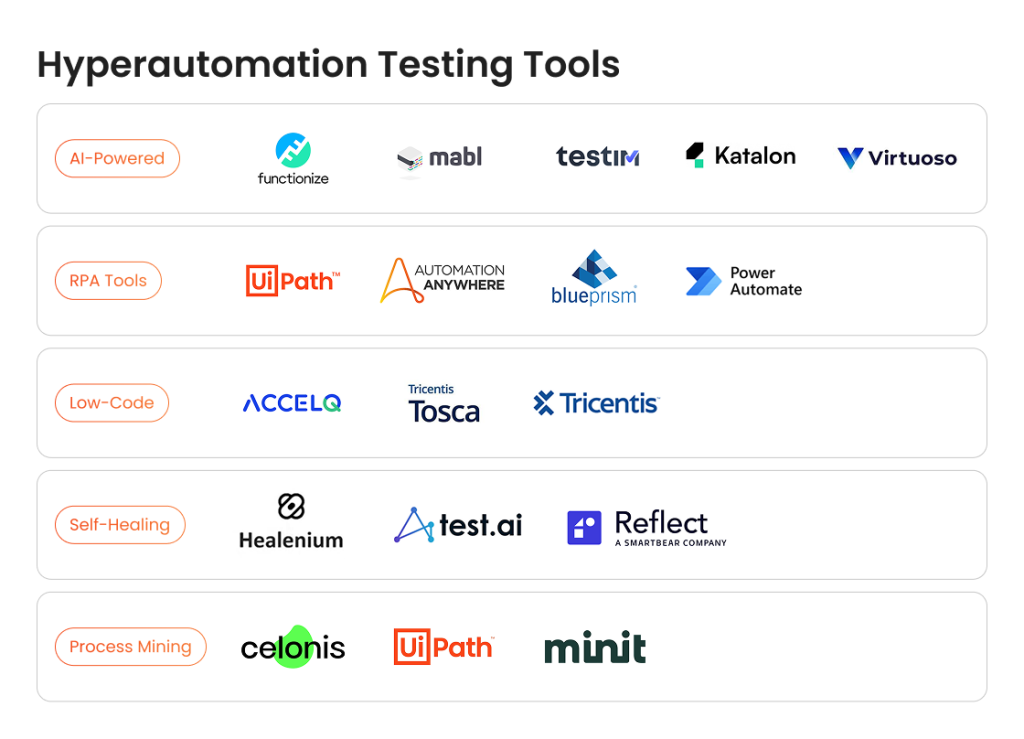
Quick Summary: Successful hyperautomation requires the right combination of testing tools — AI-powered platforms for intelligent automation, RPA solutions for cross-system execution, and low-code tools for citizen tester enablement.
Choosing automation tools for hyperautomation isn’t about finding one perfect platform. It’s about building a stack where each tool handles what it does best and integrates smoothly with others. The hyperautomation market offers options across every category, from enterprise suites to specialized solutions.
AI-Powered Testing Platforms
These platforms bring artificial intelligence to test creation, execution, and maintenance. They’re the core of intelligent testing frameworks.
| Platform | Strengths | Best For |
| Functionize | Agentic AI, self-healing, NLP test creation | Enterprises wanting full autonomous testing |
| mabl | CI/CD native, auto-healing, unified platform | DevOps-mature teams needing speed |
| Testim | AI-powered authoring, fast stabilization | Teams with frequent UI changes |
| Katalon | All-in-one, AI features, accessible pricing | Mid-market teams starting AI journey |
| Virtuoso | NLP-based, no-code, machine learning core | Business users creating tests |
What to evaluate: Self-healing accuracy, test generation quality, CI/CD integration depth, learning curve, and total cost of ownership including maintenance reduction.
RPA Tools for Test Automation
RPA handles repetitive tasks across systems — test data setup, environment configuration, and legacy system integration where APIs don’t exist.
| Platform | Strengths | Best For |
| UiPath | Largest ecosystem, strong AI integration | Enterprise-wide automation initiatives |
| Automation Anywhere | Cloud-native, good analytics | Cloud-first organizations |
| Blue Prism | Security-focused, governance built-in | Regulated industries |
| Microsoft Power Automate | Microsoft ecosystem integration | Teams already on Microsoft stack |
Integration tip: Look for RPA tools that connect natively with your testing platforms. UiPath Test Suite, for example, combines RPA capabilities with dedicated testing features.
Low-Code Testing Platforms
These tools enable citizen testers to contribute without coding skills, supporting scale automation across your organization.
| Platform | Strengths | Best For |
| ACCELQ | No-code, AI-powered, strong for Salesforce | Business analysts creating tests |
| Leapwork | Visual flowcharts, no scripting needed | Non-technical teams |
| Tosca | Model-based, SAP strength, enterprise focus | Large enterprises with complex apps |
| Tricentis | Risk-based testing, broad integrations | Risk-conscious enterprises |
Governance note: Low-code accessibility requires stronger governance frameworks. Ensure your chosen platform supports role-based access and audit trails.
Self-Healing and Maintenance Reduction
Some platforms specialize in keeping tests working when applications change — critical for reducing the maintenance burden that hyperautomation aims to automate away.
| Solution | Approach | Integration |
| Healenium | Open-source, ML-based locator healing | Works with Selenium/Appium |
| test.ai | AI visual testing, element recognition | Standalone or integrated |
| Reflect | Auto-wait, smart selectors | No-code platform with healing |
Process Mining for Test Coverage
Process discovery tools identify what to test by analyzing real user behavior — filling gaps that manual test planning misses.
| Platform | Capability |
| Celonis | Industry leader, deep process analysis |
| UiPath Process Mining | Integrated with UiPath automation |
| Minit | User-friendly, quick implementation |
Building an Integrated Stack
The power of hyperautomation comes from integration. Consider these architecture patterns:
Pattern 1: Enterprise Suite Single vendor (UiPath, Tricentis) providing most capabilities. Simpler integration, potential vendor lock-in.
Pattern 2: Best-of-Breed Specialized tools for each function connected via APIs. More flexibility, more integration work.
Pattern 3: Hybrid Core platform from one vendor, specialized tools where needed. Balance of integration and capability.
Key integration points:
- Communication (Slack, Teams)
- CI/CD pipelines (Jenkins, GitLab, Azure DevOps)
- Test management (Jira, Azure Boards, qTest)
- Monitoring (Datadog, Splunk, New Relic)
Not sure which tools fit your environment?
Our Automation Strategy Assessment evaluates your current stack and recommends the right hyperautomation tools for your needs.

Autonomous Quality: How Agentic Testing Changes Everything
Quick Summary: Agentic testing uses AI agents that don’t just execute scripts—they make decisions, heal themselves when applications change, diagnose failures automatically, and prioritize tests based on actual risk. This is where the power of hyperautomation truly emerges.
This is where hyperautomation in QA fundamentally diverges from everything that came before. Traditional automation and even AI-assisted testing still depend on humans for decisions. Agentic testing introduces AI agents that operate autonomously — pursuing quality goals, adapting to changes, and improving over time without constant human oversight.
Beyond Automation: AI Agents That Think and Decide
An AI agent in testing is a system that perceives its environment, reasons about goals, makes decisions, and takes actions. Unlike scripts that follow predetermined steps, agents interpret objectives and figure out how to achieve them.
How agentic testing differs from traditional testing methods:
| Aspect | Traditional Automation | AI-Assisted | Agentic Testing |
| Decision-making | Human only | AI suggests, human approves | AI decides and executes |
| Adaptation | Manual updates required | Some smart suggestions | Autonomous adjustment |
| Learning | None | Limited | Continuous improvement |
| Human role | Execute and maintain | Review and approve | Strategy and oversight |
When you tell a traditional script to “verify the checkout process works,” it executes a fixed sequence. When you give the same instruction to an agentic system using hyperautomation, it analyzes the checkout flow, determines what conditions to test, generates appropriate test cases, executes them, and evaluates results — all without step-by-step human direction.
See AI testing tools in action.
We helped a B2B SaaS company reduce AI hallucinations by 60% and boost user satisfaction from 6.5 to 8.7.

Self-Healing Tests: Fixing Themselves When Applications Change
Self-healing might be the most immediately valuable capability that hyperautomation brings. It directly addresses the maintenance burden that makes traditional automation so costly.
The self-healing process:
- Detection: Agent attempts to find element using primary locator
- Analysis: When primary fails, agent searches using multiple identification methods
- Resolution: Agent identifies element through visual, structural, or contextual matching
- Update: Locator database updates automatically
- Continuation: Test proceeds without human intervention
Identification methods used:
- Visual analysis: Compares current screen to historical screenshots
- DOM structure examination: Analyzes element position and relationships
- Contextual understanding: Identifies elements by function, not just location
Organizations implementing self-healing within their hyperautomation projects report 60-80% reductions in test maintenance effort. Scripts that used to break weekly now run for months without attention.
Autonomous Root-Cause Analysis
When tests do fail, agents can diagnose why — another area where hyperautomation helps eliminate hours of manual investigation.
What autonomous analysis examines:
- Screenshots and visual state at failure point
- Application logs for errors and warnings
- Environment metrics (server load, memory, network)
- Recent code changes correlated with failures
- Historical patterns from similar failures
The agent classifies each failure: genuine bug, environment problem, or test needing update. Each classification triggers appropriate action automatically. Engineers receive actionable information instead of raw failure data.
Risk-Based Test Prioritization
Agentic systems prioritize intelligently based on multiple signals, enabling continuous testing that focuses on what matters most:
- Code change analysis: Tests covering changed code run first
- Historical failure patterns: High-value tests get priority
- Production usage data: Critical user paths receive thorough testing
- Business impact assessment: Payment processing tests outrank settings page tests
This intelligent prioritization is one of the key benefits of hyperautomation — testing becomes smarter, not just faster.
Hyperautomation Testing Maturity Model: From Manual to Autonomous
Quick Summary: Organizations progress through five maturity levels—from ad-hoc manual testing to fully autonomous quality. Using hyperautomation effectively requires understanding your current level to plan realistic improvements and avoid skipping essential foundations.
Maturity models help you understand where you are, what’s realistic to aim for next, and what foundations you need before advancing. Trying to jump from Level 1 to Level 5 fails—you need intermediate capabilities. Each level builds on what comes before.
The Five Levels of Hyperautomation Testing Maturity
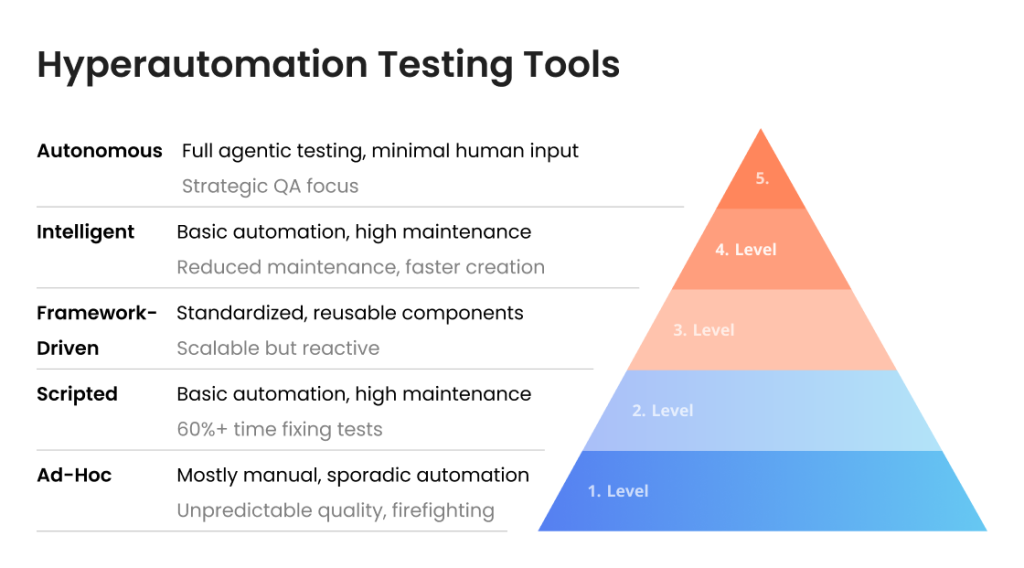
| Level | Name | Characteristics | Key Symptoms |
| 1 | Ad-Hoc | Mostly manual, sporadic automation | Unpredictable quality, firefighting |
| 2 | Scripted | Basic automation, high maintenance | 60%+ time fixing tests |
| 3 | Framework-Driven | Standardized, reusable components | Scalable but reactive |
| 4 | Intelligent | AI-assisted, some self-healing | Reduced maintenance, faster creation |
| 5 | Autonomous | Full agentic testing, minimal human input | Strategic QA focus |
Level 1: Ad-Hoc Testing
Testing is mostly manual and unstructured. Automation exists in pockets but nothing is standardized. This is where many organizations start their hyperautomation efforts.
Characteristics:
- Testing happens when there’s time, gets cut when there isn’t
- No consistent testing tools or testing frameworks across teams
- Test coverage is unknown and probably low
What’s needed to advance: Commitment to automation as a practice. Selection of standard tools. Dedicated time for automation work.
Level 2: Scripted Automation
Teams have established test automation, but it’s project-specific and high-maintenance. This level represents conventional automation that many organizations struggle to move beyond.
Characteristics:
- Test automation exists and runs regularly
- Scripts are tied to specific projects, not reusable
- Significant time spent on maintenance
What’s needed to advance: Standardized testing frameworks. Reusable component libraries. Test data management. Clear automation initiatives and ownership.
Level 3: Framework-Driven Automation
Automation is systematic and scalable. Teams use shared frameworks, follow consistent patterns, and maintain reusable components. This is where most mature enterprise QA organizations operate today.
Characteristics:
- Standardized test automation framework
- Reusable components and shared libraries
- Reliable CI/CD integration
- Metrics and reporting dashboards
What’s needed to advance: AI-powered testing tools for test generation and maintenance. Self-healing capabilities. Integration of testing intelligence that hyperautomation requires.
Ready to move beyond script maintenance?
Our Automation Strategy Assessment maps your path from current state to autonomous quality.

Level 4: Intelligent Automation
AI assists human testers, reducing manual effort and enabling capabilities that weren’t previously practical. Hyperautomation technologies begin delivering measurable value.
Characteristics:
- AI-powered test case generation
- Smart element identification and locators
- Basic self-healing capabilities
- Low-code tools enabling broader participation
What’s needed to advance: Full agentic capabilities. Autonomous decision-making. Production feedback loops. This is where hyperautomation takes testing to the next level.
Level 5: Autonomous Quality
AI agents handle routine testing independently. Humans focus on strategy, edge cases, and decisions that genuinely require human judgment. Hyperautomation creates a fundamentally different QA operation.
Characteristics:
- Fully autonomous AI agents for routine testing
- Self-healing, self-optimizing test suites
- Risk-based prioritization using production data
- Predictive quality gates
- Minimal human intervention for standard workflows
This level is emerging. Few organizations have achieved it fully, but the future of automation testing points clearly in this direction.
Assessing Your Current Level
Ask yourself these questions:
| Question | Level 1-2 Answer | Level 3-4 Answer | Level 5 Answer |
| What % of critical paths are automated? | <30% | 50-80% | >90% |
| How much time goes to maintenance? | >60% | 30-50% | <20% |
| Do tests self-heal? | No | Partially | Yes, autonomously |
| Can non-technical staff create tests? | No | With support | Yes, independently |
| Do you know your automation ROI? | No | Roughly | Precisely tracked |
Be honest about where you are. Every organization at Level 3 thinks they’re almost at Level 4. The assessment only helps if it’s accurate — that’s a key lesson when implementing hyperautomation strategies.
Low-Code Testing at Scale: Enterprise Security and Governance
Quick Summary: Low-code testing platforms let domain experts contribute to QA, but enterprises need governance frameworks to prevent security and compliance issues. Hyperautomation unlocks citizen testing potential only with proper controls.
Low-code testing platforms promise something appealing: domain experts who understand business processes can create tests without learning to code. This democratization can dramatically scale your testing capacity. It can also create serious problems without governance.
The Citizen Tester Promise — and the Risk
Benefits that hyperautomation enables:
- Domain experts create better test scenarios based on real business process management knowledge
- Removes bottleneck of limited automation engineering capacity
- Faster test creation that keeps pace with development
Risks without governance:
- Data exposure from improper handling of production data
- Compliance violations (GDPR, HIPAA, PCI-DSS)
- Security vulnerabilities from insecure test practices
- Shadow IT from uncontrolled tool adoption
OWASP’s Low-Code/No-Code Top 10 catalogs these risks. They’re real challenges of hyperautomation that organizations experience when citizen development scales without oversight.
Governance Framework for Secure Citizen Testing
Governance doesn’t mean blocking citizen testers. It means enabling them safely — making the secure path the easy path.
| Governance Component | What It Controls | Why It Matters |
| Role-Based Access | Who can do what | Prevents unauthorized actions |
| Data Sandboxing | What data tests can access | Protects sensitive information |
| Risk Tiering | How tests are reviewed | Balances speed and safety |
| Audit Trails | What gets logged | Enables compliance reporting |
| Center of Excellence | Standards and training | Ensures consistent practices |
1. Role-Based Access Controls (RBAC)
Define roles with appropriate permissions: Viewer, Contributor, Builder, Administrator. Limit access to sensitive resources based on actual need.
2. Data Sandboxing
- Isolated test environments that cannot connect to production
- Synthetic test data that contains no actual customer information
- Approval workflows for any exceptions
3. Risk-Based App Tiering
- Low-risk tests: Deploy immediately with automated checks
- Medium-risk tests: IT review required
- High-risk tests: Full security assessment
4. Low-Code Center of Excellence
A central body providing standards, training, component libraries, and oversight. This supports hyperautomation initiatives by combining governance with enablement.
Security as Enabler, Not Blocker
The goal is to enable citizen testers to contribute effectively. Design governance to make compliance easy:
- Embed security in templates
- Automate compliance checks
- Provide clear guidance and support
- Treat governance as a competitive advantage
Scaling testing without scaling risk?
Our QA teams come with built-in governance frameworks and enterprise security practices.

Implementing Hyperautomation Testing: Roadmap and ROI
Quick Summary: Implementation works best in phases — establish foundations, achieve quick wins, scale with intelligence, then shift towards automation that operates autonomously. Learn how hyperautomation delivers ROI by measuring from day one.
Strategy without execution is worthless. This section covers how to actually implement automation by combining the right approach with realistic timelines.
Phased Implementation Approach
| Phase | Timeline | Focus | Key Deliverables |
| Foundation | Weeks 1-4 | Assessment and planning | Current state audit, success metrics, stakeholder alignment |
| Quick Wins | Weeks 5-12 | Prove value | Platform selected, first automation live, CI/CD integrated |
| Scale | Months 4-9 | Expand capabilities | Self-healing enabled, citizen testers onboarded, analytics live |
| Autonomous | Month 10+ | Full transformation | Agentic testing, production-driven prioritization, strategic QA |
Phase 1: Foundation (Weeks 1-4)
Before buying tools or writing tests, understand what you have and what you need.
- Audit current state: Document existing automation, pain points, maintenance burden
- Identify opportunities: Find high-impact use cases for hyperautomation in testing
- Define metrics: Establish ROI of automation measures before starting
- Align stakeholders: Ensure leadership understands the hyperautomation market opportunity
Phase 2: Quick Wins (Weeks 5-12)
Start small, demonstrate value, build momentum toward automation initiatives that matter.
- Select platform: Commit to an automation platform based on Phase 1 evaluation
- Target quick wins: High-impact, low-complexity cases that show immediate value
- Implement basics: AI-assisted test generation, CI/CD integration
- Establish baselines: Measure everything to prove improvement
Phase 3: Scale and Intelligence (Months 4-9)
With foundations proven, increase the automation scope and capability.
- Roll out self-healing: Enable automatic maintenance across test suites
- Enable citizen testers: With governance in place, expand participation
- Deploy process mining: Identify coverage gaps using process discovery tools
- Build dashboards: Make testing solutions visible to stakeholders
Phase 4: Autonomous Operations (Month 10+)
Complete the transformation to autonomous quality that hyperautomation represents.
- Full agentic testing: Remove human bottlenecks from routine testing
- Production signals: Real-world behavior informs test prioritization
- Predictive quality gates: AI predicts build quality before full test runs
- Strategic QA: Team focuses on strategy, not script maintenance
Common Pitfalls in Hyperautomation Projects
- Trying to automate everything at once — Prioritize ruthlessly
- Ignoring governance — Especially with citizen testing
- Tools before strategy — Understand needs before committing to platforms
- Not measuring ROI — Without metrics, you can’t demonstrate value
- Underestimating change management — New tools require new workflows
Measuring Success: ROI of Automation
Quantitative metrics:
| Metric | Target Improvement | How to Measure |
| Test cycle time | 40-70% reduction | Time from commit to results |
| Maintenance effort | 60-80% reduction | Hours spent fixing vs. creating |
| Defect detection | 30%+ shift left | Where bugs are found in lifecycle |
| Release velocity | 2-3x improvement | Deployment frequency |
Benchmark results: Organizations report significant business outcomes from hyperautomation. One financial services company achieved 72% quality cost savings. A healthcare company cut testing from 40 hours to 4 hours. These results show what hyperautomation takes testing to achieve.
How TestFort Approaches Hyperautomation Testing
Quick Summary: We combine hyperautomation expertise with enterprise-grade processes — CMMI Level 3 certified, ISTQB-qualified teams, and ISO 27001 security standards — to help organizations implement automation that delivers measurable results.
Implementing hyperautomation strategies requires more than tool selection. It demands expertise in AI-powered testing tools, mature processes, and understanding of enterprise constraints. That’s what we bring to hyperautomation projects.
Our Hyperautomation Capabilities
AI Testing Tools Expertise
Our teams work hands-on with the leading automation platforms — Functionize, mabl, UiPath, Katalon, and others covered in this guide. We don’t just know the theory; we implement automation using hyperautomation technologies daily across client projects.
Certified Quality Processes
- CMMI Level 3: Our processes meet Capability Maturity Model Integration standards for defined, consistent delivery
- ISTQB-Certified Engineers: Testing professionals with internationally recognized qualifications
- ISO 27001: Information security management that meets enterprise compliance requirements
These certifications matter when you’re trusting a partner with your testing systems and data.
Engagement Models That Fit Enterprise Needs
We know enterprises need predictability. That’s why we emphasize fixed-cost engagements where scope and budget are clear from the start.
| Model | Best For | What You Get |
| QA Audit | Understanding current state | Gap analysis, automation opportunities, roadmap |
| Automation Strategy | Planning hyperautomation initiatives | Tool recommendations, architecture, implementation plan |
| Dedicated QA Team | Ongoing testing operations | Scaled team with hyperautomation skills, embedded in your workflow |
| Fixed-Cost Projects | Defined automation goals | Clear deliverables, predictable budget, milestone-based delivery |
Industry Experience
Hyperautomation challenges differ by industry. We bring specific experience in:
Fintech: Payment processing validation, regulatory compliance testing, API testing for banking integrations. We understand PCI-DSS requirements and the testing rigor financial systems demand.
HR and Recruiting Platforms: End-to-end workflow testing across applicant tracking, onboarding systems, and HRIS integrations. Complex user journeys with multiple roles and permissions.
Data Management and Analytics: Testing large-scale data pipelines, ETL validation, database migrations. When you’re handling millions of records, test automation isn’t optional — it’s essential.
Start the Conversation
Whether you’re assessing your current maturity level, selecting hyperautomation tools, or ready to implement autonomous testing, we can help scope what makes sense for your situation.
Scaling testing without scaling risk?
Our QA teams come with built-in governance frameworks and enterprise security practices.

Conclusion
Hyperautomation testing represents a fundamental shift in how enterprises approach quality assurance. It’s not just about running tests faster — it’s about building testing systems that think, adapt, and improve autonomously.
The core insight is that traditional automation, no matter how sophisticated the scripts, can’t keep pace with modern software testing complexity. You need intelligence: artificial intelligence that generates and maintains tests, agents that heal themselves when applications change, systems that prioritize based on actual risk.
The maturity model gives you a framework for progress. Know where you are — honestly. Plan realistic next steps. Build foundations before advanced capabilities. The hyperautomation market continues growing because organizations recognize that conventional automation has reached its limits.
Citizen testing can dramatically scale your QA capacity, but it requires governance. Role-based access, data sandboxing, risk tiering, and central oversight aren’t bureaucratic obstacles — they’re what makes democratized testing safe at enterprise scale.
Implementation succeeds through phases: establish foundations, achieve quick wins, scale with intelligence, then shift to autonomous operations. Measure throughout so you can demonstrate ROI of automation and guide continuous improvement.
The organizations that master hyperautomation testing will release faster with higher quality. They’ll spend less on maintenance and more on innovation. Their QA teams will focus on strategy rather than script repair.
The technology is ready. Hyperautomation enables a fundamentally better approach to quality. The question is whether your organization is ready to adopt it.
Jump to section
Hand over your project to the pros.
Let’s talk about how we can give your project the push it needs to succeed!